The SEC's crypto enforcement posture: from aggressive expansion to recalibration
The US Securities and Exchange Commission spent 2021–2024 pursuing what critics called a "regulation by enforcement" strategy: bringing hundreds of actions against crypto projects, exchanges, and token issuers without passing comprehensive crypto-specific legislation. Under Chair Gary Gensler, the SEC asserted that most tokens were unregistered securities, that most major exchanges were operating as unregistered broker-dealers and securities exchanges, and that the crypto industry as a whole was non-compliant with existing law.
The political shift that followed the 2024 US election resulted in a change in SEC leadership and a notable recalibration of enforcement priorities. The new commission has dropped several high-profile cases, established a crypto task force focused on developing workable guidance, and publicly acknowledged that some prior enforcement positions were overbroad. Understanding which cases were brought, which were dropped, and which resulted in lasting precedents is now essential knowledge for anyone building in or investing in US crypto markets.
The Howey Test and why it matters for crypto
The SEC's power to regulate crypto rests almost entirely on the Howey Test — the 1946 Supreme Court standard that defines what constitutes a security. Under Howey, an instrument is a security (specifically, an "investment contract") if it involves (1) an investment of money, (2) in a common enterprise, (3) with an expectation of profit, (4) primarily from the efforts of others.
The SEC argued that most token sales satisfy all four elements: investors put in money, the project is a common enterprise, they expect the token price to rise (profit), and the price depends primarily on the development team's efforts. This argument has been accepted by courts in some cases and rejected or narrowed in others — and the 2025–2026 period is producing the most important judicial refinements of how Howey applies to crypto.
Key SEC enforcement actions: Ripple (XRP)
The SEC v. Ripple case — filed in December 2020 — was the most consequential crypto enforcement action of the decade. The SEC alleged that Ripple's sale of XRP tokens constituted an unregistered securities offering. In July 2023, Judge Analisa Torres issued a split ruling: institutional sales of XRP were unregistered securities offerings, but programmatic sales through exchanges to retail investors were not.
The case reached a final settlement in 2024 under which Ripple paid a reduced penalty of $125 million (down from the SEC's requested $2 billion). The ruling has been cited in subsequent cases as establishing that the same token can be a security in some sale contexts (institutional, direct, with a reasonable expectation of profit from Ripple's efforts) and not a security in others (exchange sales to anonymous retail buyers who have no direct relationship with the issuer). This "context-dependent" reading of Howey has become the most important legal precedent in US crypto regulation.
Key SEC enforcement actions: Coinbase
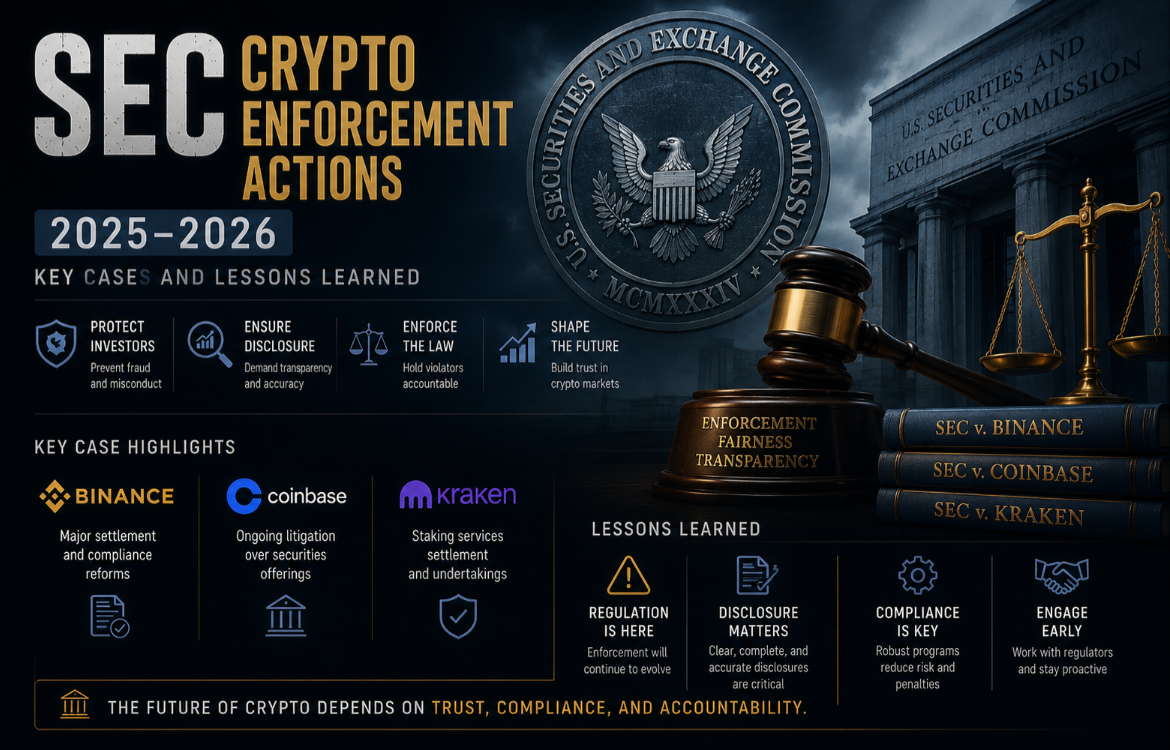
In June 2023, the SEC sued Coinbase — a publicly traded US company — alleging it had been operating as an unregistered securities exchange, broker, and clearing agency. The SEC identified 13 tokens traded on Coinbase as securities, including SOL, ADA, MATIC, and FIL.
The case against Coinbase was formally dismissed in February 2025 following the change in SEC leadership. The dismissal was accompanied by a statement from the new commission acknowledging that "the legal landscape for digital assets requires further development through rulemaking, not enforcement." For users of Coinbase, see our full Coinbase review for an assessment of the platform's current regulatory standing.
Key SEC enforcement actions: Binance
In June 2023, the SEC simultaneously sued Binance and its CEO Changpeng Zhao, alleging a wide range of violations: operating an unregistered exchange, misappropriating customer funds, wash trading, and offering unregistered securities including BNB and BUSD. The DOJ and CFTC brought parallel criminal and civil charges.
In November 2023, Binance pleaded guilty to Bank Secrecy Act violations and agreed to pay $4.3 billion in penalties — one of the largest financial settlements in US history. Changpeng Zhao pleaded guilty to AML violations and was sentenced to four months in prison. The SEC's civil case was partially settled in 2025. For Binance's current operational status and user protections, see our Binance review.
Key SEC enforcement actions: Genesis and Gemini
In January 2023, the SEC charged Genesis Global Capital and Gemini Trust with the unregistered offer and sale of securities in connection with the Gemini Earn lending programme. Genesis had lent customer assets to Three Arrows Capital and Alameda Research — both of which collapsed in 2022. The case resulted in Genesis filing for bankruptcy and Gemini reaching a $21 million settlement with the SEC in 2024.
The Gemini Earn case established important precedent: yield-generating crypto products where customer assets are lent to a third party are likely to qualify as securities under Howey. This has directly influenced how exchanges structure and market their lending and staking products going into 2026.
The Terraform / Do Kwon case: the most severe outcome
The SEC brought charges against Terraform Labs and its co-founder Do Kwon in February 2023 following the collapse of the TerraLUNA ecosystem in May 2022 — which wiped approximately $40 billion in market value in a matter of days. The SEC alleged that both LUNA and TerraUSD were unregistered securities, and that Kwon had misled investors about the stability of the algorithmic stablecoin.
In June 2024, a jury found Terraform and Kwon liable on all counts. In September 2024, the court imposed a $4.47 billion civil penalty — the largest securities fraud judgment against a crypto entity. The case is now the leading judicial authority on algorithmic stablecoins as securities and on founder liability for fraudulent public statements about protocol mechanics.
Post-2024 recalibration: what the new SEC stance means
Under the new commission leadership, the SEC dropped or paused actions against Coinbase, Kraken (second suit), Uniswap Labs, Consensys, and several others. The new Crypto Task Force, established in early 2025, has issued requests for information and invited industry comment on token classification, exchange registration pathways, and DeFi oversight.
The shift does not mean crypto is now unregulated. The Binance settlement, Genesis settlement, Terraform judgment, and Ripple precedent all remain binding. The SEC has signalled continued enforcement against fraud, Ponzi schemes, and clear unregistered securities offerings — particularly ICO-style raises where a centralised team sells tokens to finance development. What the agency is pulling back from is the broad assertion that all secondary market trading of most tokens constitutes exchange activity requiring SEC registration.
Lessons for crypto projects and investors from SEC enforcement
- Token distribution method matters legally: institutional direct sales to investors face much higher Howey scrutiny than anonymous exchange sales.
- Lending and yield programmes on customer assets are likely securities and must be registered or exempted.
- Algorithmic stablecoins that depend on issuer promotion to maintain their peg face the highest regulatory risk.
- Founder statements about protocol mechanics and financial performance can create personal liability for securities fraud.
- Operating in the US without engaging legal counsel and a compliance programme is an existential risk for any crypto business.
- Even tokens that survive SEC challenge face ongoing state-level enforcement — the SEC dismissal does not eliminate state blue sky law exposure.
What investors should check before using a crypto exchange
Given the enforcement history, these due diligence steps are now standard practice:
- Verify the exchange is registered with FinCEN as a Money Services Business.
- Check whether the exchange holds state money transmitter licences in the states you operate from.
- Review any SEC or CFTC enforcement history for the exchange on the respective agency websites.
- For lending or staking products: understand whether the product has been registered under securities law or relies on an exemption.
- Prefer exchanges that have published proof-of-reserves and maintain segregated customer assets.
For detailed reviews of two of the most-scrutinised US exchanges, see our Coinbase review and Binance review.
This article is for informational purposes only and does not constitute legal or investment advice. SEC enforcement actions are subject to ongoing legal proceedings. Consult a qualified US securities lawyer for guidance on specific situations.