What is MiCA and when did it take effect?
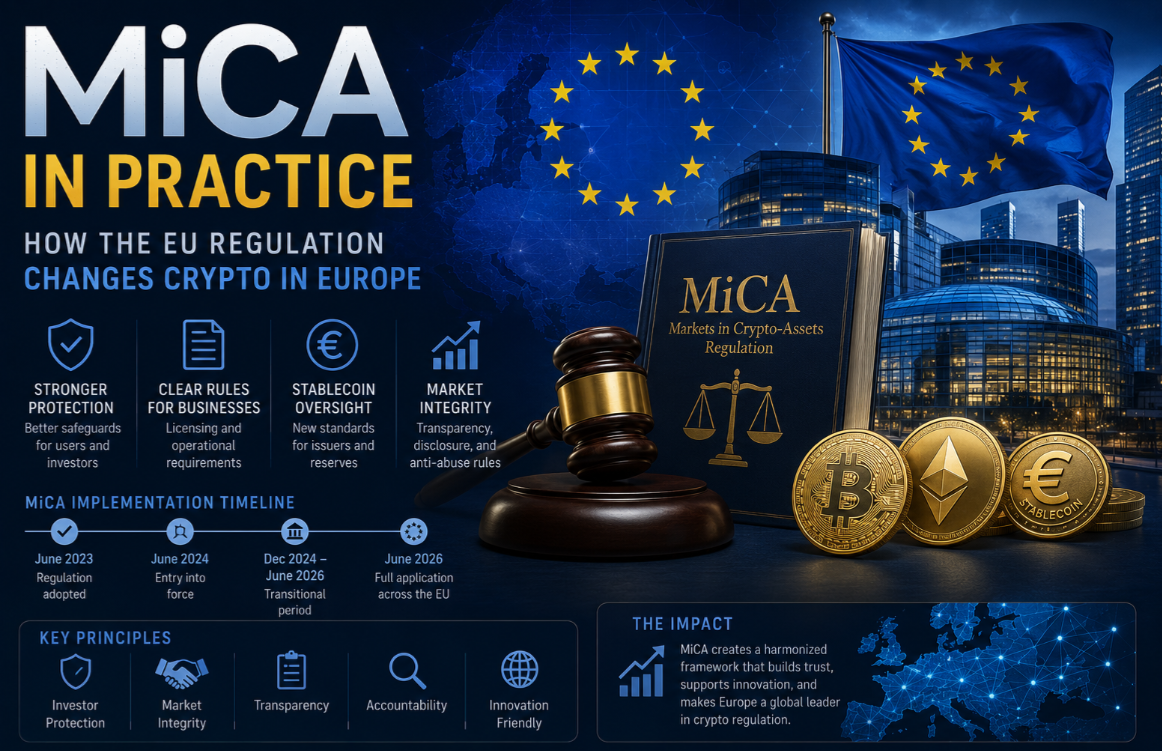
The Markets in Crypto-Assets Regulation (MiCA) is the European Union's comprehensive regulatory framework for cryptocurrency markets. It was published in the Official Journal of the EU in June 2023 and entered full application for all crypto asset service providers and token issuers in December 2024. It is the first major economy to create a single, unified crypto regulatory framework that applies across an entire trading bloc of 27 countries and over 450 million consumers.
Before MiCA, EU member states had patchwork national rules. A crypto exchange operating in Germany faced different requirements than one operating in France or Malta. MiCA replaces this fragmentation with a single rulebook: one licence, one set of disclosure requirements, one set of consumer protections — and a passport that allows a CASP licenced in any EU member state to serve customers across all 27.
What MiCA actually regulates — and what it does not
MiCA covers three types of crypto assets: utility tokens (issued to fund projects and redeemable for access to a service), asset-referenced tokens (stablecoins backed by a basket of assets or currencies — ARTs), and e-money tokens (stablecoins pegged to a single fiat currency — EMTs). It also regulates Crypto Asset Service Providers (CASPs) — entities offering custody, exchange, portfolio management, investment advice, order execution, transfer, or placing of crypto assets.
MiCA does NOT cover: financial instruments already regulated under MiFID II (which means many security tokens fall outside MiCA), NFTs that are genuinely unique and non-fungible (though "fractionalised" NFTs may fall in scope), and fully decentralised protocols with no identifiable issuer or service provider. Bitcoin and Ethereum are classified as utility tokens not subject to the stablecoin title — they are regulated under the CASP framework when services are provided on them, but the assets themselves are not directly regulated.
The CASP licence: what it requires
To offer crypto services in the EU after December 2024, a business must be authorised as a CASP by a national competent authority (NCA) in at least one EU member state. The MiCA authorisation process requires:
- A programme of operations (business plan, services offered, target markets).
- Governance arrangements — at least two independent directors, fit and proper management with relevant experience.
- Capital requirements — minimum own funds starting at €50,000 for basic services, scaling to €150,000 for custody or exchange services.
- Organisational requirements — written policies for conflicts of interest, safeguarding of client assets, complaint handling, and business continuity.
- Cybersecurity and operational resilience standards.
- Complaint handling and client disclosure procedures.
Once authorised in one member state, the CASP can passport its services to all other EU member states by notifying its home NCA and the NCA of the host state. This is a significant advantage over the pre-MiCA era when businesses had to obtain separate licences in each country.
How MiCA changes stablecoin rules in Europe
Stablecoins are the area where MiCA makes the most immediate and disruptive difference. Under MiCA, issuers of e-money tokens (EMTs) — stablecoins pegged 1:1 to a single fiat currency, such as USDC or USDT — must be authorised as either an e-money institution or a credit institution under existing EU e-money law.
Circle obtained EMT authorisation for USDC in France in 2024. For the current regulatory status of USDC, see our USD Coin market page. Tether — the issuer of USDT, the world's largest stablecoin by market cap — did not obtain EU authorisation before the MiCA deadline. As a result, several EU-regulated exchanges began limiting or delisting USDT for EU users from December 2024. For USDT's market position and regulatory developments, see the Tether market page.
MiCA also imposes volume caps on large EMTs: if a stablecoin processes more than one million transactions or €200 million in daily transaction volume within the EU, additional requirements apply including a mandatory ESMA review.
Asset-referenced tokens (ARTs) under MiCA
ARTs are stablecoins backed by a basket of assets, currencies, or commodities — think of the original Libra/Diem concept, or tokens backed by gold and EUR. Under MiCA, ART issuers must publish a detailed whitepaper, maintain reserve assets in custody with EU credit institutions, conduct stress testing, and hold own funds of at least 3% of the average outstanding reserve assets. Significant ARTs — those with over five million holders or €5 billion in outstanding value — face enhanced supervision directly by the European Banking Authority (EBA).
Token whitepaper requirements under MiCA
Any person publicly offering crypto assets in the EU (other than EMTs and ARTs, which have separate regimes) must publish a whitepaper and notify the relevant NCA at least 20 working days before issuance. The whitepaper must include:
- Information about the issuer — legal entity, beneficial ownership, audited financial statements.
- Technology description — protocol, consensus mechanism, smart contract security audits.
- Token description — rights attached, transferability, applicable law.
- Risk factors — at least five specific risk factors, not generic boilerplate.
- Climate and environmental impact — energy consumption data for the underlying consensus mechanism.
- Liability statement — the issuer is liable for inaccuracies in the whitepaper.
The EU NCA does not approve the whitepaper — it is filed and published, with civil liability resting on the issuer for its accuracy.
Consumer protection provisions under MiCA
- CASPs must act honestly, fairly, and professionally in the best interests of clients.
- Marketing communications must be fair, clear, and not misleading, and must include prominent risk warnings.
- Retail clients must be given cost disclosures before any transaction.
- CASPs must maintain a complaints procedure and resolve complaints within 15 business days.
- Client assets must be segregated from the CASP's own assets and held in custody by authorised custodians.
- CASPs cannot use client crypto assets for their own purposes without explicit written consent.
Market abuse rules under MiCA
MiCA introduces market integrity rules for crypto markets for the first time at the EU level. It prohibits insider trading (using non-public information to trade), market manipulation (wash trading, pump-and-dump, spoofing), and unlawful disclosure of inside information. These rules apply to anyone trading crypto assets admitted to a CASP's platform in the EU — not just the CASPs themselves.
CASPs are required to implement systems to detect and report suspicious transactions to the relevant NCA. This brings crypto market surveillance in line with obligations that have existed in equity and bond markets for decades.
How MiCA affects exchanges and what users should expect
- MiCA-compliant exchanges will display their CASP authorisation number prominently.
- Non-compliant stablecoins (like USDT in some jurisdictions) may be delisted or restricted.
- Users will receive clearer cost disclosures and risk warnings before transactions.
- Transfers between EU CASPs will be subject to the zero-threshold Transfer of Funds Regulation Travel Rule.
- Exchanges can now passport across all 27 EU member states — consolidation of EU licensing may reduce the number of separately-licenced entities.
What MiCA does not solve — gaps and criticisms
- DeFi is largely excluded — fully decentralised protocols have no CASP authorisation obligation.
- NFT regulation is ambiguous — genuinely unique NFTs are exempt, but in-game tokens, fractionalised NFTs, and series NFTs may fall in scope without clear guidance.
- Cross-border enforcement gaps — a CASP licenced in a member state with lighter-touch supervision may passport into stricter markets.
- No harmonised crypto tax treatment — MiCA does not address capital gains tax or income tax on crypto.
- Innovation risk — the whitepaper and authorisation burden may disadvantage smaller European projects relative to non-EU competitors.
This article is for informational purposes only and does not constitute legal advice. MiCA implementation guidance continues to evolve. Consult a qualified EU regulatory adviser for compliance-specific questions.