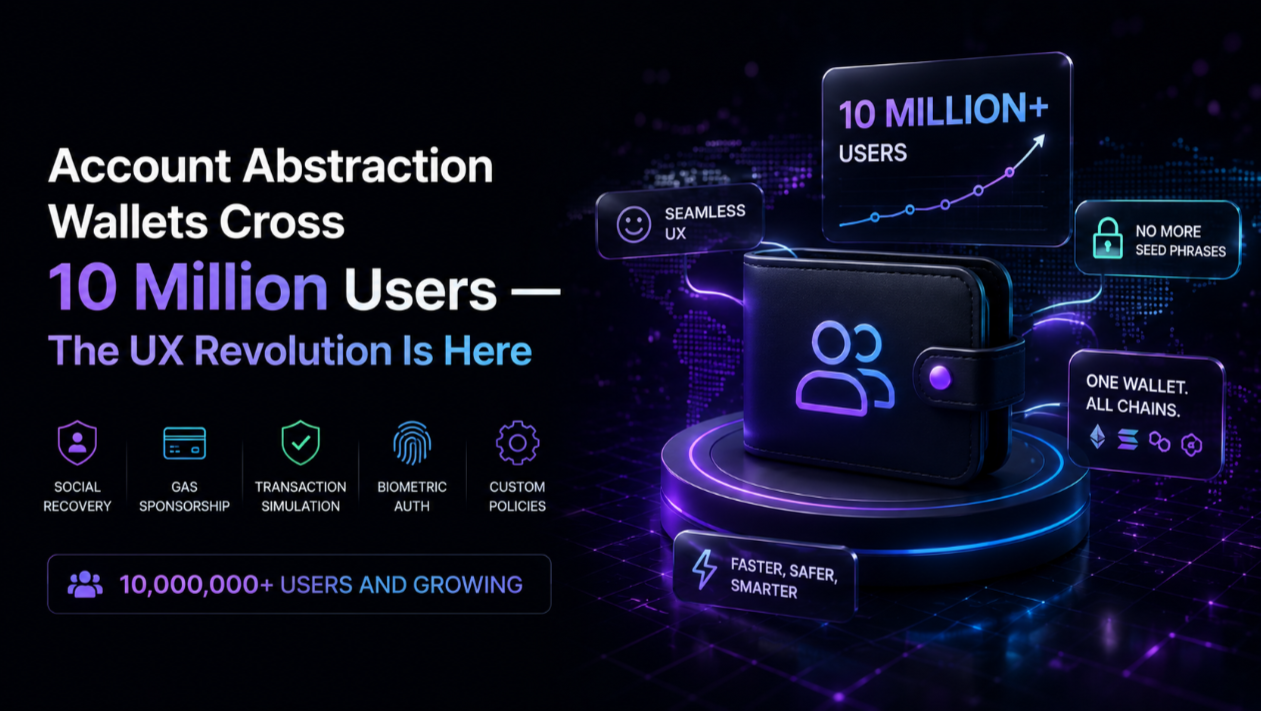
In early 2023, ERC-4337 was a technical proposal with fewer than 10,000 wallets deployed on testnets. By April 2026, account abstraction wallets had crossed 10 million cumulative users across Ethereum, Arbitrum, Base, Optimism, Polygon, and a dozen other EVM networks. The milestone marks the point at which smart contract wallets moved from an enthusiast experiment to a mainstream infrastructure layer reshaping how people interact with crypto. For context on where each major wallet product stands, see the wallets rating and individual reviews including MetaMask, Rabby, and Phantom.
What Account Abstraction Actually Solves
The problems that account abstraction addresses are not abstract engineering concerns — they are the concrete friction points that have prevented mainstream crypto adoption for over a decade. The most fundamental is the gas problem: every new Ethereum user must acquire ETH before they can do anything, even if they received USDC, an NFT, or a game token. This prerequisite — hold a native token before using the network — does not exist in any other consumer software category and has been responsible for enormous onboarding dropout.
Account abstraction solves this through Paymasters: smart contracts that can pay gas on behalf of users, recovering costs through various mechanisms (ERC-20 gas payments, protocol subsidies, app-funded sponsorship). When a dApp deploys a Paymaster, its users can interact with zero ETH in their wallet — the UX becomes identical to a web2 app where infrastructure costs are invisible to the end user.
The second major problem is key management catastrophe. In a traditional EOA wallet, losing the seed phrase means permanent, unrecoverable loss of funds. No bank, no support ticket, no court order can recover them. Account abstraction enables social recovery: designate trusted guardians (family members, a hardware device, a trusted service) that can collectively authorise a key rotation if access is lost. This single capability has the potential to make self-custody safe enough for genuinely mass-market adoption.
The 10 Million User Breakdown: Who and Where
The 10 million figure comes from on-chain data aggregated across major ERC-4337 indexers including Bundlebear and the ERC-4337 Observatory. It counts unique Smart Account addresses that have executed at least one UserOperation — a more stringent definition than wallet installs or signups. The geographic and use-case distribution is revealing.
- Consumer gaming and NFT wallets: ~38% of Smart Accounts (onboarding-focused)
- DeFi active users via upgraded wallets (MetaMask, Coinbase Wallet): ~29%
- Embedded wallets in consumer apps (social, payments): ~21%
- Developer/testing accounts: ~7%
- Other/unclassified: ~5%
Base network leads all chains with approximately 3.1 million Smart Account addresses, driven by Coinbase's aggressive Smart Wallet promotion and the onboarding incentives of Base's consumer dApp ecosystem. Arbitrum and Optimism follow with approximately 2.2 million and 1.8 million respectively. Ethereum mainnet, despite being the origin chain for ERC-4337, represents only 12% of Smart Accounts due to its higher gas costs making Paymaster economics less favourable.
Embedded Wallets: The Silent Driver of Adoption
A substantial portion of the 10 million accounts came not from users downloading a standalone wallet app but from embedded wallet SDKs integrated into consumer applications. Services like Privy, Dynamic, Thirdweb, and Biconomy allow dApp developers to create a Smart Account for users during their normal signup flow — using email, social login, or passkey authentication as the key generation mechanism rather than asking users to generate a seed phrase.
This approach trades some sovereignty for dramatically lower friction: a user can sign up to a blockchain game, receive an embedded wallet, and make their first on-chain transaction in under 60 seconds without ever seeing a seed phrase, a gas fee prompt, or a wallet extension. The user owns their account — the Smart Account is deployed to their email-derived key — but recovery and key management are handled by the embedded wallet provider rather than the user.
Critics argue this model re-centralises key custody in wallet SDK providers, recreating the custody risks of centralised exchanges in a new form. Proponents respond that the progressive decentralisation path is clear: users can export keys and move to self-custody as they become more sophisticated, while the onboarding layer captures users who would otherwise never reach self-custody at all.
Bundler and Paymaster Economics: The New Middleware Layer
ERC-4337 created a new category of infrastructure provider: bundlers (who aggregate UserOperations into blocks and earn priority fees) and Paymasters (who sponsor gas in exchange for various compensation mechanisms). This middleware layer has grown into a competitive market with significant VC investment.
Leading bundler operators include Alchemy, Pimlico, and Blocknative; leading Paymaster services include Alchemy's Gas Manager, Pimlico's Paymaster, and Biconomy's Token Paymaster. The economics have stabilised: bundler margins are thin (competing on reliability and latency); Paymaster services charge 10-20% premium over raw gas costs for USDC gas payments, or charge dApps a flat fee for sponsored transactions.
Gas sponsorship at scale has proven economically viable because the conversion lift from removing the gas barrier outweighs the cost for most consumer applications. Gaming companies report 40-60% higher level 1 completion rates when gas is sponsored; DeFi protocols see 25-35% higher first-deposit conversion when users can deposit USDC without first acquiring ETH. These conversion economics justify sponsorship as a user acquisition cost rather than a charity.
What Comes After 10 Million: The Path to 100 Million
The next order-of-magnitude growth in account abstraction will depend on two developments. First, hardware wallet integration: the most security-conscious self-custody users are unlikely to adopt Smart Accounts until they can use a Ledger hardware device or Trust Wallet as the guardian/signing key for their Smart Account, keeping the critical key offline while benefiting from AA features. Ledger has committed to native ERC-4337 support in its Ledger Live roadmap for 2026.
Second, EIP-7702: a Ethereum protocol upgrade scheduled for the Pectra hard fork (expected late 2026) that allows existing EOA wallets to temporarily adopt Smart Account behaviour for a single transaction without deploying a new contract address. EIP-7702 would let all 50+ million existing MetaMask EOA wallets access gas sponsorship and batch transactions without migrating to a new address — potentially tripling the addressable market for AA features overnight.
The trajectory from 10 million to 100 million Smart Account users is visible from here: embedded wallets capturing consumer app users, EIP-7702 unlocking the existing EOA base, and hardware wallet integration bringing security-focused holders into the ecosystem. The wallets rating will continue tracking this space as the competitive landscape evolves through 2026 and beyond.