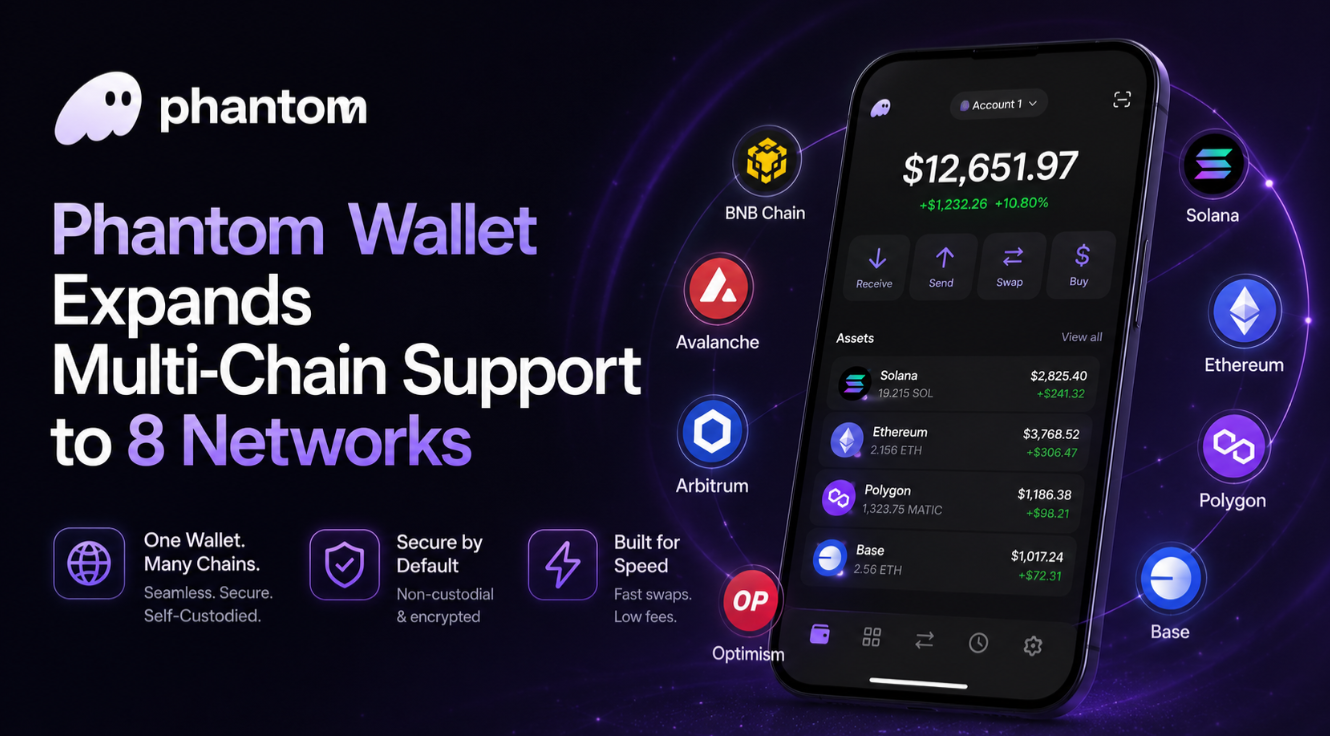
Phantom launched in 2021 as a clean, consumer-friendly Solana wallet and quickly became the default choice for the Solana ecosystem. The company made its first major strategic shift in 2022 by adding Ethereum support, signalling an ambition beyond its Solana roots. In March 2026 that ambition crystallised into a full multi-chain platform: Phantom now supports eight networks, making it one of the most broadly compatible self-custody wallets available. For a full assessment of features and security, see the Phantom review and compare it against peers at wallets rating.
The Eight Networks: What Each Adds
The expansion did not happen in a single release. Phantom has been methodically adding chains since mid-2022, with the March 2026 update bringing Sui and a Bitcoin signing mode to complete the current eight-network lineup. Understanding what each chain adds to the Phantom experience helps clarify who benefits most from the expansion.
- Solana — original home, deepest integration: Jupiter swaps, compressed NFTs, Solana Pay
- Ethereum — full EVM dApp browser, MetaMask migration tool, ENS resolution
- Polygon — low-fee EVM, NFT marketplaces, gaming dApps
- Arbitrum — DeFi-focused, GMX and Uniswap v3 integration via dApp browser
- Base — Coinbase ecosystem, high-growth consumer dApps
- Avalanche — C-Chain DeFi, AVAX staking links, Trader Joe integration
- Sui — Move-based chain, high throughput, growing gaming ecosystem
- Bitcoin — PSBT signing for hardware wallet-style transactions, view-only mode
The Bitcoin addition is the most strategically interesting. Rather than a full Bitcoin hot wallet (which would require a separate key management architecture), Phantom implements Bitcoin as a signing layer: users can connect a Ledger hardware wallet to sign Bitcoin PSBTs from within the Phantom interface, keeping BTC keys cold while managing the rest of their portfolio in Phantom.
Cross-Chain Swaps: How Phantom Routes Them
The most user-visible improvement from eight-network support is the cross-chain swap experience. Phantom's swap engine aggregates routes from multiple sources — Jupiter for Solana liquidity, 1inch for EVM networks, and Wormhole Token Bridge for cross-chain bridging — and presents users with a single quote covering the full path from source to destination asset.
When a user wants to swap SOL on Solana for ETH on Base, Phantom breaks this into: (1) swap SOL for USDC on Solana via Jupiter; (2) bridge USDC from Solana to Base via Wormhole; (3) swap USDC for ETH on Base via Uniswap. The multi-step complexity is hidden — the user sees a single confirmation screen showing input SOL, output ETH, total fees, and estimated time (typically 1-4 minutes).
This abstraction is impressive but not without trade-offs. Each hop introduces bridge latency and smart contract risk; a failure mid-route requires manual recovery. Phantom's approach is to hold funds at each intermediate step in the user's wallet rather than in a contract, reducing the impact of bridge failures to a stuck transaction rather than a loss of funds.
dApp Browser and NFT Support Across Chains
Phantom's in-app dApp browser supports all eight networks with automatic chain detection — when a user navigates to a dApp that requests Polygon, Phantom switches the active network without requiring manual configuration. This wallet_switchEthereumChain behaviour, standard in MetaMask, has been extended to Solana and Sui through Phantom's own wallet adapter standard.
NFT management across chains has also matured. Phantom automatically detects NFT collections on all supported networks and organises them in a unified gallery with floor price data pulled from OpenSea (EVM), Magic Eden (Solana and multi-chain), and Mysten Labs marketplaces (Sui). Users can send, list, and hide NFTs from all chains within a single interface without switching network contexts.
Security Model: Expanding the Attack Surface
Adding more networks increases wallet functionality but also expands the attack surface. Each new chain integration introduces new smart contract dependencies (bridge contracts, swap aggregators, dApp connections) that could theoretically be exploited. Phantom has responded by building a transaction simulation engine that previews the expected state changes of any transaction before the user signs — flagging unexpected token outflows, suspicious contract interactions, and known phishing addresses.
Phantom Security Shield — the company's real-time malicious site detection system — has expanded its database to cover dApps and contract addresses across all eight supported chains. Users attempting to connect to a flagged address receive a prominent warning with the option to proceed or cancel.
For users holding significant assets, the combination of Phantom's hot wallet with a Ledger hardware wallet as a signing device for large transactions represents the recommended security posture. The wallets rating provides a scored comparison of each wallet's security architecture.
Competitive Positioning Against MetaMask and Rabby
Phantom's eight-network support now covers all chains where MetaMask operates (EVM networks) plus Solana, Sui, and Bitcoin — giving it broader native coverage than any major competitor. MetaMask remains dominant among Ethereum-native users, and Rabby Wallet retains a strong following among DeFi power users for its transaction risk analysis. Phantom's differentiation is consumer-grade UX combined with genuine cross-chain depth.
Monthly active user data is not publicly disclosed, but app store rankings show Phantom consistently in the top 3 self-custody wallet apps on both iOS and Android, suggesting the multi-chain expansion has translated into user growth rather than just feature parity. The next expansion milestone, according to the company's public roadmap, is Cosmos IBC integration and native TON network support.