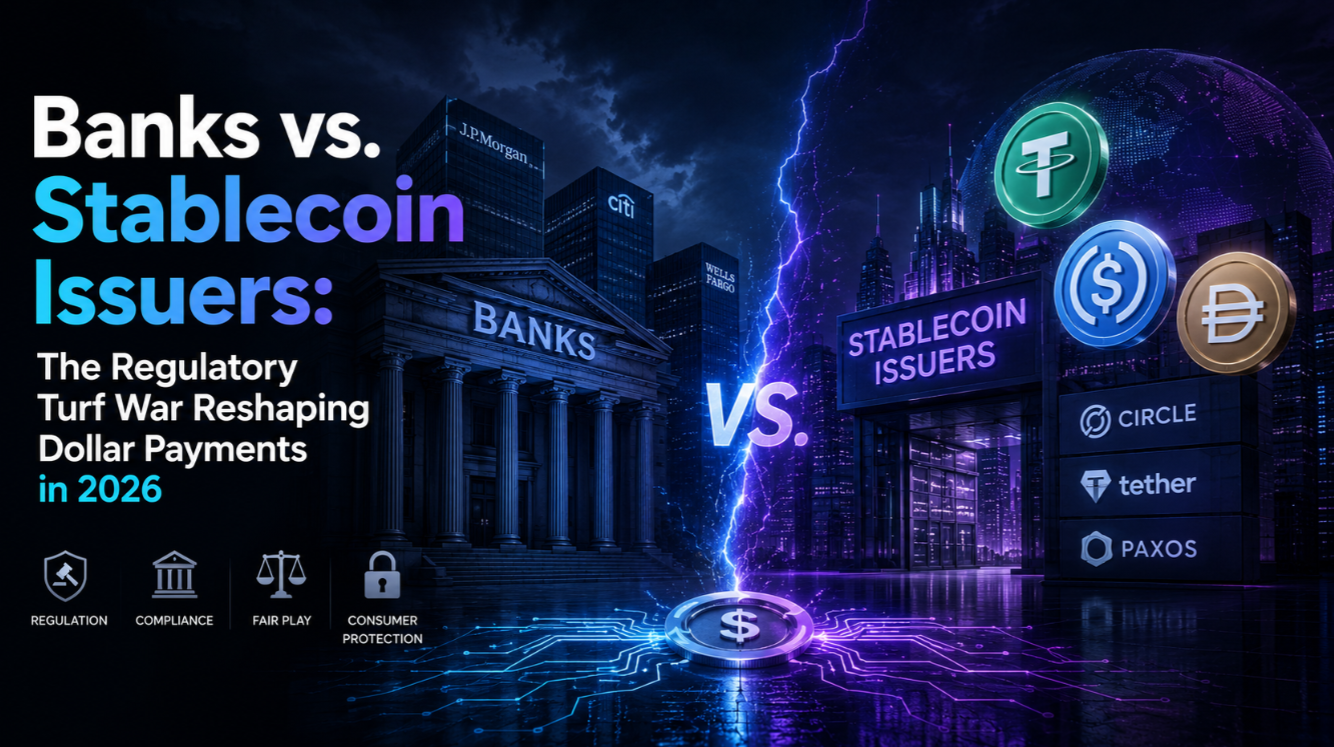
The battle for control of the dollar stablecoin market has moved from trading desks to Congressional hearing rooms, central bank committees, and federal court filings. In 2026, the conflict between traditional banks lobbying to restrict non-bank stablecoin issuance and crypto-native firms defending their market position has become one of the most consequential regulatory fights in financial history — with trillions of dollars in future payment flows at stake.
The Trigger: The GENIUS Act and Its Contested Provisions
The Guiding and Establishing National Innovation for U.S. Stablecoins (GENIUS) Act, signed into law in February 2026, was supposed to create clarity. It does — but not the kind every stakeholder wanted. The Act permits non-bank technology companies to issue "payment stablecoins" with 1:1 reserves in cash or Treasuries, federal registration, and monthly reserve attestations. Circle, PayPal, and Paxos qualify under this framework.
Banking industry trade groups — including the American Bankers Association and the Bank Policy Institute — lobbied aggressively against this provision during the drafting process. Their argument: allowing non-banks to issue money-like instruments without full bank charters, deposit insurance requirements, or Fed access creates an unlevel playing field and introduces systemic risk. They lost the legislative battle, but the lobbying war continues through regulatory rulemaking.
The Banks' Counterattack: Three Simultaneous Fronts
Facing a framework that permits non-bank stablecoin issuers, the banking industry has opened three simultaneous pressure campaigns:
- Federal Reserve access: Banks are lobbying the Fed to deny master accounts and payment system access (FedWire, FedACH) to stablecoin issuers who do not hold a full bank charter. Without Fed access, issuers must route through bank intermediaries — increasing costs and reducing the speed advantage of stablecoin settlement.
- OCC supervisory rules: The Office of the Comptroller of the Currency is drafting examination guidelines for stablecoin issuers under the GENIUS Act. Bank lobbyists are pushing for capital requirements, stress testing, and liquidity rules that mirror bank regulations — effectively imposing bank-equivalent compliance costs on non-bank issuers.
- State-level fragmentation: Several banking-aligned state legislatures have introduced bills requiring stablecoin issuers to hold state money-transmission licences (MTLs) with stricter reserve requirements than the federal baseline — creating a patchwork that smaller issuers cannot afford to navigate.
Tether's Peculiar Position
Tether, as the world's largest stablecoin issuer at $145 billion in supply, occupies a peculiar position in this regulatory battle. Tether is incorporated in the British Virgin Islands and does not seek U.S. federal registration under the GENIUS Act. This means it falls outside the new framework entirely — it can continue serving non-U.S. markets and U.S. users who access it through offshore exchanges, but it cannot be integrated into U.S. bank payment systems or Fedwire.
This creates a de facto two-tier stablecoin market: GENIUS-compliant issuers (USDC, PYUSD, Paxos) with full U.S. banking integration, and offshore issuers (Tether) with global reach but restricted U.S. access. Whether this bifurcation strengthens or weakens Tether's position depends on your view of where future stablecoin growth originates.
Circle and USDC: Regulatory Compliance as Competitive Moat
Circle has explicitly positioned USDC's regulatory compliance as its primary competitive advantage. Circle filed for IPO registration in early 2026 and has structured its business to be the first stablecoin issuer to receive a U.S. federal payment charter. The IPO prospectus estimates a $20 trillion addressable market for dollar-denominated stablecoin payments by 2030 — a projection that requires winning the regulatory battle as a prerequisite.
Circle CEO Jeremy Allaire has repeatedly argued that the banking lobby's opposition is protectionist, not prudential. "Banks want the stablecoin market to exist — but only on their own infrastructure and under their control," he told a Senate Banking Committee hearing in March 2026. "That is not innovation; it is regulatory capture."
The European Dimension: MiCA's Head Start
While the U.S. fights over frameworks, the European Union's Markets in Crypto-Assets (MiCA) regulation has been live since June 2024. MiCA requires e-money token (stablecoin) issuers to be licensed as e-money institutions, hold 1:1 reserves, and comply with EBA oversight. Both Circle (USDC) and Société Générale (EUR CoinVertible) have obtained MiCA licences, giving them a clear path to European market access unavailable to non-compliant issuers.
The MiCA framework is increasingly being cited in the U.S. debate as a working model: it is stricter than the GENIUS Act on governance and reserve requirements but does not require a full bank charter. If U.S. regulators adopt MiCA-equivalent standards through rulemaking, it would represent a middle ground that narrows — but does not eliminate — the advantage of bank-issued stablecoins.
What This Means for Users and Investors
For everyday users holding stablecoins on Coinbase or in DeFi protocols, the regulatory turf war has practical implications. A tightening of Fed access rules could slow the settlement rails underlying USDC redemptions. New capital requirements could force smaller issuers to exit the market, concentrating supply among a handful of large players. And a failure to resolve the U.S. regulatory framework could push stablecoin innovation — and the associated economic activity — to more permissive jurisdictions.
The irony is that both banks and stablecoin issuers are ultimately competing for the same prize: the privilege of issuing the digital infrastructure layer for a globalised, programmable dollar economy. The outcome of this regulatory battle will determine whether that infrastructure is built on public blockchains accessible to everyone, or on permissioned bank rails accessible only to the institutions regulators already know.
- GENIUS Act: non-bank stablecoin issuers permitted with federal registration
- Banking lobby: pushing for Fed access denial and bank-equivalent capital rules
- Tether: outside U.S. framework, serving global markets
- Circle/USDC: positioning compliance as competitive moat ahead of IPO
- MiCA (EU): live framework increasingly cited as U.S. regulatory template
The $300 billion stablecoin market is too large — and too strategically important — for any single side to win outright. Expect years of litigation, rulemaking, and legislative revision before the dust settles.