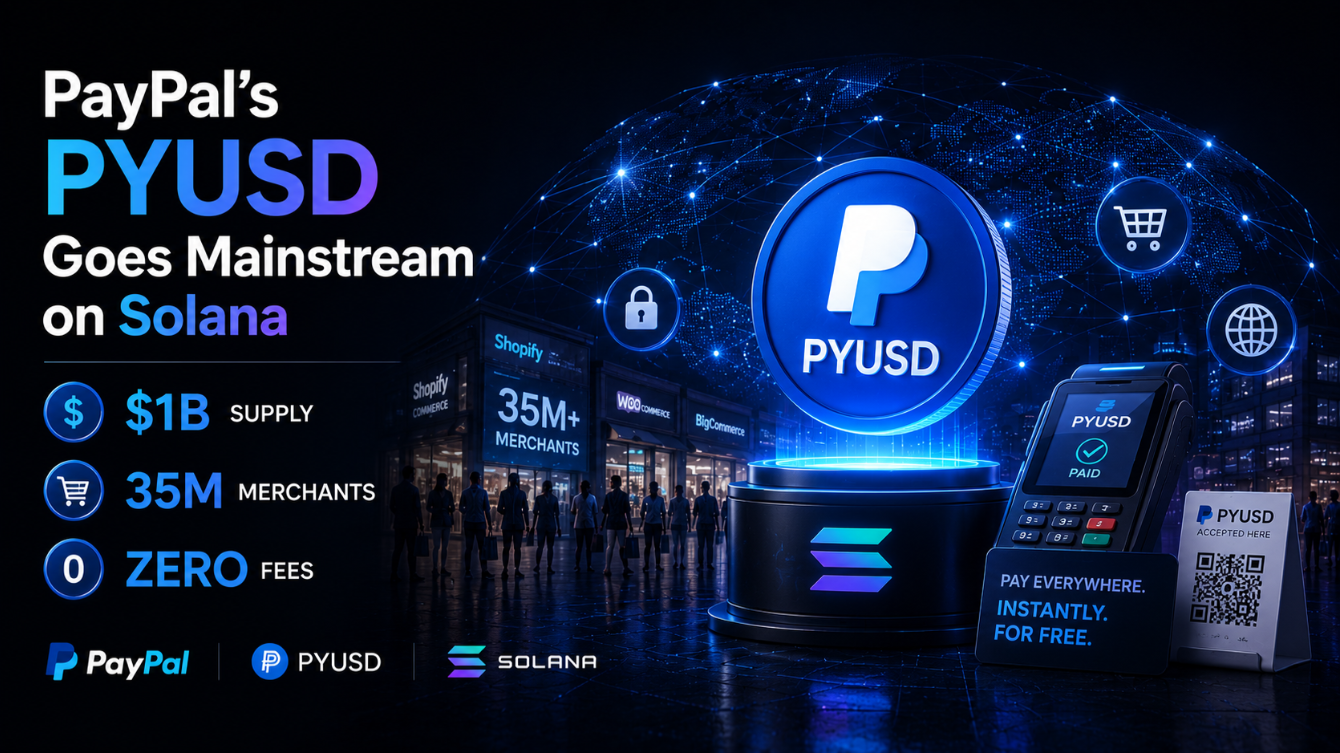
PayPal's stablecoin PYUSD has completed its most significant strategic expansion to date, moving from a niche Ethereum-based experiment to a fully integrated payments rail across Solana's high-throughput ecosystem. With over 430 million active PayPal accounts now able to send, receive, and hold PYUSD with zero fees on Solana, the product has crossed the threshold from crypto-curious to genuinely mainstream.
From Ethereum to Solana: A Strategic Pivot
When PayPal launched PYUSD on Ethereum in August 2023, adoption was modest. Gas fees made small transactions economically unviable, and the user experience required bridging from a familiar fintech interface into an unfamiliar blockchain environment. The Solana expansion, announced in May 2024, changed the calculus entirely.
Solana's combination of sub-second finality, sub-cent transaction fees, and high throughput — capable of handling 65,000 transactions per second — makes it the natural home for a consumer payments stablecoin. PYUSD on Solana settles in under 400 milliseconds and costs approximately $0.00025 per transaction. For reference, a cross-border wire transfer via SWIFT typically costs $25–50 and settles in 1–3 business days.
Mainstream Milestones: $1B Supply and Real-World Merchants
PYUSD's supply on Solana exceeded $1 billion in March 2026 — more than doubling in six months. The growth is driven by PayPal's decision to make PYUSD the default settlement currency for its Xoom international remittance product, which serves millions of users sending money to Mexico, the Philippines, India, and Nigeria.
On the merchant side, PayPal has enrolled over 35 million merchants in its network to accept PYUSD as a payment option. The settlement happens in PYUSD on-chain but merchants can opt for instant conversion to fiat in their local currency — a "stablecoin backend, fiat frontend" model that removes the need for merchants to understand blockchain technology at all.
The DeFi Layer: PYUSD in Solana Protocols
Beyond peer-to-peer payments, PYUSD has gained traction in Solana's DeFi ecosystem. Liquidity pools on Jupiter, Raydium, and Orca now hold hundreds of millions in PYUSD, and the token is accepted as collateral on lending protocols including Kamino and MarginFi. This DeFi integration provides yield opportunities for PYUSD holders and deepens the token's liquidity profile.
For users who want to buy PYUSD and participate in on-chain yield, Coinbase supports PYUSD trading pairs and enables direct on-ramp from bank accounts. USDC, Circle's competing stablecoin available at /market/usd-coin/, competes directly with PYUSD for the same DeFi mindshare on Solana.
Regulatory Tailwinds: The GENIUS Act Framework
PayPal's expansion is well-timed with the regulatory environment. The U.S. GENIUS Act (Guiding and Establishing National Innovation for U.S. Stablecoins), passed in early 2026, creates a federal framework for "payment stablecoins" that explicitly permits non-bank technology companies to issue dollar-pegged tokens provided they maintain 1:1 reserves in cash or short-term Treasuries.
PYUSD is backed by U.S. dollar deposits, short-term Treasuries, and similar cash equivalents, placing it squarely within the GENIUS Act's definition of a compliant payment stablecoin. PayPal has already filed for the required federal registration, giving it a competitive advantage over less-regulated rivals in U.S. market access.
Competition and the Road to $10B
PYUSD's main competitors on Solana are USDC — which retains a larger ecosystem footprint and institutional depth — and the emerging Circle-backed native USDC on Solana. PayPal's advantage is distribution: no stablecoin issuer has access to 430 million consumer accounts with linked bank cards and established trust.
Analysts at several crypto research firms project PYUSD supply could reach $5–10 billion by year-end 2026 if PayPal continues its roadmap of integrating stablecoin settlement into its full product suite, including Venmo. That would make PYUSD a top-five stablecoin by supply — a remarkable ascent for a product that barely registered two years ago.
"PYUSD on Solana is the first time a major fintech has used a public blockchain as production payments infrastructure at scale. This is not a pilot." — PayPal SVP of Blockchain, May 2026
The mainstream moment for stablecoins may have already arrived — it just looks like a PayPal transfer, not a crypto wallet.