
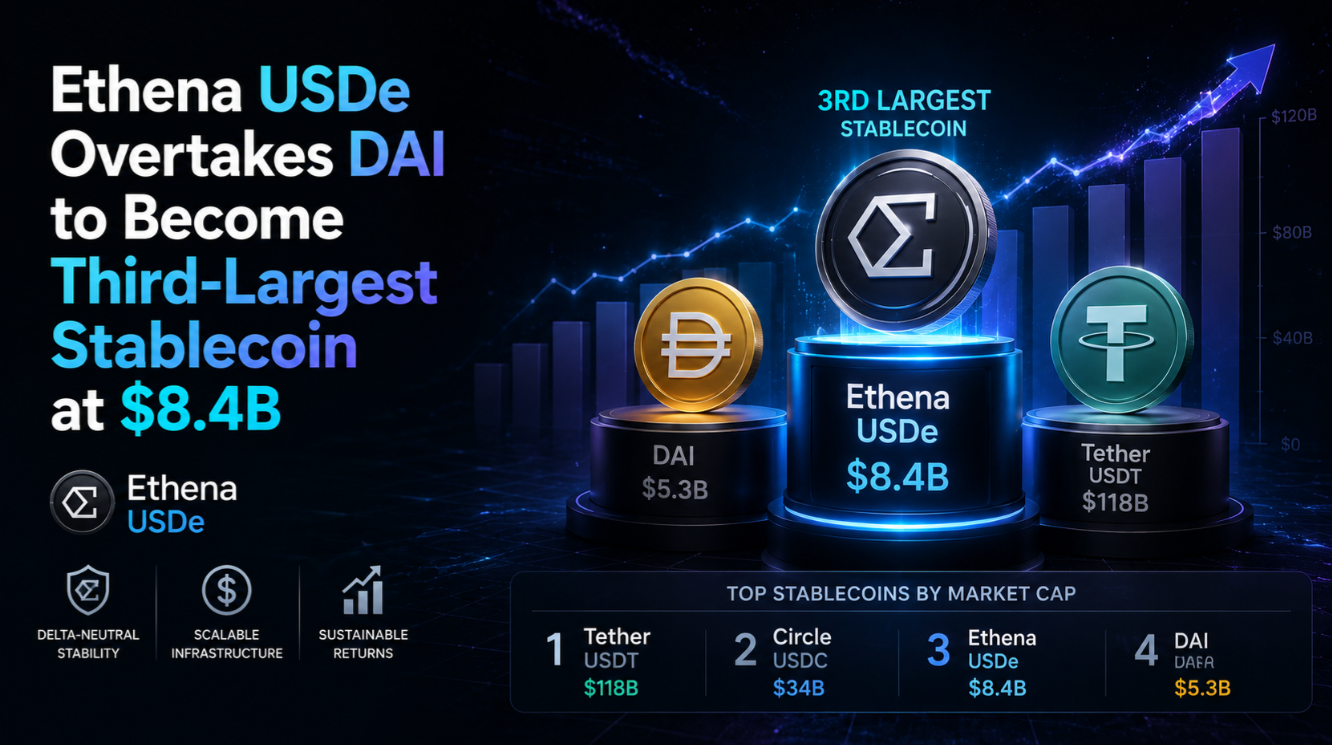
Ethena's USDe has officially surpassed DAI to become the third-largest stablecoin by market capitalisation. The milestone marks a generational shift in decentralised stablecoins: yield-bearing synthetic designs are displacing over-collateralised lending models as the dominant format for on-chain dollar exposure.
The Numbers: USDe at $8.4B, DAI at $5.5B
USDe's market cap reached $8.4 billion in April 2026, a 340 % increase from its $1.9 billion cap at the start of 2025. DAI, the original decentralised stablecoin created by MakerDAO in 2017, now stands at $5.5 billion — having itself grown, but unable to match USDe's velocity. The gap continues to widen as new users drawn by USDe's yield proposition choose it over the non-yielding DAI.
Behind USDe in the rankings sit FDUSD, TUSD, and a dozen smaller stablecoins. Only Tether (USDT) and USDC remain comfortably ahead — and even USDC's lead of roughly $54 billion over USDe is narrowing as the yield premium sustains USDe demand through market cycles.
How USDe Maintains Its Peg — and Generates Yield
USDe's mechanism is elegant but carries specific risks. Users deposit stETH (staked Ether) or other LSTs as collateral. Ethena simultaneously opens an equivalent-size perpetual short position on ETH against the same notional value on a centralised exchange. The two legs are delta-neutral: if ETH rises 10 %, the collateral gains 10 % while the short loses 10 %, keeping the net USD value stable.
Yield comes from two sources: staking rewards on the LST collateral (currently ~3.8 % APY) and funding rate income from the short perpetual position. When markets are in "contango" — longs paying shorts — funding rates are positive, and Ethena collects that income. Over the past 18 months the blended yield has averaged around 12–15 % annualised, far exceeding the near-zero return on holding DAI or USDC.
The Risk Debate: Funding Rate Reversals
Critics, including several prominent DeFi researchers, argue that USDe's yield is not risk-free. During sharp bear markets, perpetual funding rates can turn negative — meaning Ethena must pay longs rather than receive payments. Sustained negative funding erodes the insurance fund and, in an extreme scenario, could force liquidations or break the peg.
Ethena has responded by building a $450 million insurance fund sourced from protocol revenues, and by diversifying collateral across BTC, SOL, and ETH LSTs to reduce single-asset exposure. The protocol has also introduced a "sUSDe" staking contract where holders lock USDe for 7 days to receive yield, creating a natural buffer that slows redemption runs during stress periods.
DAI's Response: The Sky Protocol Rebrand and New Products
MakerDAO — now operating under the Sky Protocol brand — has not stood still. The team launched the USDS stablecoin (an upgraded DAI successor) with an integrated savings rate module offering 6–8 % yield, attempting to compete directly with USDe's value proposition while maintaining the fully on-chain, non-custodial properties that made DAI famous.
DAI itself will continue to exist alongside USDS for the foreseeable future, as billions remain locked in long-term DeFi vault positions. But the rebranding signals that even the founding decentralised stablecoin acknowledges the market has shifted toward yield as the primary competitive dimension.
What This Means for DeFi Composability
USDe's rise has reshaped DeFi liquidity. The token is now the second-largest collateral asset on Aave v3 (Ethereum mainnet), the dominant stablecoin in several Curve pools, and increasingly used as margin on perp DEXs. This creates a reflexive dynamic: more integrations attract more users, which deepens liquidity, which attracts more integrations.
For users of platforms like Coinbase, USDe is now available for purchase and custody alongside traditional stablecoins. The competitive pressure has also forced USDC and DAI ecosystem partners to improve their own yield offerings — a net positive for all stablecoin holders.
Outlook: Can USDe Reach the $20B Mark?
Projections from on-chain analytics firms suggest USDe could reach $15–20 billion by end-2026, potentially challenging USDC's position if funding rate conditions remain favourable. The critical unknown is whether a prolonged bear market — with persistent negative funding — would trigger a confidence crisis before the insurance fund can absorb the impact.
For now, the market has voted with capital: yield-bearing stablecoins represent the next evolution of on-chain dollar instruments, and Ethena is leading that charge.