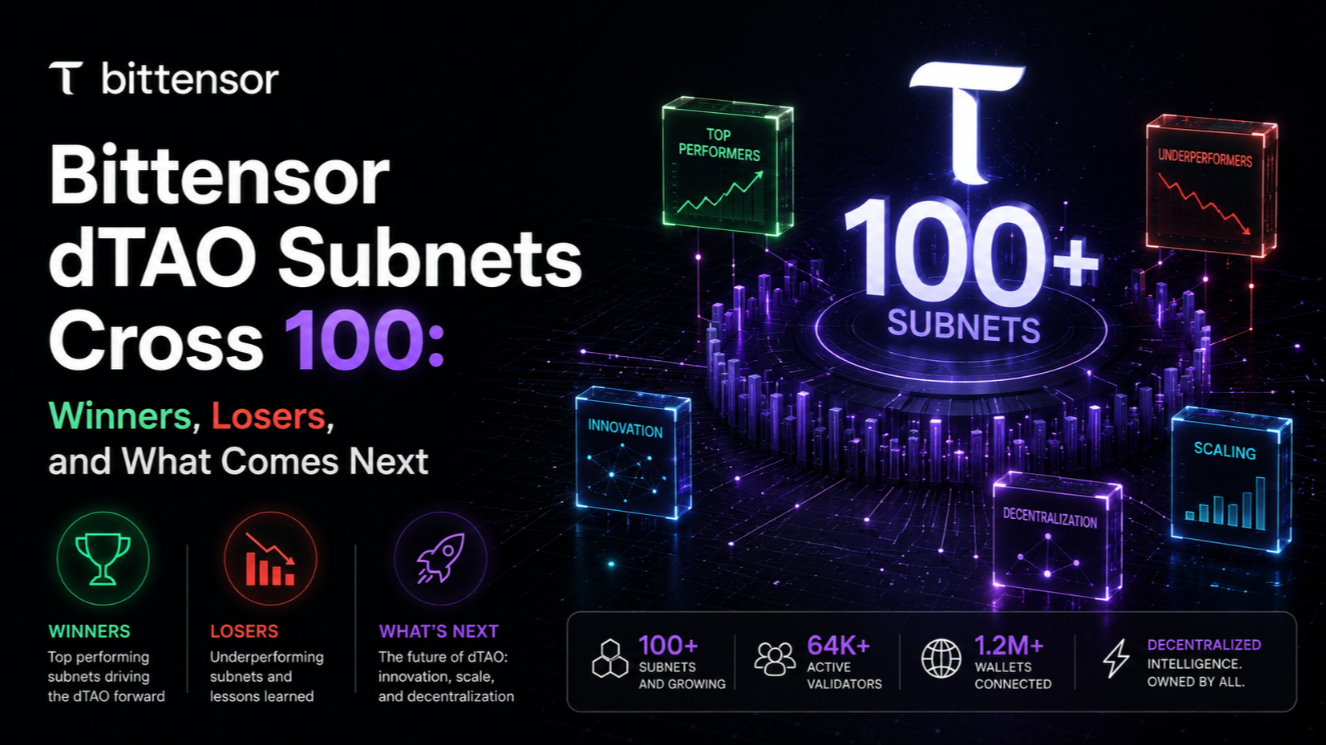
The Bittensor network has crossed a symbolic threshold: more than 100 subnets are now active on its dTAO architecture, each carrying its own bonded alpha token tied to the base TAO asset via on-chain bonding curves. The milestone arrived quietly — no single announcement, just a steady tick upward in subnet registrations that accelerated through March and April 2026. For observers who have followed Bittensor since its early validator days, the speed of expansion is striking. For skeptics, the key question is: how many of those subnets are doing anything useful?
The dTAO Mechanic, Briefly
Before the dTAO upgrade (shipped February 2025), all Bittensor subnet emissions flowed through a single root network, and validators competed for TAO based on subnet rankings. The dTAO change replaced that flat structure with a per-subnet token economy. Each subnet now has an alpha token whose price is determined by a bonding curve — as more TAO is staked into a subnet, the alpha token price rises. Subnet owners and miners earn alpha tokens; validators earn a share of root TAO in proportion to how much capital their subnet attracts.
This mechanic turns each subnet into a mini-market. Capital flows toward subnets that signal real utility. In theory, markets are better at allocating resources than committee voting. In practice, the market is young and thin, and most subnets are still in the "launch party" phase — high initial registration interest, low long-term retention.
For a full breakdown of TAO tokenomics and subnet economics, visit the Bittensor market page.
The Winners: SN1, SN64, and SN9
Three subnets are pulling the vast majority of meaningful capital. SN1 (Apex Chat) has crossed $60 million in TVL and hosts the most sophisticated model validators on the network. It is the closest Bittensor has to a working on-chain inference market for conversational AI. SN64 (Chutes) operates a GPU inference API that third-party application teams have actually integrated — not demo integrations, but production queries against open-weight models. SN9 (Pretrain) offers a continuous pretraining evaluation benchmark, incentivizing miners to train models that score higher than the current best-known checkpoint.
These three subnets share a common trait: measurable output. You can query SN64's API and get a response. You can compare SN9's leaderboard to known public model benchmarks. SN1's validator scores correlate with human-rated conversation quality. The rest of the top 10 are more speculative — time-series prediction, anomaly detection, and DeSci data markets — with some real activity but thinner ecosystems.
The Losers: Ghost Subnets and Incentive Farming
Below the top 15 or so, the picture changes quickly. Roughly 60 of the 100+ active subnets show fewer than five unique miner addresses, bonding-curve TVL under $500k, and validator scores that correlate more with staking power than with genuine model quality. These are not fraudulent — subnet creation is permissionless, and low-activity subnets do not damage the network directly. But they represent misallocated registration fees and distorted emissions that could otherwise flow toward productive subnets.
A second class of problematic subnets are the incentive farmers: projects that registered subnets primarily to capture early alpha-token emissions before meaningful competition arrived. These subnets have validators that are technically compliant but optimized for scoring mechanisms rather than real task performance. The Opentensor Foundation has acknowledged the farming problem and is working on validator quality metrics that penalize low-signal scoring. Implementation is expected in a protocol update tentatively scheduled for Q3 2026.
What the 100-Subnet Milestone Means for TAO
Reaching 100 subnets increases the surface area for speculation: any new subnet that gains traction reflects positively on TAO because it bonds TAO through its bonding curve. More subnets also mean more pathways for capital to enter the ecosystem without having to commit to a single use case. For TAO holders, diversification of subnet utility is structurally positive — it reduces the risk that a single high-profile subnet failure would crater the entire network.
The risk is dilution of attention and capital. If most subnets are ghost chains, the 100-subnet headline becomes a liability when independent analysts start publishing accurate activity data. The market is currently pricing Bittensor on optionality — the belief that some subnets will eventually capture meaningful AI workloads. That repricing only sustains if productive subnets continue growing faster than ghost chains.
- 100+ active subnets as of April 2026, up from ~80 in January
- SN1, SN64, SN9 lead on measurable utility metrics
- Roughly 60% of subnets show thin activity or incentive farming
- Opentensor Foundation targeting validator quality upgrade for Q3 2026
- TAO bonding-curve mechanic creates structural demand from subnet growth
Looking Forward: Subnet Consolidation or Continued Expansion?
The most likely path is not linear expansion to 200 subnets, but consolidation. As validator quality metrics tighten and emissions shift toward high-signal subnets, weaker registrations will stop attracting miners. The number of active subnets may plateau or even contract while productive TVL continues rising. That would be a healthy development — quality over quantity, measurable output over registration counts.
The alternative — continued speculative expansion with no quality filtering — risks a credibility problem. AI developers evaluating decentralized infrastructure do not need 100 subnets; they need three or four that work reliably. Bittensor's long-term value depends on the network finding that balance. The 100-subnet milestone is a data point, not a destination.
This article is information, not financial advice. Do your own research before investing.