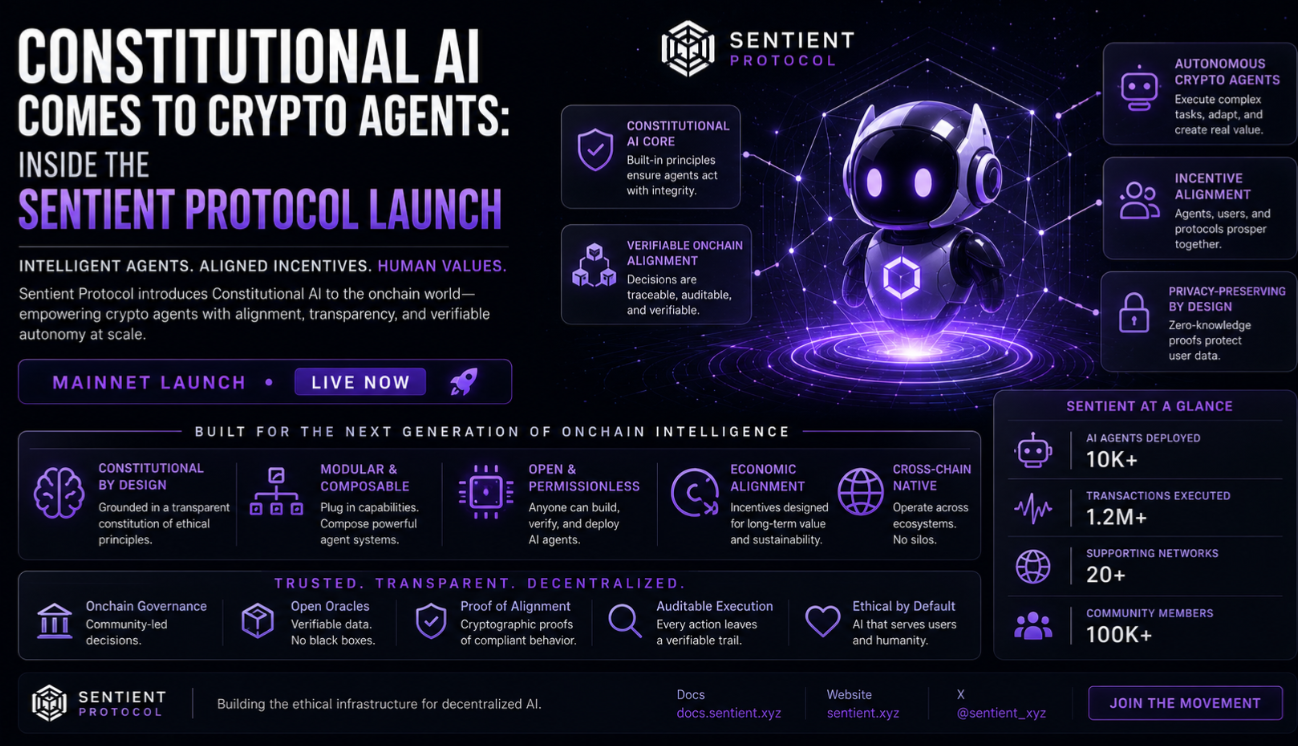
When Anthropic published its Constitutional AI paper in 2022, the primary audience was AI safety researchers and large language model teams. The core idea — embedding explicit principles into a model's training process so it self-critiques against those principles rather than relying entirely on human feedback — was compelling but largely theoretical for the crypto world. That changed this week when Sentient Protocol shipped its mainnet launch, bringing a version of constitutional AI guardrails to autonomous on-chain agents.
The Sentient system does not retrain models. Instead, it implements constitutional principles at the smart contract layer: a set of verifiable rules that an agent's action proposals must pass before they are executed on-chain. The agent proposes an action, a separate validator model critiques the proposal against the constitution, and only proposals that pass the critique are permitted to execute. The critique step runs on-chain and is publicly auditable.
What Constitutional AI Actually Means in Crypto Context
In Anthropic's original framing, a "constitution" is a set of principles — things like "be helpful," "avoid harm," "be honest" — that a model uses to evaluate its own outputs. The model generates a draft response, then critiques it against the principles and revises. The process repeats until the output passes self-critique. This is effective for conversational AI because the stakes of individual outputs are relatively contained.
For on-chain agents managing financial assets, the risk profile is different. A wrong output does not just give a user bad advice — it can drain a wallet, execute an irreversible market order, or approve a malicious contract interaction. The Sentient Protocol adapts the constitutional approach to this higher-stakes context by making the critique step external and verifiable rather than internal to the model.
The Sentient constitution for financial agents currently includes twelve principles. Examples: "Never approve a transaction that transfers more than 10% of total portfolio value in a single step without a time-lock." "Reject any contract interaction with a deployment timestamp under 30 days old unless it is on the whitelist." "Flag any action that would concentrate more than 50% of assets in a single protocol." These are not absolute vetoes — a human operator can override with a multi-sig — but they are the default behavior.
How the On-Chain Critique Works
The technical implementation uses a two-agent architecture. The primary agent generates action proposals in structured JSON. The validator agent — a smaller, specialized model running on Sentient's inference infrastructure — evaluates each proposal against the constitutional ruleset and returns a pass/fail verdict with a reasoning trace. Both the proposal and the verdict are stored on-chain as calldata.
The on-chain storage of the critique reasoning trace is the key differentiating feature. In traditional AI safety systems, the critique is internal and unauditable. On Sentient, anyone can inspect the chain, retrieve the critique trace for any agent action, and verify that the constitutional check happened and what the reasoning was. This creates an audit trail that is valuable both for post-hoc review and for real-time monitoring by third parties.
The validator model itself is also subject to oversight. Sentient operates a council of five independent validator nodes that each run their own version of the critique model. A proposal must pass three of five validators to execute. This quorum requirement prevents a single compromised or manipulated validator from either blocking legitimate agent actions or approving harmful ones.
AI Token Implications: NEAR, Render, Fetch.AI as Infrastructure
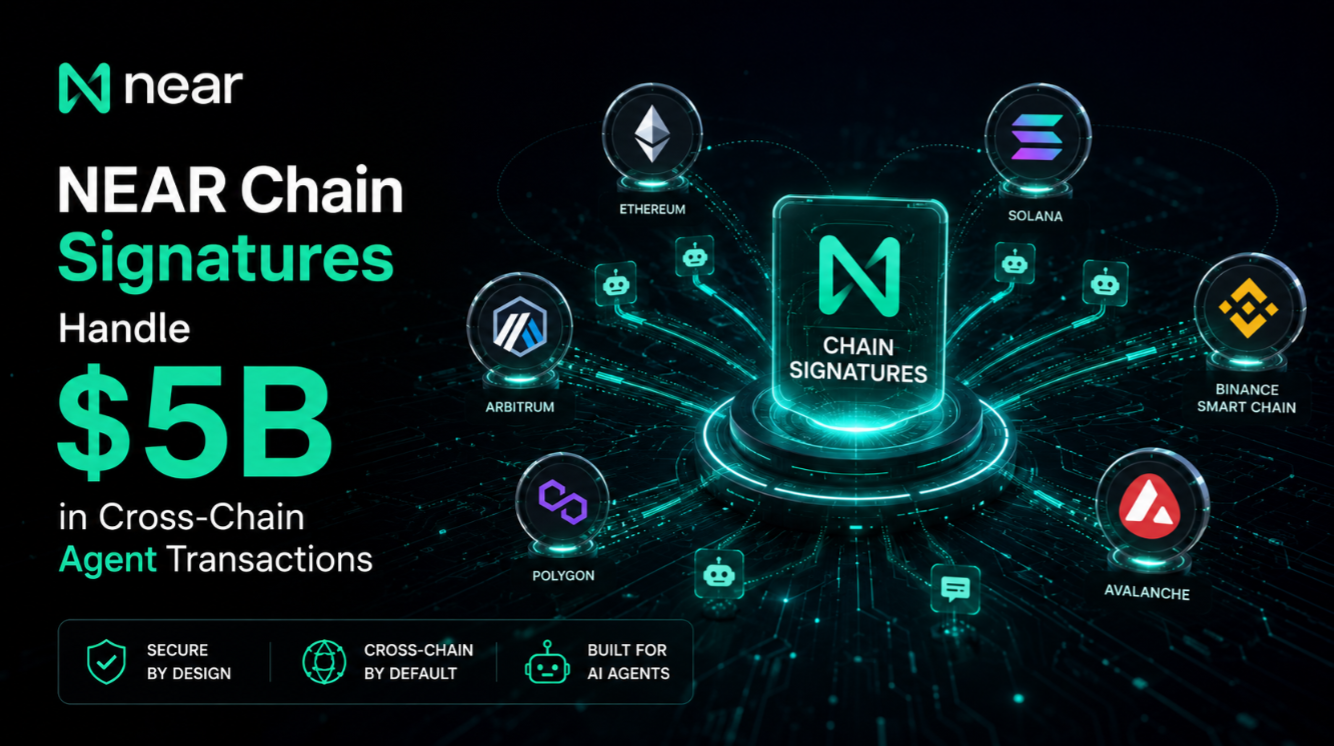
Sentient Protocol is not a standalone island. Its inference infrastructure runs on a combination of Render Network compute for the validator models and Fetch.ai agent framework for the primary agent layer. Agents using Sentient's constitutional guardrails can also leverage NEAR Chain Signatures for cross-chain action execution, giving the full stack an interesting multi-protocol dependency structure.
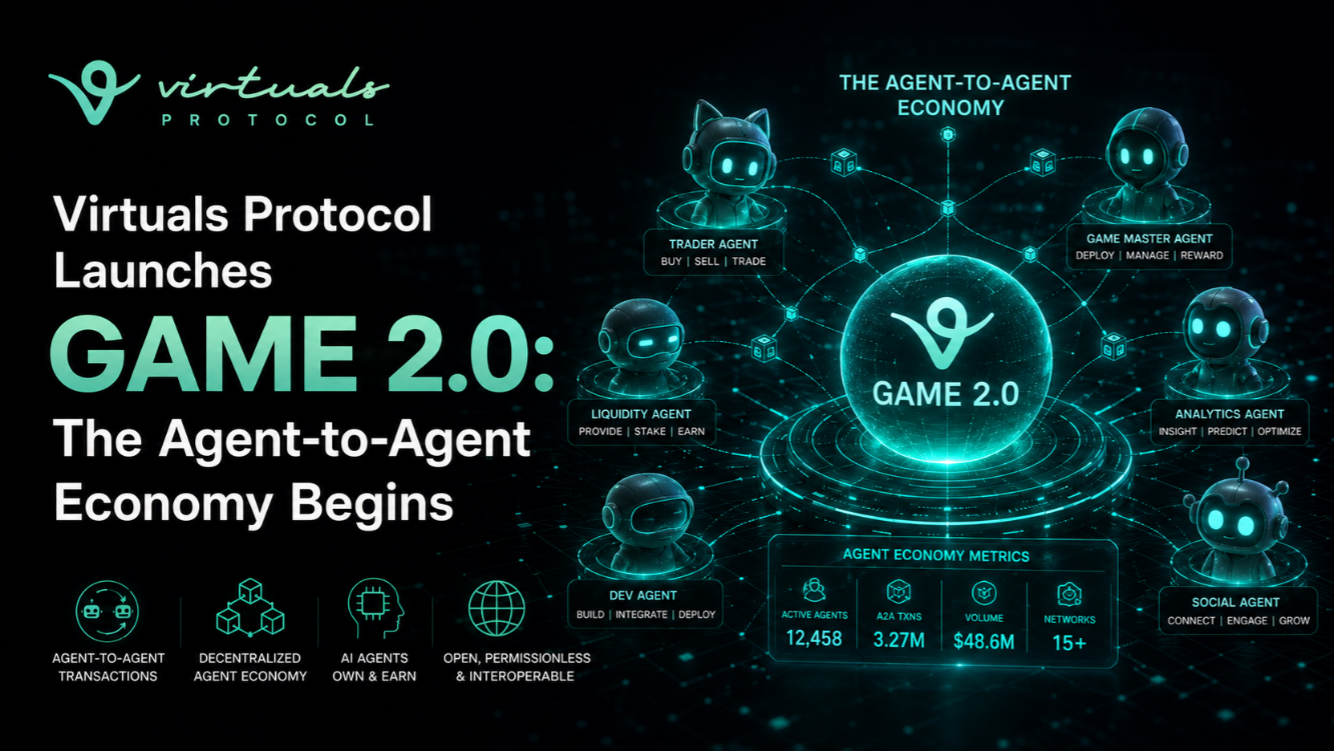
This integration pattern is notable because it shows how the AI agent crypto sector is beginning to develop a supply chain. Compute (Render), coordination and agent primitives (Fetch.ai), multi-chain execution (NEAR Chain Signatures), safety layer (Sentient), and token-bonded agent ownership (Virtuals Protocol) are each a distinct layer. No single protocol dominates the whole stack. The ecosystem is maturing toward specialization.
For market data on Virtuals Protocol and its VIRTUAL token, see the Virtuals Protocol market page. For Bittensor and its subnet infrastructure, see the dedicated market page.
Adoption and Early Traction
Sentient Protocol launched with eleven agent teams deploying constitutional guardrails in the first 48 hours. The earliest adopters are DeFi treasury management agents — protocols that want to automate routine rebalancing and yield harvesting but need audit trails demonstrating they did not take reckless risks. The constitutional framework gives treasury managers a defensible answer to governance questions about autonomous agent behavior.
A second cohort is cross-chain bridge operators using Sentient to govern their relayer agent logic. Bridge exploits have historically cost the crypto ecosystem billions, often because relayer agents executed transactions they should not have. Embedding constitutional principles into bridge relayer behavior — particularly rules about transaction size limits and destination address validation — is a direct response to that exploit history.
Critiques and Limitations
Not everyone is impressed. Critics point out that the constitutional principles in Sentient's current implementation are simple heuristics — rules that a well-written traditional smart contract could enforce without a language model. The case for using an LLM-based validator rather than rule-based code is that LLMs can handle edge cases and ambiguous inputs that rigid rules miss. But LLMs also hallucinate, and a hallucinating validator could pass a harmful proposal or block a legitimate one with equal frequency.
The "three of five validators" quorum reduces but does not eliminate validator failure risk. And the critique reasoning stored on-chain is only useful if someone is reading it. In practice, most agent transactions will never be audited in real time. The on-chain audit trail is a forensic tool, not a prevention mechanism. These are real limitations, and Sentient's team has not claimed otherwise — the protocol is v1, and the design is explicitly framed as a starting point rather than a complete solution.
- Sentient Protocol embeds constitutional AI critique at the smart contract layer
- On-chain critique traces provide publicly auditable agent action records
- 3-of-5 validator quorum prevents single-node manipulation of constitutional checks
- Infrastructure stack spans Render (compute), Fetch.ai (agents), NEAR (cross-chain execution)
- 11 agent teams deployed constitutional guardrails within 48 hours of launch
This article is information, not financial advice. Do your own research before investing.