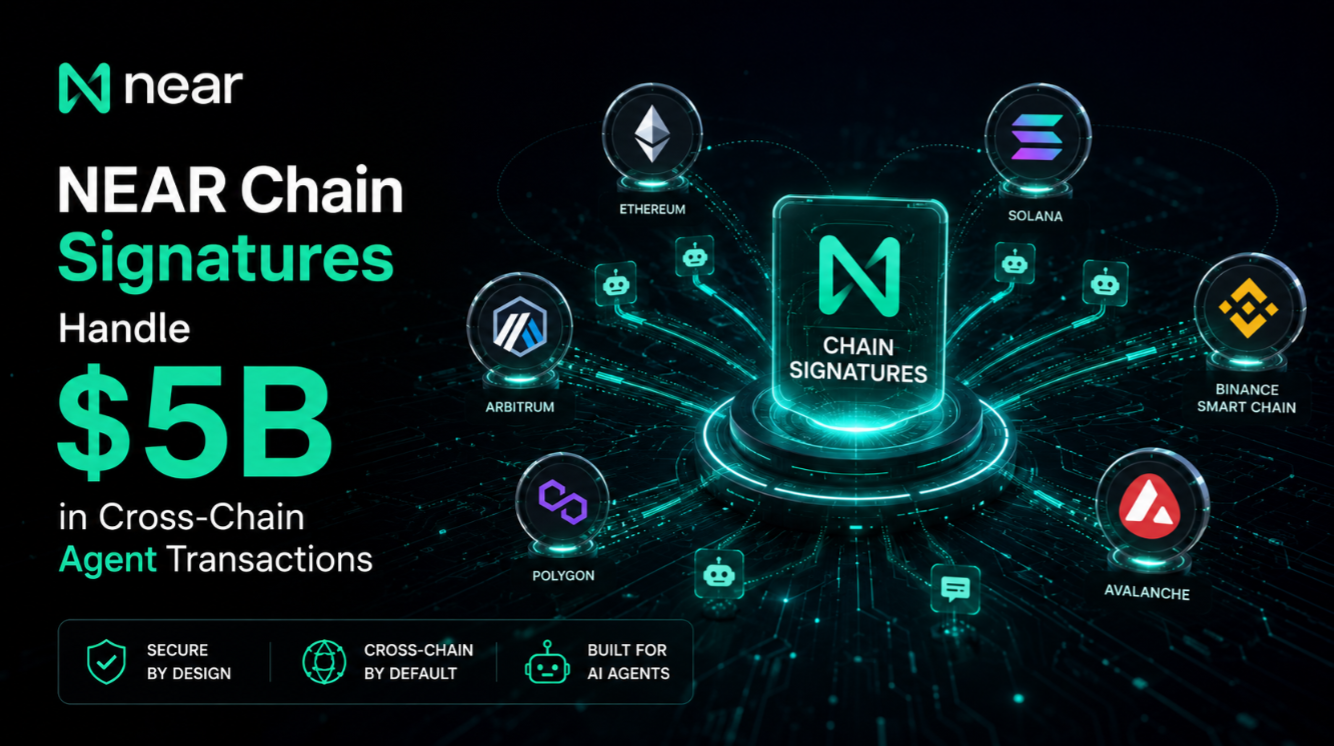
NEAR Protocol's Chain Signatures technology has crossed a meaningful milestone: cumulative cross-chain transaction volume facilitated through the primitive has passed $5 billion, according to on-chain data compiled from NEAR Explorer and independent indexers. The figure covers all transaction types — asset transfers, contract calls, multi-step DeFi sequences, and autonomous agent instructions — settled across Ethereum, Bitcoin, Solana, and six other chains from a NEAR smart contract as the coordination layer.
The $5 billion figure matters less as a valuation signal and more as a proof point. It confirms that Chain Signatures has crossed from "interesting demo" to "production infrastructure" faster than most cross-chain primitives have managed. The underlying driver of volume growth over the past two quarters has been a category that was barely mentioned in the original Chain Signatures launch notes: autonomous AI agents executing multi-chain DeFi strategies on behalf of human principals.
For full NEAR market data and technical context, visit the NEAR Protocol market page.
How Chain Signatures Work
Chain Signatures allows a NEAR account to generate and broadcast cryptographically valid signatures for transactions on other blockchains, without requiring a bridged asset or a custodian. The mechanism uses a Multi-Party Computation (MPC) node network — a set of validators that collectively hold key shards. When a NEAR smart contract requests a signature for a Bitcoin UTXO or an Ethereum transaction, the MPC nodes jointly compute the signature without any single node ever holding the complete private key.
From the user's perspective, the experience is simple: one NEAR account, one transaction to the Chain Signatures contract, and the desired action executes on the target chain within seconds. There is no token lock-up, no bridge liquidity pool to drain, no fraud-proof delay. The security model depends on the MPC network's honest majority assumption — if more than a threshold of nodes collude, they can forge signatures. The current network uses a 2-of-3 sharding scheme with a planned upgrade to larger committees as the validator set grows.
The AI Agent Connection
The transaction type that has grown fastest in the $5 billion tally is multi-step autonomous agent execution. A pattern has emerged: a human user deploys a NEAR smart contract that encodes a DeFi strategy — for example, "rebalance this portfolio to 60% ETH / 40% BTC if the 30-day correlation drops below 0.7." The contract monitors on-chain data feeds, and when the trigger condition is met, it fires a Chain Signatures call that simultaneously moves assets on Ethereum and Bitcoin without the human needing to approve each leg.
This is materially different from existing cross-chain automation tools. Bridge-based agents require the user to pre-position wrapped assets on each target chain. Chain Signatures agents hold native assets and sign native transactions — a simpler, cheaper, and more capital-efficient architecture. Three of the five largest DeFi yield optimizers on NEAR by TVL are now running Chain Signatures-powered agents for their cross-chain rebalancing logic.
Transaction Breakdown: Who Is Generating the Volume
The $5 billion is not evenly distributed. Ethereum is the largest destination by volume (roughly 55%), followed by Bitcoin (28%), Solana (12%), and other chains (5%). The distribution reflects where liquidity lives: ETH and BTC are the logical targets for any multi-chain DeFi strategy because they have the deepest markets and best exit liquidity.
By transaction type, automated agent execution accounts for approximately 62% of cumulative volume. Human-initiated multi-chain transfers make up the remaining 38%. The agent share has been growing each month: in January it was 48%; by March it had reached 67%. If the trend holds, agents will represent over 80% of Chain Signatures volume by end of 2026.
- $5B cumulative cross-chain volume processed via Chain Signatures since launch
- Ethereum (55%), Bitcoin (28%), Solana (12%) are leading target chains
- Autonomous AI agents now account for ~62% of all Chain Signatures transactions
- 3 of the top 5 NEAR DeFi protocols use Chain Signatures for cross-chain rebalancing
- MPC network upgrade to larger committees planned to increase security threshold
What This Means for NEAR Tokenomics
Every Chain Signatures call incurs NEAR transaction fees at the coordination layer. As agent volume scales, NEAR fee revenue scales proportionally. More importantly, agents that manage substantial portfolios need to hold NEAR in their contract wallets to pay for ongoing operations. A portfolio manager running weekly rebalances might hold $500–$2,000 in NEAR for operational liquidity. Multiply that by thousands of deployed agent contracts and the structural NEAR demand is non-trivial.
NEAR staking yields have also benefited: higher transaction volume means higher total fee revenue for validators, which compresses the yield gap between staking and idle holding. As of April 2026, NEAR staking yield stands at approximately 8.5% annualized — competitive with other proof-of-stake L1s and supported partly by the fee revenue from Chain Signatures activity.
Risks and Next Steps
The MPC honest majority assumption is the technical Achilles' heel. A compromised MPC committee could drain native assets on target chains without the NEAR smart contract noticing until after the fact. NEAR is addressing this through graduated committee expansion and multi-party attestation requirements, but the security model is newer and less battle-tested than alternative cross-chain approaches.
Regulatory risk is also present. An autonomous agent that moves assets across Bitcoin, Ethereum, and NEAR simultaneously might trigger reporting requirements in multiple jurisdictions, depending on the size and nature of the movement. The legal framework for autonomous agent transactions is undefined in most jurisdictions, which may create compliance friction for institutional adoption.
This article is information, not financial advice. Do your own research before investing.