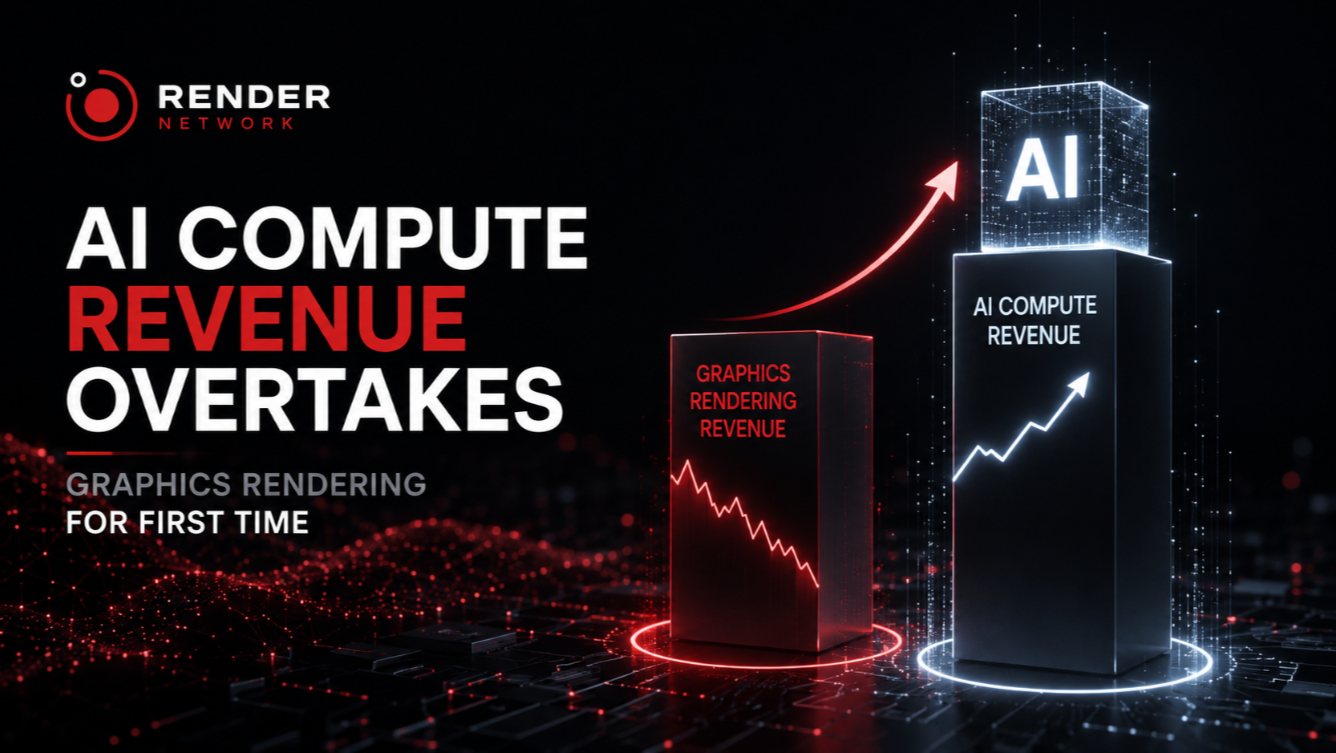
Render Network has quietly crossed an inflection point that most market observers missed until the April on-chain fee data landed. For the first time in the network's history, revenue from AI compute jobs — inference, fine-tuning, and training runs — exceeded revenue from the traditional 3D rendering workloads that the network was originally built to serve. The shift happened in March 2026 and was confirmed by April data showing the ratio at 53% AI to 47% graphics.
The inversion matters because it validates a strategic bet that Render's founders made in 2023: that the GPU supply constraints driving AI workload costs would eventually make a decentralized GPU marketplace economically competitive with hyperscaler cloud pricing. That bet has paid off — and the implications for RNDR tokenomics are starting to emerge in on-chain data.
See current RNDR price, staking data, and network metrics on the Render Network market page.
What Changed: The GPU Supply Story
The proximate cause of the AI revenue surge is GPU supply. NVIDIA H100 and H200 availability for cloud AI inference has remained constrained through Q1 2026. Major cloud providers — AWS, Google Cloud, Azure — have waiting lists for reserved GPU instances measured in weeks or months. That constraint forces mid-size AI companies and independent model developers to seek alternatives.
Render Network offers GPU time from a distributed network of node operators, priced in RNDR tokens. The effective hourly rate for H100-equivalent compute on Render ran approximately 15–25% below comparable AWS spot pricing over Q1 2026, according to an analysis by a DeFi research firm. That discount — plus faster availability — has attracted a cohort of buyers who would have defaulted to AWS a year ago.
The second factor is fine-tuning economics. Companies running recurring fine-tuning jobs on open-weight models (Llama 3, Mistral variants, and others) find that the cost differential compounds quickly at scale. A team running weekly 10,000-GPU-hour fine-tuning jobs saves $40,000–$80,000 per month at a 15% discount. Over a year, that is real infrastructure budget that shifts to Render.
Who Is Paying: The New Client Cohort
The traditional Render client was a 3D artist, a VFX studio, or an architectural visualization firm. Those clients remain — the 47% graphics revenue is not declining in absolute terms, just growing more slowly than AI. The new cohort looks different: AI application teams, model fine-tuners, research labs that need burst compute without procurement paperwork, and a small but growing segment of autonomous AI agents that spin up compute resources programmatically.
The last category — AI agents as compute buyers — is particularly interesting for long-term network economics. An agent that self-directs GPU purchasing does not negotiate SLAs or evaluate vendors by brand. It evaluates by price, latency, and availability, then routes workloads automatically to the cheapest qualifying option. Render's on-chain pricing and reputation system maps cleanly to the data inputs an autonomous procurement agent needs. Three agent teams have publicly disclosed using Render's API for automated GPU procurement.
RNDR Tokenomics: The Fee Revenue Mechanism
All Render Network jobs are denominated in RNDR. When a client pays for AI compute, they purchase RNDR, transfer it to the protocol's job contract, and it is released to node operators upon job completion. A burn mechanism destroys a portion of each job fee — currently 1% of gross job value. As AI revenue grows, the absolute burn rate scales with it.
The shift from graphics to AI changes the average job size. A complex 3D rendering job might cost $200–$500 in RNDR. An AI training run can cost $5,000–$50,000. Fewer jobs at higher ticket sizes means a higher burn per job, even if total job count stays flat. In Q1 2026, average job size increased 3.2x year-over-year, entirely explained by the AI cohort. The annualized burn rate is now estimated at 800,000–1.2 million RNDR, up from under 200,000 RNDR in 2024.
- AI compute revenue exceeded graphics revenue for the first time in March 2026 (53/47 split)
- Render priced 15–25% below AWS spot H100 rates through Q1 2026
- Average job size up 3.2x year-over-year, driven by AI training and fine-tuning jobs
- Estimated annualized RNDR burn now 800k–1.2M tokens, up from under 200k in 2024
- Autonomous AI agents beginning to procure Render compute programmatically
Risks: Centralization Pressure and GPU Depreciation
Success brings pressure. As AI compute revenue grows, Render faces demand from enterprise clients for SLA guarantees — specific uptime commitments, geographically redundant nodes, and data residency controls that a decentralized network of independent operators is structurally challenged to provide. If Render cannot satisfy enterprise SLA requirements, the addressable market for high-value AI contracts shrinks to the more price-sensitive tail.
GPU depreciation is a second structural risk. The rapid release cycle of new NVIDIA hardware means node operators' existing cards lose competitive pricing power every 12–18 months. Older GPUs get priced below the cost of electricity if newer hardware undercuts them on performance per dollar. Render's node operator churn rate and hardware vintage distribution are not publicly disclosed, but they are metrics that institutional AI buyers will scrutinize before committing large workloads to the network.
This article is information, not financial advice. Do your own research before investing.