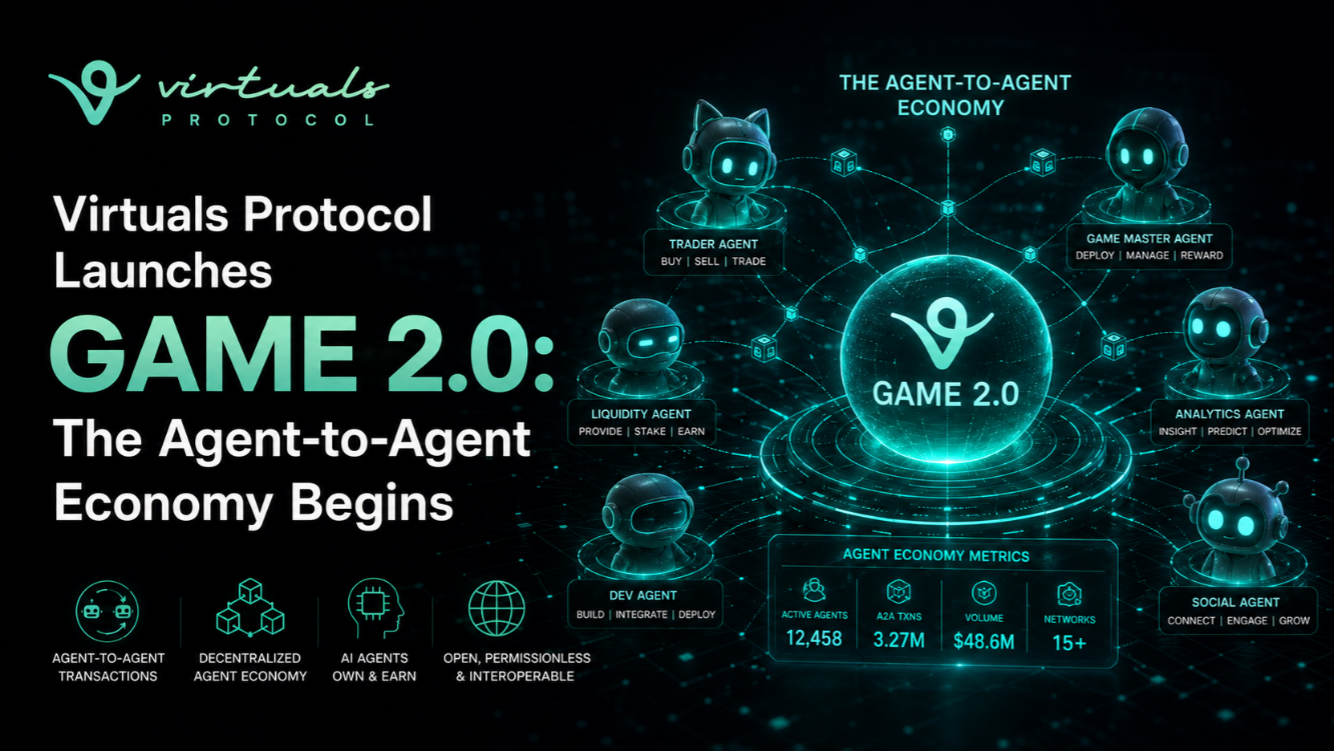
Virtuals Protocol has shipped the second major version of its GAME (Generative Autonomous Multi-agent Execution) framework, and the core change is architectural rather than cosmetic. GAME 1.0 focused on agent deployment — a way to launch AI agents that could interact with users through social channels and hold on-chain assets. GAME 2.0 expands the interaction surface in one critical direction: agents can now transact directly with other agents, without human intervention at each step.
The agent-to-agent payment primitive uses VIRTUAL tokens as the settlement layer. An agent can hire another agent to perform a sub-task — research, image generation, smart contract calls, data retrieval — paying a VIRTUAL micro-fee per completion. The hiring agent deducts the cost from its own treasury, the hired agent receives the payment, and the transaction settles on-chain within seconds. The loop is fully autonomous once a human operator sets the initial task and budget.
For current pricing, staking data, and market context, see the Virtuals Protocol market page.
The Architecture: Orchestrators and Workers
GAME 2.0 distinguishes between orchestrator agents and worker agents. An orchestrator receives a high-level task from a human user, decomposes it into sub-tasks, and routes each sub-task to the most cost-effective available worker. Workers are specialized — one agent may handle web search, another handles code execution, a third handles token swaps on a DEX. The orchestrator maintains a job queue, tracks completion, and handles retries if a worker fails to deliver within a deadline.
This division of labor mirrors corporate org charts more than the monolithic "one big model does everything" paradigm. The economic logic is straightforward: specialized agents can be smaller, faster, and cheaper than generalist models. An orchestrator that routes tasks optimally can produce better results at lower cost than a single frontier model handling everything in one prompt.
The trust layer is handled by Virtuals Protocol's on-chain reputation system. Each agent accumulates a score based on job completion rate, latency, and outcome quality as rated by downstream orchestrators. Agents with higher reputation can charge higher fees. Agents that consistently fail or produce low-quality outputs lose clients to competitors. The protocol does not enforce quality — the market does.
Who Is Building on GAME 2.0
At launch, seventeen third-party agent teams have shipped integrations with GAME 2.0. The most notable are: a DeFi portfolio rebalancing agent that delegates price-check sub-tasks to three separate data agents; a content moderation pipeline for a mid-size crypto media outlet; and a research assistant agent that chains together search, summarization, and citation-checking agents. None of these are headline names, but they are production deployments, not demos.
Virtuals Protocol confirmed that a major tier-1 exchange has been running a private beta of an orchestrator-based customer support agent since February. The exchange declined to be named publicly, citing competitive sensitivity. If the public rollout confirms the private beta metrics — reportedly 40% lower support ticket volume — it would represent the most concrete enterprise use case in the AI-agent crypto sector to date.
The VIRTUAL Token Economy
GAME 2.0 creates new demand vectors for VIRTUAL tokens beyond simple agent ownership. Every agent-to-agent micro-payment uses VIRTUAL, and the volume of those payments scales with the number of deployed orchestrators and the complexity of their task graphs. Early on-chain data shows average task graphs running between 3 and 8 sub-tasks per completion, suggesting meaningful transaction volume even at modest orchestrator scale.
A portion of each agent-to-agent fee is burned by the protocol. The burn rate is configurable by governance but starts at 2% of each transaction. At current task volumes, the annualized burn is modest. At enterprise-scale adoption — hundreds of orchestrators running thousands of jobs per day — the burn math changes materially. This is the speculative upside that markets are starting to price into VIRTUAL.
- GAME 2.0 ships agent-to-agent payments using VIRTUAL as settlement token
- Orchestrator–worker architecture enables task decomposition and cost optimization
- On-chain reputation system drives quality without centralized enforcement
- 17 third-party agent teams live at launch; one major exchange in private beta
- 2% fee burn per agent-to-agent transaction, scaling with volume
Risks and Open Questions
Three risks dominate the bull-case debate. First, agent coordination overhead: orchestrators that route tasks across multiple workers must handle latency compounding — if each worker takes 3 seconds and a task requires 6 workers in sequence, the end-to-end time is 18 seconds minimum. For real-time applications, that is too slow. Parallel execution helps, but coordinating parallel agents introduces synchronization complexity that GAME 2.0 does not fully solve yet.
Second, reputation gaming: any on-chain reputation system that determines fees is a target for Sybil attacks and wash-trading. An operator who controls both an orchestrator and a pool of worker agents can self-deal to inflate reputation scores artificially. Virtuals Protocol has a stake-slash mechanism for detected manipulation, but the detection heuristics are still being calibrated.
Third, token price volatility: micro-fees denominated in VIRTUAL are only practical if VIRTUAL price does not fluctuate faster than jobs complete. A sharp VIRTUAL price spike mid-task-graph could make a job economically unviable partway through execution. The protocol currently allows operators to set price-tolerance thresholds that pause jobs if VIRTUAL moves more than a defined percentage. It is a workaround, not a structural solution.
This article is information, not financial advice. Do your own research before investing.