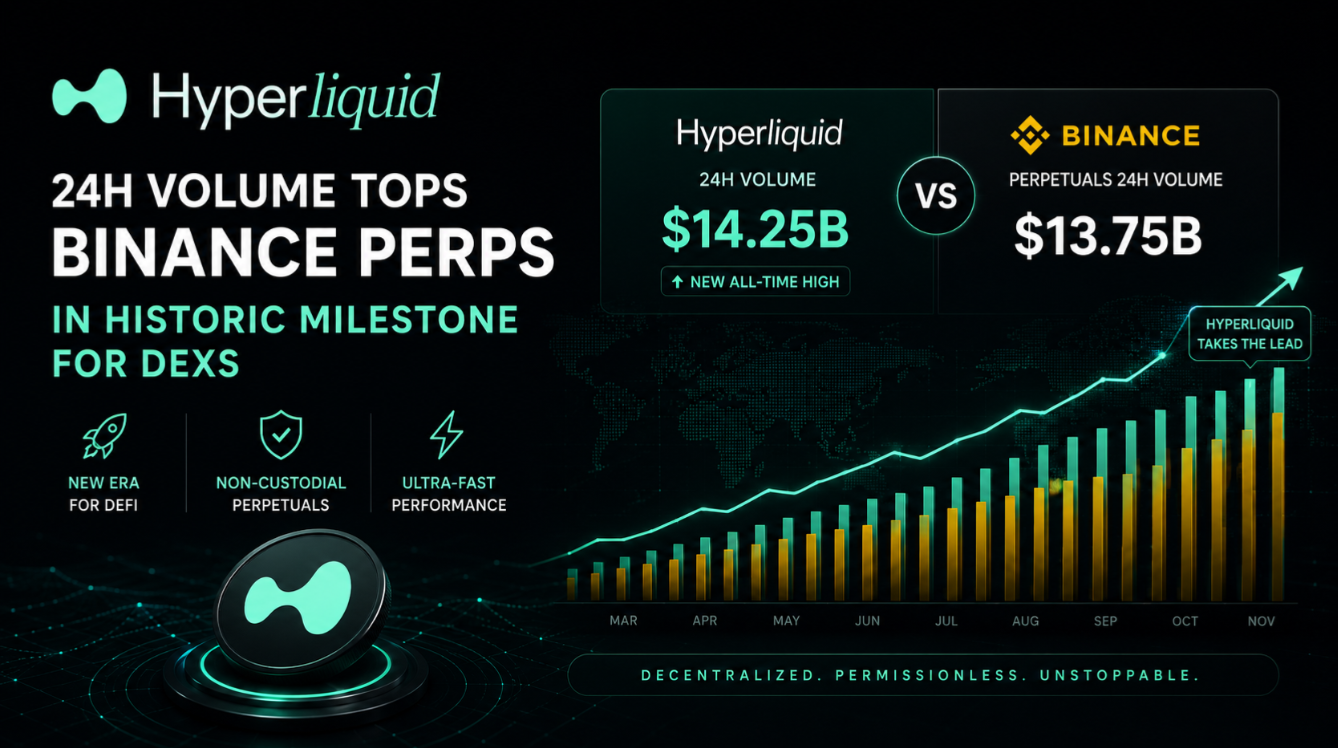
On April 14, 2026, Hyperliquid processed more than $18 billion in 24-hour perpetuals volume — surpassing Binance's derivatives platform for the first time in history. The milestone was not a flash-in-the-pan driven by a single token listing; it reflected months of structural momentum as non-custodial trading infrastructure crossed a quality threshold that made it genuinely competitive with the world's largest centralised exchange. For context on the broader exchange landscape, see the top exchange ratings or compare platforms individually at the Binance review.
What Made the Volume Crossover Possible
Hyperliquid launched its mainnet in 2023 as a vertically integrated Layer 1 designed exclusively for derivatives trading. Unlike most DEXs that bolt a perpetuals interface onto a general-purpose blockchain, Hyperliquid's consensus mechanism is optimised for order-book matching: blocks are produced every 400 milliseconds, enabling a centralised-exchange-like trading experience with on-chain settlement. The platform supports cross-margined portfolios, partial fills, and conditional orders — features that professional traders demand and that many earlier DEX perpetuals platforms lacked.
The second driver was the HYPE token airdrop in November 2024, one of the largest in DeFi history. The airdrop rewarded early traders with tokens worth several thousand dollars per eligible wallet, creating a massive word-of-mouth referral effect and depositing real economic value into the community. Unlike many airdrops that generate a short-term pop followed by dumping, HYPE maintained significant value because the protocol generates real fee revenue distributed to stakers.
Third, the regulatory environment worked in Hyperliquid's favour. Several major jurisdictions tightened rules on offshore centralised exchanges in 2025, restricting leverage or requiring local entity registration. Traders who faced reduced limits on regulated CEX platforms found Hyperliquid a straightforward alternative: no KYC, no leverage caps enforced by a compliance team, and full self-custody of funds.
Architecture: How Hyperliquid Achieves CEX-Level Performance
Hyperliquid's HyperBFT consensus protocol achieves finality in under one second by design. The validator set — currently around 20 permissioned validators — is smaller than fully decentralised networks, which critics note is a centralisation trade-off. However, the team has published a roadmap to expand and permissionlessly open the validator set as the network matures.
The matching engine runs in a specialised execution environment separate from the broader EVM layer, allowing the order book to process thousands of updates per second without congestion from unrelated smart contract activity. Liquidations are handled on-chain by a Dutch auction mechanism that minimises slippage and protects the insurance fund, which has accumulated over $400 million in USDC from fee allocations.
- Block time: ~400ms (HyperBFT consensus)
- Supported markets: 130+ perpetuals pairs
- Maximum leverage: 50x on BTC/ETH, up to 20x on altcoins
- Insurance fund: $400M+ USDC (April 2026)
- On-chain fee revenue shared with HYPE stakers: ~$2.1M/day at peak
Binance's Response and the Competitive Landscape
Binance has not been passive. In March 2026, it announced an accelerated development roadmap for its own decentralised exchange on BNB Chain, targeting sub-second finality and a perpetuals interface. The timing is not coincidental: Binance has significant engineering resources and could replicate Hyperliquid's core technical stack given sufficient priority.
The broader competitive picture for DEX perpetuals is crowded. dYdX v4, GMX v2, Vertex Protocol, and Drift Protocol on Solana all compete for the same non-custodial derivatives market. However, Hyperliquid's first-mover advantage in genuine order-book DEX performance — as opposed to AMM-based perpetuals — gives it a category lead that would take years to meaningfully erode. Traders interested in the full CEX perpetuals comparison can also review Bybit and Kraken for regulated alternatives.
Implications for the Future of Decentralised Trading
The volume crossover matters beyond bragging rights. It demonstrates that on-chain settlement is no longer a fundamental barrier to professional trading. Once the market accepts that DEX infrastructure can handle institutional order flow, the pressure on centralised exchanges to justify their custody risk becomes structural rather than theoretical.
For regulators, it poses a new challenge: how to apply consumer protection frameworks to permissionless protocols that exist outside any jurisdiction. For traders, it offers genuine choice between custodial convenience and non-custodial security. And for the crypto ecosystem at large, it validates the thesis that DeFi can eventually absorb financial functions that currently require trusted intermediaries.
Traders evaluating Hyperliquid alongside centralised alternatives can find a detailed comparison of fees, liquidity, and security at the Hyperliquid review.