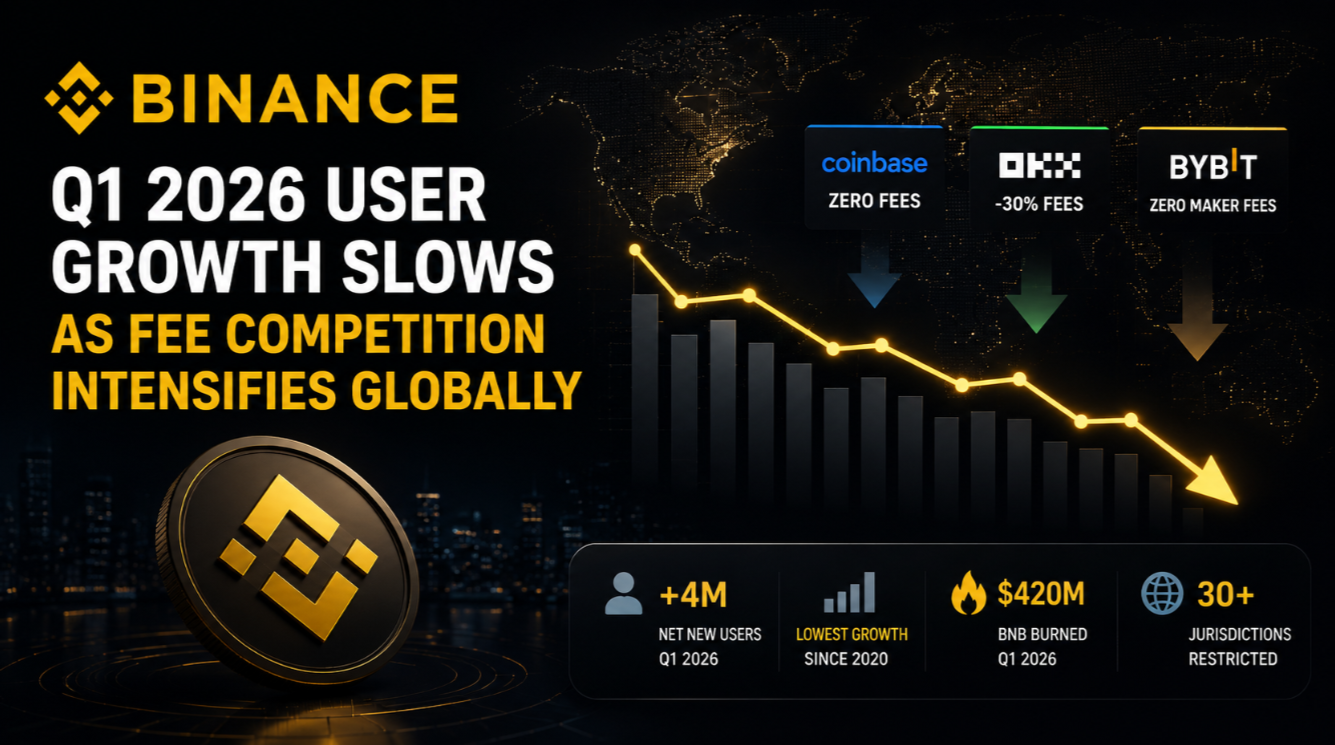
Binance entered 2026 facing a more competitive landscape than at any point in its eight-year history. Internal metrics leaked to industry publications and corroborated by on-chain data analytics show Q1 2026 user growth at its lowest quarterly rate since 2020 — approximately 4 million net new registered users versus 15-20 million per quarter at the 2021-2022 peak. For traders evaluating whether Binance remains the right platform for their needs, the Binance review and exchange ratings provide current comparisons.
Mapping the Competitive Pressures
Three distinct competitive forces are converging on Binance simultaneously. The first is regulatory attrition: the November 2023 DOJ settlement and subsequent compliance transformation under CEO Richard Teng required Binance to exit or restrict services in more than 30 jurisdictions, cutting off access for users who were not willing or able to complete enhanced KYC. The addressable market shrinkage is structural — recovering lost users in restricted jurisdictions requires new regulatory licences that take years to obtain.
The second pressure is fee competition. Coinbase launched a zero-fee promotion for its international derivatives platform in Q4 2025; OKX reduced spot fees by 30% across the board in January 2026; Bybit extended its zero-maker-fee programme permanently for top 100 trading pairs. Binance responded with a selective fee reduction programme for BNB stakers but has not made across-the-board cuts, defending gross margin at the cost of market share at the margin.
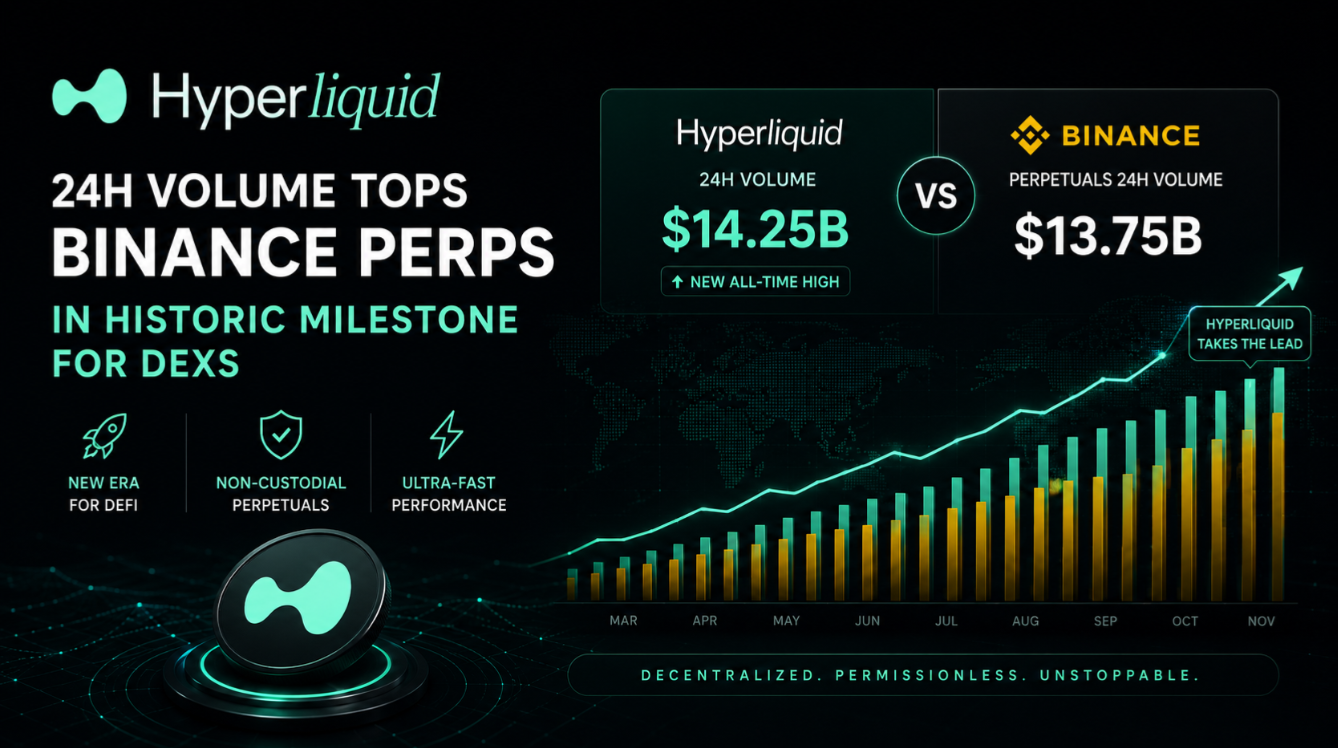
The third pressure is DEX cannibalisation. As the Hyperliquid volume milestone demonstrated (see story above), sophisticated traders increasingly prefer non-custodial perpetuals for larger positions. These users tend to be high-frequency, high-volume traders — disproportionately valuable in terms of fee revenue relative to user count. Losing them to DEXs compresses Binance's revenue per active user even if registered user counts stay stable.
BNB Chain as a Hedge Against Exchange Market Share Loss
Binance's most strategically important response to exchange-level pressure is the continued growth of BNB Chain. If users migrate from Binance's CEX to Hyperliquid or Coinbase International for derivatives, but continue using PancakeSwap, Venus Protocol, or Binance-integrated DeFi apps on BNB Chain, Binance retains economic exposure to their trading activity through BNB's fee burn mechanism and ecosystem fund returns.
BNB Chain processed approximately $4.2 billion in monthly DEX volume in Q1 2026, ranking third globally behind Ethereum L2s and Solana. The chain's low fees and Binance ecosystem integration give it a sticky user base among retail DeFi participants who are price-sensitive. However, BNB Chain's DeFi TVL has been relatively flat at $5-6 billion for over a year, indicating that it has not meaningfully captured the institutional DeFi migration that has benefited Ethereum and Solana ecosystems.
Product Innovation: Structured Products and Copy Trading
To defend average revenue per user, Binance has expanded into higher-margin product categories. Its copy trading feature — allowing retail users to mirror the positions of verified top traders — reached 8 million users in Q1 2026 with take rates generating meaningful incremental fee revenue. Structured products (principal-protected notes, dual-currency investments, shark-fin products) now account for an estimated 12% of Binance's non-trading revenue.
The prediction markets product launched in late 2025 attracted 2.3 million participants in its first quarter, leveraging the broader trend of on-chain prediction markets popularised by Polymarket and Kalshi. Binance's version is custodial and requires KYC, limiting its appeal to users who prefer permissionless alternatives, but its integration with the main exchange interface lowers friction for existing users.
- Copy trading users: 8M+ (Q1 2026)
- Structured products AUM: ~$3.4 billion
- Prediction market participants: 2.3M
- Binance Earn TVL: ~$18 billion (staking, savings, liquidity)
- BNB burned in Q1 2026: ~$420M equivalent
The Road Ahead: Can Binance Maintain Dominance?
Binance's position is challenged but far from precarious. Its liquidity network effects remain enormous: with 45% market share across CEX spot volume, Binance offers the tightest spreads and deepest books for most trading pairs, a self-reinforcing advantage that new entrants struggle to replicate. Its P2P marketplace is unmatched in volume and geographic coverage, particularly in markets where banking infrastructure is limited.
The more relevant long-term question is whether centralised exchange market share itself will decline as DEX infrastructure matures. If 2026 marks the year DEX perpetuals reached parity with CEX performance for professional traders, the structural trend may be toward a multi-venue world where no single centralised exchange dominates as thoroughly as Binance did in 2019-2022.
Traders seeking independent assessments of Binance's current strengths and weaknesses can read the full Binance review, compare it with Coinbase, Kraken, and Bybit, or view ranked comparisons at the exchange ratings hub.