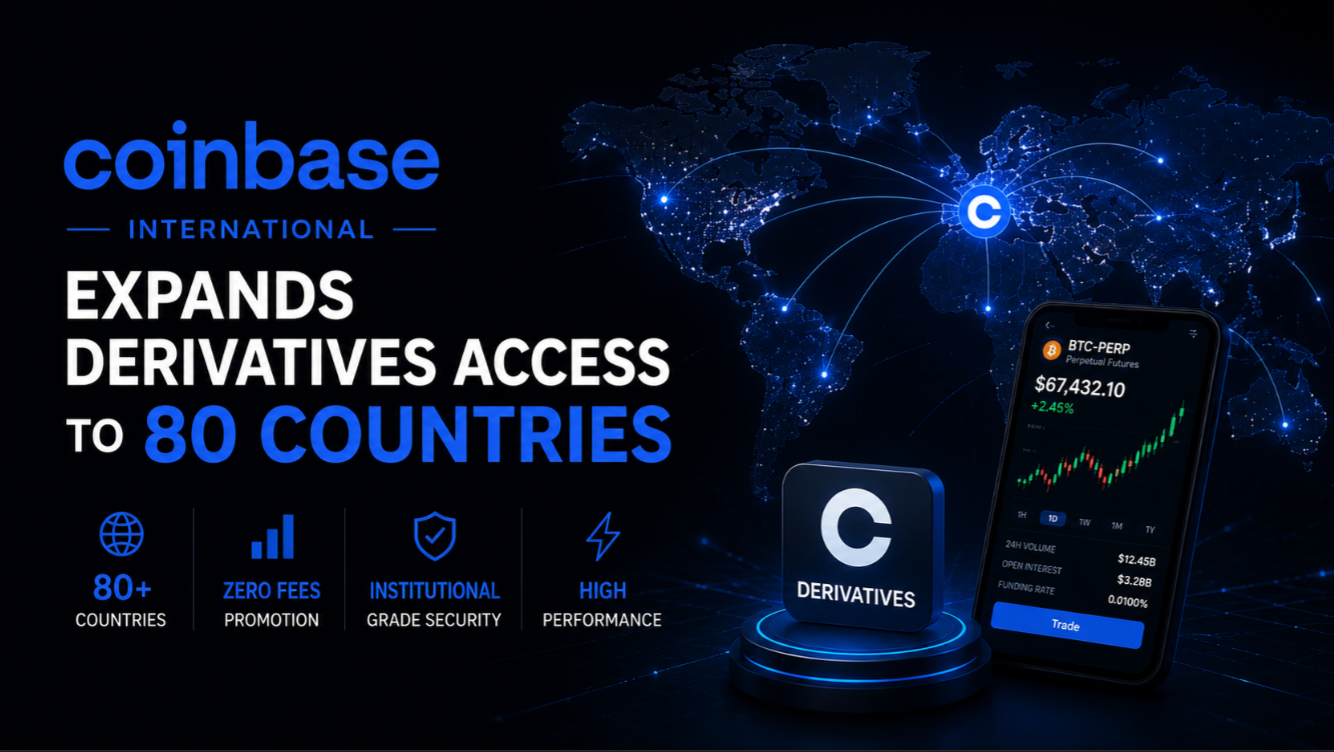
Coinbase International Exchange announced in April 2026 that its regulated perpetuals trading platform is now accessible to users in 80 countries — roughly a third of the world's recognised jurisdictions. The expansion, phased over the past 18 months, positions Coinbase as the broadest-reach fully regulated crypto derivatives venue globally, a meaningful competitive challenge to Binance's long-standing international dominance. For a full breakdown of how the platform compares, see the Coinbase review and the exchange ratings page.
The Strategic Logic Behind Coinbase International
Coinbase's domestic US business faces structural headwinds: regulatory uncertainty over which crypto assets are securities, limited ability to offer high-leverage products to retail clients, and intense competition from Robinhood and emerging retail platforms in the ETF era. The international derivatives market, by contrast, is large, growing, and less constrained by US-specific compliance burdens.
Binance processes over $30 billion in perpetuals volume daily across its international user base — a market Coinbase has historically not participated in meaningfully. By standing up a Bermuda-licensed entity with MiCA authorisation in the EU and bilateral agreements in major emerging markets, Coinbase gains access to this revenue stream while maintaining the compliance pedigree that differentiates it from offshore-registered competitors.
The timing is also strategic relative to regulatory trends. Binance settled with US authorities in 2023 under conditions that restrict its US operations. OKX faces ongoing regulatory scrutiny in multiple jurisdictions. Bybit relocated its headquarters multiple times in response to regulatory pressure. Coinbase's fully transparent public company structure — with quarterly SEC filings and detailed risk disclosures — offers an institutional credibility that privately-held competitors cannot match.
What the 80-Country Expansion Includes
The expansion covers perpetual futures on Bitcoin, Ethereum, and approximately 50 additional crypto assets including major altcoins, DeFi tokens, and Layer 1 protocols. Maximum leverage varies by jurisdiction and asset: EU users face a 10x cap on major assets under MiCA guidelines, while users in less restrictive jurisdictions can access up to 20x leverage. Cross-margin and portfolio margin modes are available for institutional accounts.
- EU (27 countries) — MiCA licence, 10x leverage cap for retail
- UK — FCA temporary registration, 2x retail leverage (pending full authorisation)
- Australia — ASIC-regulated, up to 10x leverage
- Singapore — MAS licence, institutional traders only
- Brazil + 12 Latin American countries — local partnership model
- South Africa, Nigeria, Kenya — emerging market pilot programme
- Southeast Asia (Thailand, Indonesia, Philippines, Vietnam) — new in April 2026
The platform also introduced a localised fiat on-ramp programme in 15 countries, allowing users to deposit local currency via bank transfer or mobile money networks. This removes the friction of acquiring USDC through a third party before trading — a meaningful barrier to adoption in markets where stablecoin infrastructure is still developing.
Institutional Features That Drive the Expansion
Coinbase International's institutional infrastructure includes prime brokerage services, co-location API access for algorithmic traders, and direct connectivity to Coinbase Prime custody. For asset managers running multi-venue strategies, the ability to trade derivatives on the same platform that holds custody of the underlying assets significantly simplifies operational workflows and collateral management.
Sub-account management allows institutional clients to segregate trading books by strategy, fund, or risk limit without maintaining separate exchange accounts. Real-time risk monitoring dashboards provide position-level PnL, margin utilisation, and liquidation price data in formats compatible with standard portfolio management systems.
The exchange's market-making programme has attracted over 40 registered liquidity providers as of April 2026, ensuring tight spreads on major pairs during peak trading hours. This depth of book is comparable to Binance and Bybit for top-tier pairs, though smaller altcoin markets remain thinner.
Compliance Architecture: Coinbase's Competitive Moat
Where Coinbase International most clearly differentiates itself is compliance infrastructure. The platform maintains full KYC/AML on all accounts, real-time transaction monitoring, and automated reporting pipelines to 23 financial intelligence units across its operating jurisdictions. For institutional traders who are themselves regulated — banks, fund managers, pension funds — this compliance coverage is not optional; it is required by their own internal policies.
The MiCA authorisation from the EU is particularly significant. Under MiCA, any crypto asset service provider authorised in one EU member state can passport services across all 27 members — giving Coinbase International access to 450 million potential users through a single regulatory approval. Competitors without MiCA licences face higher compliance costs to serve EU users after the regulation's full implementation.
Traders comparing regulatory environments across major platforms can find detailed jurisdiction breakdowns at the exchange ratings page alongside reviews of Binance, Bybit, and Kraken.