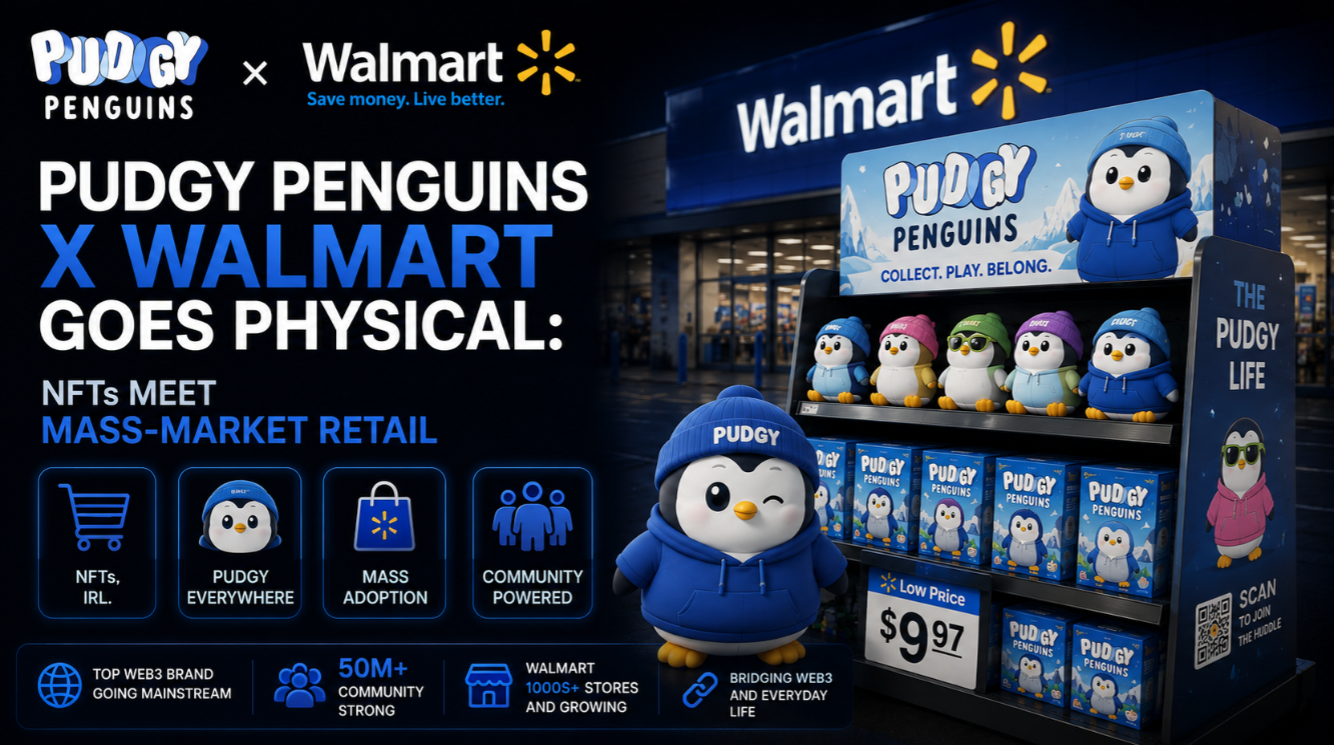
Pudgy Penguins, the Ethereum-based NFT collection launched in 2021 that survived the bear market through community-driven reinvention, has announced the second wave of its physical toy collaboration with Walmart. The partnership — which began in late 2023 — has now scaled to over 4,000 Walmart locations across the United States and expanded internationally to Canada and selected European markets. It represents the most ambitious and commercially validated physical-digital NFT crossover executed to date.
How the Walmart Partnership Works
Each Pudgy Penguin plush toy sold in Walmart includes a unique QR code that links to an on-chain "Pudgy World" digital identity. The physical toy's traits — accessory color, outfit, expression — correspond to a verifiably unique digital collectible minted on Ethereum L2. Buyers who do not hold a Pudgy Penguin NFT can still access a Pudgy World experience through the toy link, creating an on-ramp to blockchain interaction for consumers who have never owned a crypto wallet.
The second wave introduces "Dynamic Penguin" toys whose on-chain digital counterpart evolves based on user interaction in the Pudgy World mobile app. Toy owners earn in-game items, cosmetics, and event access that update the on-chain digital identity over time. This creates an ongoing engagement loop that justifies repeat purchases and drives Pudgy World's daily active user metrics.
Sales Numbers and Commercial Validation
Pudgy Penguins has not disclosed exact unit volumes, but Walmart's toy buyer has publicly described the line as "materially outperforming" initial projections in restocking cadence and sell-through rates. Third-party estimates based on Walmart POS data (via Placer.ai and similar retail analytics) suggest over 600,000 units sold across both waves. At an average retail price of $14.99, that represents approximately $9 million in gross merchandise value — a scale that rivals mid-tier established toy IP launches.
The commercial success has driven floor price appreciation for Pudgy Penguin NFTs directly. Holders benefit from royalty flows, brand visibility in mainstream retail, and increased scarcity narrative as non-NFT buyers onboard into the ecosystem and some convert to full NFT ownership.
The Blockchain Layer: Ethereum and Abstract Chain
Pudgy World runs on Abstract Chain, an Ethereum L2 built by the Igloo Inc. team (Pudgy Penguins' parent company). Abstract uses ZK-rollup technology to provide near-zero gas fees for in-game interactions while inheriting Ethereum's security guarantees. The physical toy's linked digital identity is minted on Abstract, with provenance anchored to Ethereum mainnet for permanent record.
This architecture illustrates a broader trend: consumer-facing applications migrating to purpose-built L2s to eliminate gas friction, while maintaining L1 settlement for ownership records. The approach is similar to how gaming projects use Immutable X or Ronin for in-game asset management while anchoring to Ethereum for withdrawal and secondary market settlement.
What the Walmart Deal Means for NFT Mainstream Adoption
The Pudgy Penguins-Walmart deal is significant beyond its commercial metrics. It demonstrates a viable product structure for introducing blockchain ownership to mass-market consumers without requiring them to understand wallets, gas fees, or private keys. The toy is the primary product; the on-chain component is an enhancement that creates stickiness and repeat engagement.
This "physical first, digital layer second" model avoids the UX barriers that killed most previous NFT consumer products. It also addresses a fundamental challenge: most NFT projects tried to sell digital scarcity to a market that did not understand or value it. Pudgy Penguins sold a $15 toy to a parent in a Walmart toy aisle and delivered the digital collectible as a bonus — radically lowering the acquisition and education barriers.
NFT Market Implications: Royalties, Brand Value, and Holder Benefits
For NFT holders and traders, the Walmart deal creates a template for evaluating NFT project fundamentals beyond floor price. Collections with real-world brand licensing potential, physical product revenue, and consumer market distribution represent a fundamentally different risk-reward profile than pure speculative PFP projects.
Collectors tracking similar physical-digital opportunities should watch ApeCoin (APE), whose ecosystem includes the Ape Foundation's licensing operations and metaverse ambitions — though Yuga's execution on physical products has lagged behind Pudgy's Walmart success. For trading Pudgy Penguin NFTs and other blue-chip collections, our OpenSea review and Blur NFT market data pages cover platform selection, royalty policies, and liquidity depth. See also our full NFT marketplace ratings for a ranked comparison of where to trade physical-linked NFT collections.
Conclusion
Pudgy Penguins has built something rare in the NFT space: a collection with genuine mainstream commercial traction and a product model that does not depend on crypto-native buyers to sustain demand. The Walmart expansion validates the "physical-digital" bridge strategy and sets a benchmark that other NFT projects will struggle to replicate without comparable brand recognition, product design capability, and retail distribution relationships. It is the most significant NFT mainstream-adoption milestone since the Christie's Beeple sale.