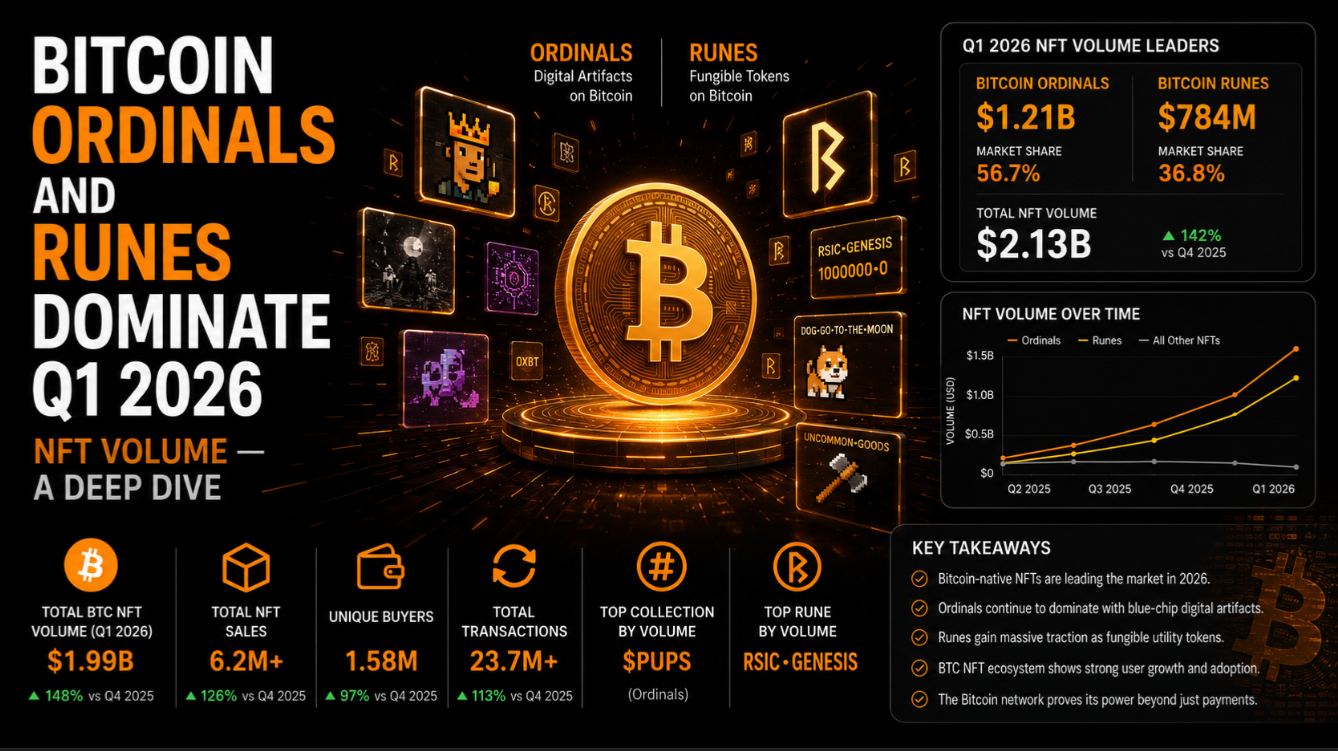
When Casey Rodarmor inscribed the first Ordinal on the Bitcoin blockchain in January 2023, most NFT market participants dismissed it as a technical curiosity that would never compete with Ethereum's rich smart contract ecosystem. Three years later, Bitcoin Ordinals and the Runes protocol together accounted for nearly 22% of global NFT-adjacent on-chain volume in Q1 2026 — a figure that demands serious attention.
What Are Bitcoin Ordinals?
Ordinals work by inscribing arbitrary data — images, text, video, code — directly onto individual satoshis (the smallest Bitcoin denomination). Each inscription is permanently recorded on the Bitcoin base layer, inheriting Bitcoin's security and immutability with no smart contract required. The "ordinal theory" assigns a unique serial number to every satoshi based on mining order, enabling NFT-like scarcity and provenance.
Because inscriptions live on Bitcoin L1, they benefit from the deepest security budget in crypto and are accessible to any wallet that understands the Ordinals protocol. There are no bridges, no wrapped tokens, and no smart contract risk — properties that strongly appeal to Bitcoin maximalists and long-term hodlers who previously rejected NFTs as an "Ethereum thing."
Runes: Fungible Tokens Native to Bitcoin
The Runes protocol, launched at Bitcoin's April 2024 halving block, introduced a more efficient fungible token standard on Bitcoin. Unlike earlier BRC-20 tokens (which relied on JSON inscriptions and were expensive to process), Runes use a more compact OP_RETURN-based model. Each Rune issuance or transfer is a standard Bitcoin transaction, enabling higher throughput and lower fees.
While Runes are fungible (not NFTs in the strict sense), they compete for the same block space as Ordinals and contribute to the fee market that secures the Bitcoin network. The halving-launch timing made Runes the dominant driver of Bitcoin's record fee day in April 2024, briefly pushing average transaction fees above $100. In 2026, Runes activity has normalized but remains a consistent contributor to Bitcoin block demand.
Top Ordinals Collections by Volume: Q1 2026
- NodeMonkes — floor ~0.18 BTC, cumulative volume 2,400 BTC
- Quantum Cats — floor ~0.14 BTC, cumulative volume 1,950 BTC
- Bitcoin Puppets — floor ~0.09 BTC, cumulative volume 1,100 BTC
- OMB (Ordinal Maxi Biz) — floor ~0.07 BTC, cumulative volume 890 BTC
- Runestones — floor ~0.06 BTC, cumulative volume 810 BTC
These collections trade primarily on Magic Eden's Bitcoin Ordinals marketplace and on the dedicated Ordinals marketplaces Gamma.io and OKX's NFT platform. Magic Eden review covers fee structure, royalty policy, and liquidity depth for Ordinals trading in detail.
Why Bitcoin NFTs Appeal to a Different Collector
Bitcoin Ordinals attract a collector type that rarely participates in Ethereum NFT markets. The typical Ordinals buyer has a longer BTC investment horizon, is more skeptical of smart contract complexity, and views inscription-based ownership as more permanent and censorship-resistant. The cultural narrative around Bitcoin scarcity — 21 million coins, fixed supply forever — maps naturally onto limited-edition digital art.
This demographic diversifies the NFT market meaningfully. Ordinals buyers are less correlated with Ethereum gas price cycles and DeFi liquidity conditions, which historically synchronized NFT demand with ETH price movements. A multi-chain, multi-demographic NFT market is more resilient to single-chain shocks.
Challenges: UX, Custody, and Liquidity Fragmentation
Bitcoin Ordinals are not without friction. UTXO management — ensuring inscribed satoshis are not accidentally spent as regular BTC — requires specialized wallet support. Hardware wallet compatibility is limited, and the developer tooling ecosystem is far less mature than Ethereum's. Liquidity is also more fragmented, with multiple competing marketplaces lacking a unified order book.
These UX gaps are closing. Wallets like Xverse, Leather, and Unisat have invested heavily in Ordinals-aware UTXO handling, and cross-marketplace aggregation is improving. As tooling matures, the gap between Bitcoin and Ethereum NFT collector experiences will narrow. Our NFT marketplace ratings tracks which platforms support Bitcoin Ordinals trading and how their UX compares.
Implications for the Broader NFT Market
Bitcoin's 22% volume share in Q1 2026 has significant implications. It validates the multi-chain future of NFTs, reduces Ethereum's de facto monopoly on digital ownership, and introduces a permanently scarce base layer as a canvas for digital art. For collectors and traders, it expands the opportunity set. For Ethereum-based projects, it introduces real competition for collector mindshare and capital.
The Ordinals phenomenon also raises important questions about Bitcoin's identity. Some miners welcome the fee revenue; some Bitcoin maximalists oppose "polluting" the base layer with non-monetary data. This philosophical tension will shape Bitcoin NFT policy debates as the ecosystem matures — and could influence protocol decisions around block size and data storage in future soft forks.