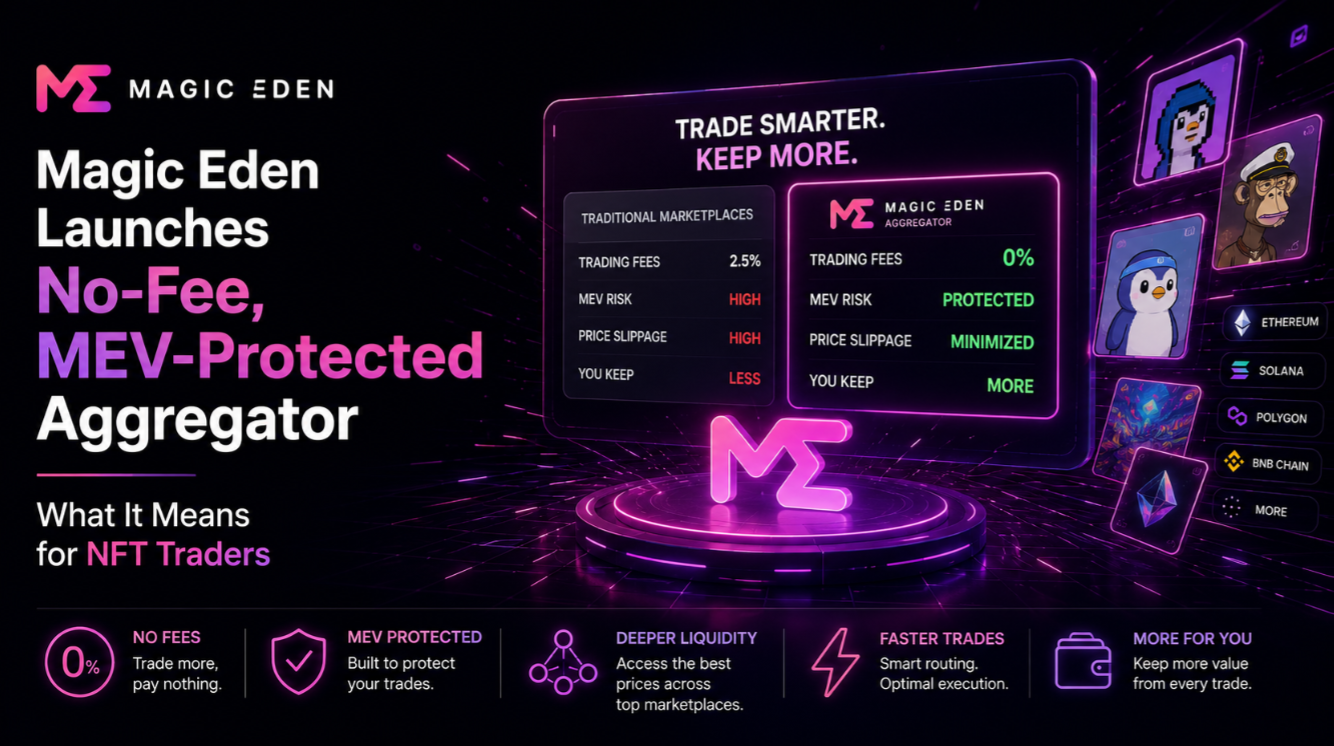
Magic Eden, the multi-chain NFT marketplace that built its reputation on Solana before expanding aggressively to Ethereum and Bitcoin Ordinals, has launched what it describes as a zero-platform-fee, MEV-protected aggregator. The product targets professional traders and serious collectors who have been frustrated by the combination of marketplace fees and sandwich attacks that inflate the effective cost of NFT trading. Here is a detailed breakdown of what Magic Eden has actually shipped and what it means in practice.
What Is MEV in NFT Trading?
Maximal Extractable Value (MEV) in NFT markets refers to the profit bots and validators can extract by reordering, inserting, or censoring transactions in a block. In the NFT context, the most common form is front-running: when a profitable NFT trade (such as buying a Punk listed below floor or sniping a newly listed rare) is detected in the mempool, a bot submits a competing transaction with a higher gas bid to execute first.
Front-running and sandwich attacks on NFT transactions can cost collectors hundreds to thousands of dollars per trade at floor prices above 10 ETH. MEV protection routes transactions through private mempools or uses commit-reveal schemes that hide transaction intent until block inclusion is guaranteed, preventing bots from profiting at the trader's expense.
What Magic Eden Shipped
- Zero platform fee on all trades routed through the new aggregator interface
- Private mempool routing via Flashbots Protect for Ethereum-based collections
- Commit-reveal order submission on Solana to prevent front-running
- Unified order book aggregation across OpenSea, Blur, LooksRare, and Magic Eden's own liquidity
- Bulk buy and sell tools with gas optimization for multi-item transactions
- Real-time rarity and floor deviation scoring embedded in the browsing interface
The zero-fee model is supported by Magic Eden's token-based business model and exchange revenue. The platform retains maker-taker fees on its own native liquidity but does not charge an additional aggregation premium on orders routed from third-party marketplaces. This mirrors the approach Blur NFT used to rapidly gain market share from OpenSea in 2022-2023.
How MEV Protection Actually Works
For Ethereum collections, Magic Eden routes purchase transactions through Flashbots' MEV Blocker RPC by default. This sends transactions to a set of trusted block builders who have agreed not to front-run or sandwich the order. The transaction remains hidden from the public mempool until it is included in a block, eliminating the visibility window that bots exploit.
On Solana, the architecture differs because Solana's transaction processing model is not mempool-based in the same way. Magic Eden uses a commit-reveal scheme: the trader's intent is committed as an encrypted hash, the block producer includes the commitment, and the reveal is executed atomically in the next slot. This effectively prevents any observer from acting on the trade intent before execution.
Who Benefits Most
MEV protection and zero fees are most valuable to:
- Collectors buying above 5 ETH floor — where sandwich attack losses are material
- Snipe traders who need guaranteed execution on underpriced listings
- Bulk buyers purchasing 5+ items in a single transaction
- Institutional acquirers building significant positions in blue-chip collections
- Solana NFT traders whose fast block times made front-running a persistent annoyance
Casual collectors buying single low-value items will see smaller absolute benefits, but the zero-fee structure still reduces their per-trade cost meaningfully. For context, a standard 2.5% OpenSea fee on a 1 ETH purchase represents $35 at current prices — a meaningful saving repeated over dozens of trades.
Competitive Response Expected
Magic Eden's launch puts direct pressure on Blur and OpenSea to respond. Blur has maintained zero fees for takers but charges creators variable royalties. OpenSea recently reduced its fee to 0.5% but has not matched zero. The aggregator arms race benefits collectors directly in the near term, but raises sustainability questions: if all platforms converge on zero fees, where does the revenue come from?
Our full Magic Eden review covers fee structure, supported chains, royalty policy, creator tools, and how the platform compares to alternatives. For a side-by-side comparison of all major NFT marketplaces, see our NFT marketplace ratings.
Conclusion
Magic Eden's no-fee, MEV-protected aggregator raises the bar for what collectors should expect from NFT marketplace infrastructure. MEV protection addresses a real and under-discussed cost that has silently taxed serious collectors for years. Combined with zero fees and multi-chain aggregation, it positions Magic Eden as the most technically sophisticated platform currently available to professional NFT traders — and forces competitors to respond.