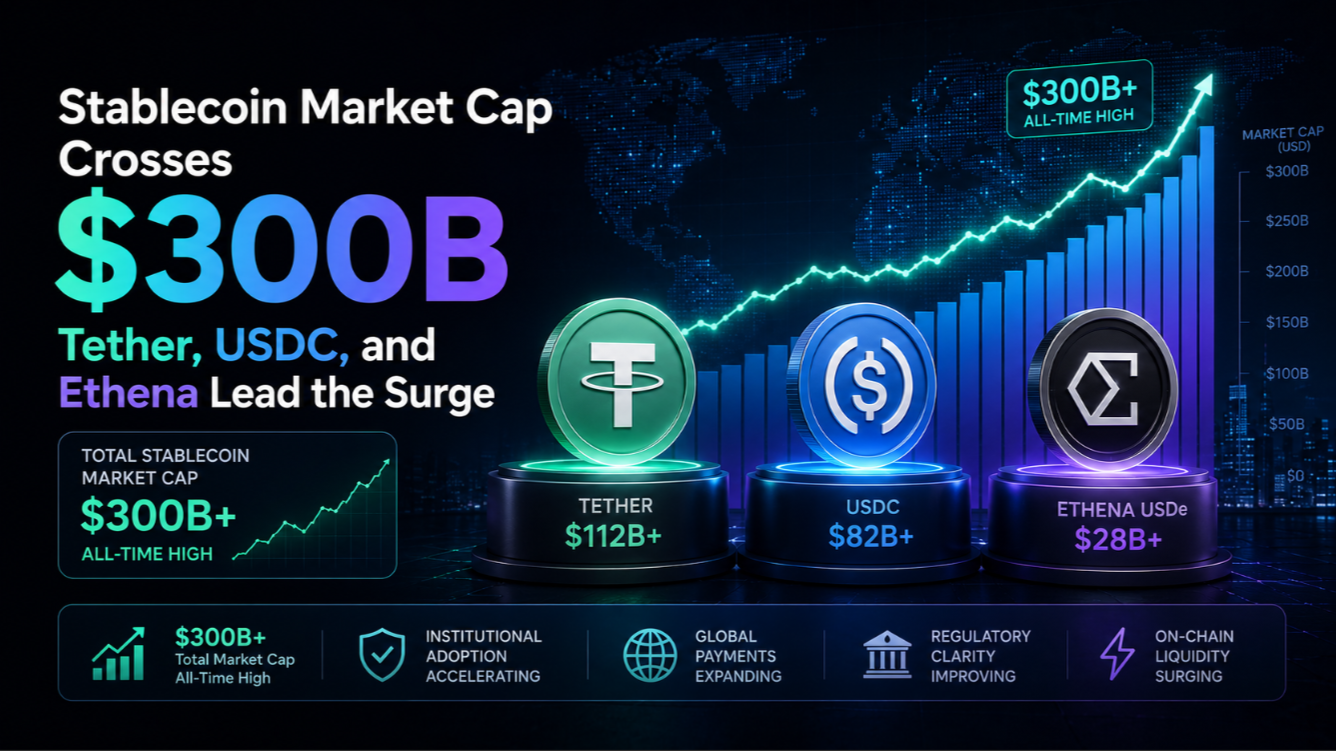
The combined market capitalisation of all stablecoins has crossed $300 billion for the first time in history, cementing their status as the payments layer of the crypto economy. The milestone, reached in April 2026, reflects surging demand from retail users, institutional treasuries, and on-chain DeFi protocols alike. Three issuers — Tether, Circle, and Ethena — account for more than 90 % of the total supply.
A $300 Billion Payments Rail
The stablecoin market has more than doubled since the start of 2025, when the combined cap sat near $140 billion. The acceleration is driven by a convergence of factors: regulatory clarity in the United States following the GENIUS Act, surging cross-border payment volumes, and a wave of institutional adoption that has seen Fortune 500 companies add dollar-pegged tokens to their treasury operations.
Daily on-chain stablecoin transfer volume now regularly exceeds $50 billion — surpassing Visa and Mastercard combined on their peak settlement days. This is no longer a crypto-native phenomenon; major banks and payment processors are actively building integrations with stablecoin rails to cut correspondent-banking costs and settlement latency.
Tether: Still the Undisputed Giant
Tether (USDT) retains its position as the dominant stablecoin with a market cap above $145 billion, representing roughly 48 % of the total. Tether's grip on the market is reinforced by its deep liquidity across more than 70 blockchains, near-universal acceptance on centralised exchanges, and its role as the primary settlement currency across emerging markets in Asia, Latin America, and Africa.
Tether reported $7.1 billion in net profit for 2025, making it one of the most profitable financial entities in the world per employee. The company holds U.S. Treasury bills as the primary reserve asset, with a current reserve ratio exceeding 100 %. Critics continue to call for a full third-party audit, but institutional demand has shown little sensitivity to that concern.
USDC: The Institutional-Grade Challenger
USD Coin (USDC) has grown its market cap to approximately $62 billion, benefiting from Circle's IPO preparations and its regulated status under MiCA in Europe. Unlike Tether, Circle publishes weekly reserve attestations and maintains strict compliance with U.S. money-transmission laws — a posture that appeals to banks, asset managers, and fintech platforms operating in regulated markets.
USDC is now the stablecoin of choice on institutional DeFi platforms, RWA tokenisation protocols, and cross-border B2B payment networks. Its integration with Coinbase — you can read our full exchange review at Coinbase review — gives it unmatched distribution to retail Americans, while its MiCA approval opens the European corridor.
Ethena USDe: The Fastest-Growing Newcomer
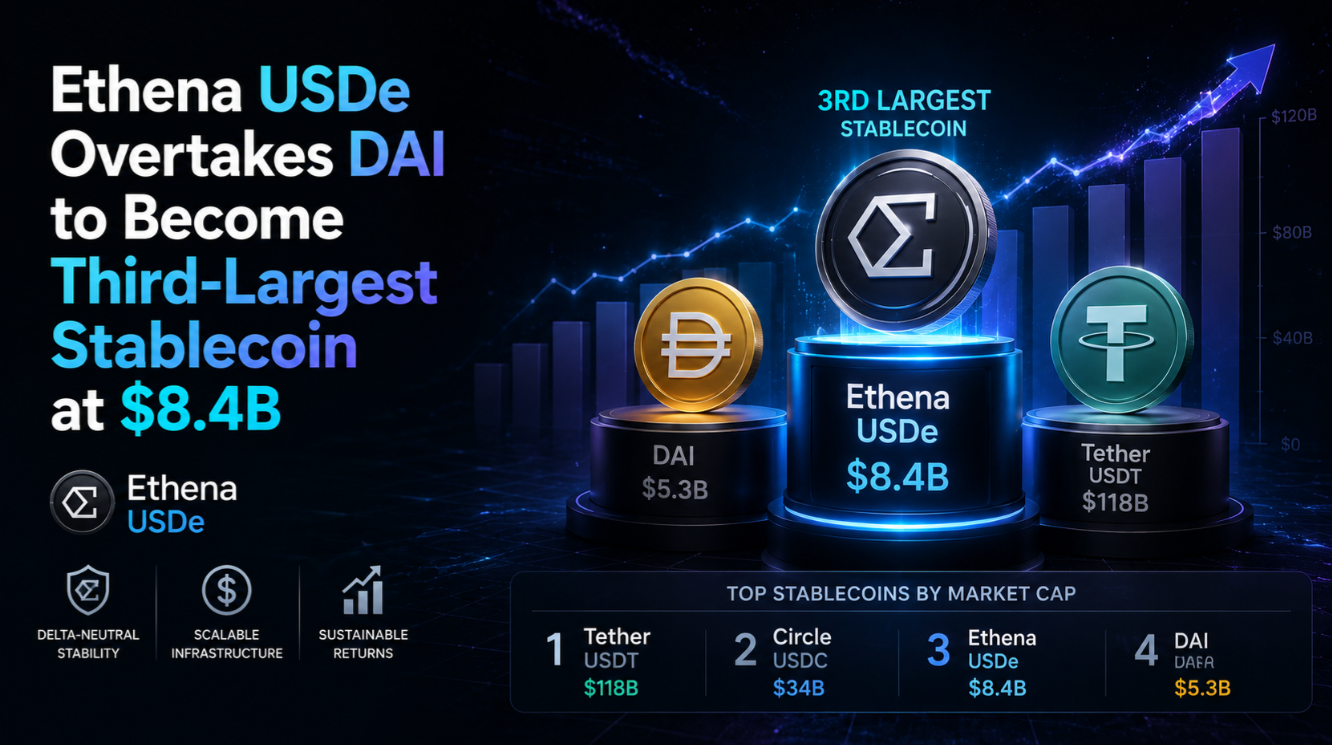
The third spot in the ranking now belongs to Ethena's USDe, which has surpassed $8 billion in market cap. USDe achieves its dollar peg through a delta-neutral strategy: staked ETH as collateral offset by perpetual short positions on centralised exchanges. The model generates yield — currently around 12 % annualised — making USDe attractive as both a stable store of value and a yield-bearing instrument.
Ethena's rise has been meteoric: the protocol launched in early 2024 and crossed the $1 billion mark within weeks. Risk managers note that the model depends on consistently negative funding rates for perpetuals — a condition that historically reverses during extreme bull markets — but Ethena has introduced insurance funds and reserve mechanisms to cushion drawdowns.
DAI and the Rest of the Field
DAI, the pioneering decentralised stablecoin from MakerDAO (now Sky Protocol), sits at approximately $5.5 billion — down from its prior third-place position after being displaced by USDe. DAI remains the preferred stablecoin for maximally decentralised DeFi applications, but its conservative collateralisation approach limits growth velocity compared to yield-bearing alternatives.
The remainder of the $300 billion total is distributed across FDUSD, PYUSD, TUSD, and a long tail of chain-native stablecoins. Each has carved out a niche — FDUSD dominates Binance trading pairs, while PYUSD is expanding aggressively on Solana.
What $300B Means for Crypto and Global Finance
At $300 billion, the stablecoin market is now larger than the M1 money supply of many mid-sized economies. More importantly, it functions as programmable money — capable of being locked in smart contracts, streamed per second, and settled cross-border in under a minute for fractions of a cent. That capability is why central banks and regulators worldwide are paying close attention.
The next milestone — $500 billion — is already within sight if current growth rates persist through 2026. The key variables are regulatory frameworks in the U.S. and EU, the pace of bank-issued stablecoin launches, and whether decentralised alternatives can scale without sacrificing the security properties that make them useful.