Why dedicated NFT tools matter in 2026
The NFT market in 2026 moves fast. Floor prices can double in an hour during a hyped mint or collapse after a bad reveal. Without real-time data, rarity rankings, wallet tracking, and market depth analysis, navigating NFT investments is guesswork. The good news: a comprehensive free toolkit exists — you do not need to pay for premium tiers to research effectively.
Portfolio tracking: Zapper and Zerion
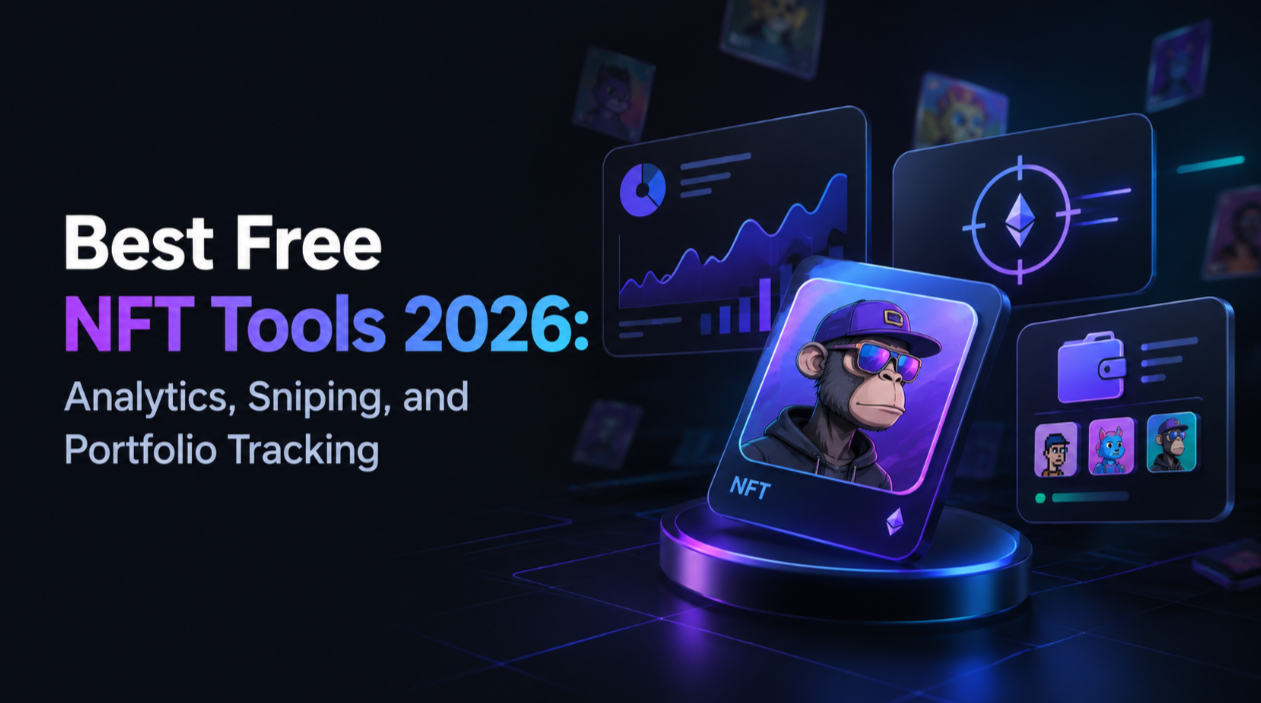
Zapper and Zerion are the leading free portfolio dashboards for Web3 wallets. Both display your NFT holdings alongside DeFi positions and token balances. Zapper shows estimated NFT values based on recent sales and floor prices, categorised by collection. Zerion provides historical portfolio value charts that include your NFT holdings.
Both tools connect via read-only wallet address — you never need to sign a transaction or give any permissions. Just paste your address and the dashboard populates automatically. Zapper supports 30+ chains; Zerion supports similar coverage. The Blur NFT token and ApeCoin holdings appear in these dashboards alongside your NFT positions.
NFT analytics: NFTScan and marketplace dashboards
For collection-level analytics, NFTScan is a free multi-chain explorer covering Ethereum, Polygon, BNB Chain, Solana, Arbitrum, and others. It shows contract details, historical mint data, holder distribution, and transaction history. Useful for verifying contract authenticity and checking whale concentration.
OpenSea's free tier includes collection-level stats: 7-day volume, floor price history, listed supply, and unique holders. Blur NFT's analytics dashboard is better for traders — showing bid depth, listing distributions across price ranges, and real-time sweep activity. Both are free with wallet connection.
Rarity ranking tools: Rarity Sniper and Rarity Tools
Rarity Sniper is the most widely used free rarity ranking tool. After a collection launches, Rarity Sniper indexes trait data from the contract metadata and ranks each token by statistical rarity — rarer traits across fewer tokens produce higher rarity scores. The site covers thousands of Ethereum and Solana collections.
For new mints, the rarity reveal is often one of the most important price catalysts — tokens in the top 1% of rarity typically command 5–20x floor price premiums. Checking rarity immediately after a reveal can identify underpriced items before the market reprices. This applies equally to generative PFP collections and 1-of-1 art drops tracked across NFT Marketplaces ratings.
NFT sniping: what it is and how to approach it
NFT sniping means buying underpriced NFTs on the secondary market — typically rare or desirable tokens listed below their fair market value. This happens when a holder lists a token without checking its rarity ranking, underestimates demand, or makes a listing error (wrong price denomination).
Free sniping approaches: manually monitor new listings on Blur NFT or OpenSea sorted by "lowest price" for collections where you understand the rarity distribution. Filter for rare traits in the collection traits panel. Speed matters — popular underpriced listings are bought within seconds by bots on mainnet, but on L2s and Solana, manual sniping remains viable.
Wallet tracking: Cielo and Nansen free tiers
Following smart money in NFTs — tracking wallets that consistently identify winners early — is a key alpha strategy. Cielo provides a free NFT wallet tracker that sends notifications (via web, Telegram, or Discord) when tracked wallets buy, sell, or mint. You can follow up to 10 wallets on the free tier.
Nansen's free tier provides limited wallet profiling for known entities (exchanges, known smart money wallets, protocol treasuries). For deep wallet analytics, their paid plans are needed — but the free wallet lookup can tell you whether a buying address is labelled as a known entity, which is often enough context for a trading decision.
Mint calendars and launch tracking
NFT Calendar and Rarity Sniper's mint calendar are the primary free resources for upcoming launches. Projects submit their mint details — date, price, supply, chain, and social links. Both allow filtering by chain and price. Magic Eden's launchpad calendar is the best source for Solana mints.
Before entering any mint, check: contract audit status (ask in the project Discord or check Etherscan verified source), team doxxed or anonymous (anonymous teams are higher risk), and secondary market indicators if the project ran an allowlist phase.
On-chain activity monitoring: Etherscan and Solscan
Etherscan is the essential free tool for any Ethereum NFT investigation. You can view every transaction to a contract address, check the contract source code verification status, see the holder distribution, and track minting patterns. For Solana, Solscan provides equivalent functionality.
Key Etherscan checks before buying: verify the contract is the official address (cross-reference against the project's official channels), check the "token" tab to see how widely distributed the NFTs are (high concentration in a few wallets is a red flag), and look at recent transactions to see if large holders are selling.
Free NFT aggregators: Blur and Gem
NFT aggregators let you buy multiple NFTs from different marketplaces in a single transaction, reducing gas costs. Blur's aggregator is free and covers major Ethereum marketplaces. Buying a 10-item sweep from multiple sources in one transaction saves 60–80% on gas versus individual purchases. Blur NFT is also the best venue for limit orders (bids below floor), giving you passive snipe infrastructure at no cost.
Social and sentiment tools: Twitter lists and Discord
Despite the arrival of more sophisticated tools, Twitter/X and Discord remain the most important free sentiment indicators in NFT markets. Key signals: sudden spike in mentions of a specific collection, influential collectors publicly buying, a blue-chip artist joining a project as an advisor.
Practical free setup: create a Twitter list of 30–50 active NFT traders and influential collectors. Turn on notifications for the top 5–10. Monitor Discord servers of projects you are interested in — floor activity is often discussed in real time before it appears in charts.
Tracking ApeCoin and ecosystem tokens
For collectors with positions in ApeCoin or other NFT ecosystem tokens, standard crypto price trackers (CoinGecko, CoinMarketCap) cover token prices and market cap. Dune Analytics offers free community-built dashboards tracking ApeCoin staking volumes, Otherside land sales, and BAYC ecosystem activity in real time.
The full free tool stack for 2026
- Portfolio: Zapper or Zerion — cross-chain NFT and DeFi dashboard.
- Collection analytics: Blur analytics and OpenSea stats — volume, floor, listings depth.
- Rarity: Rarity Sniper — free rarity ranks for thousands of collections.
- Wallet tracking: Cielo free tier, 10 wallets with Telegram alerts.
- Contract verification: Etherscan and Solscan — on-chain data source of truth.
- Mint calendar: NFT Calendar plus Magic Eden launchpad for Solana.
- Aggregator/sniping: Blur NFT for Ethereum; Magic Eden for Solana.
- Platform comparison: NFT Marketplaces ratings — fees, royalties, and security audit status.
NFT tools evolve rapidly. Always verify that a tool is still actively maintained before relying on its data for trading decisions.