The royalty promise that defined early NFTs
When NFTs exploded in 2021, creator royalties were presented as a revolution: artists could earn 5–10% of every secondary sale forever, automatically, without relying on galleries or intermediaries. For the first time, a digital creator could build long-term income from a single collection rather than selling their work once.
The royalty model worked while the market was hot and platforms competed on creator features. OpenSea, Rarible, and Foundation all enforced royalties by default — taking the royalty percentage from the sale price and forwarding it to the creator wallet on every transaction.
How the royalty wars started: LooksRare and X2Y2
The first crack appeared in early 2022 when LooksRare and X2Y2 launched as OpenSea competitors with optional royalties. Traders migrated volume to these platforms to avoid paying creator fees. Wash trading inflated their numbers, but the message was clear: there was a market for royalty-free trading.
Then came Blur. Launched in October 2022, Blur NFT targeted professional traders with zero marketplace fees and a royalty system that was technically enforceable but practically optional. To earn maximum BLUR token rewards, traders were incentivised to set royalties to zero or minimum. Volume flooded in. By early 2023, Blur had surpassed OpenSea in raw ETH volume.
OpenSea response: the Operator Filter Registry
In November 2022, OpenSea introduced the Operator Filter Registry — a Solidity tool that allowed creators to block their NFTs from being traded on marketplaces that did not enforce royalties. Collections that opted in would effectively blacklist Blur, LooksRare, and others unless those platforms agreed to enforce royalties.
The experiment fractured the market. Some high-profile collections (Bored Ape Yacht Club's ApeCoin-adjacent projects, DeGods, y00ts) publicly dropped royalties to zero. Others held firm. The Operator Filter created a liquidity bifurcation — collections that used it had thinner markets because they excluded major trading venues.
The pivot: OpenSea drops royalty enforcement in 2023
In August 2023, OpenSea reversed course and announced it would no longer enforce creator royalties for new collections. The platform said the Operator Filter was not achieving its goal because most collections that used it eventually removed it under liquidity pressure. The announcement triggered widespread criticism from creators who had built financial models around royalty income.
Simultaneously, OpenSea shut down OpenSea Pro (formerly Gem) and relaunched it as a new aggregator. The message to creators was blunt: in a competitive market, traders choose liquidity, and liquidity goes to the platforms with lowest friction.
On-chain royalty enforcement: the technical solution
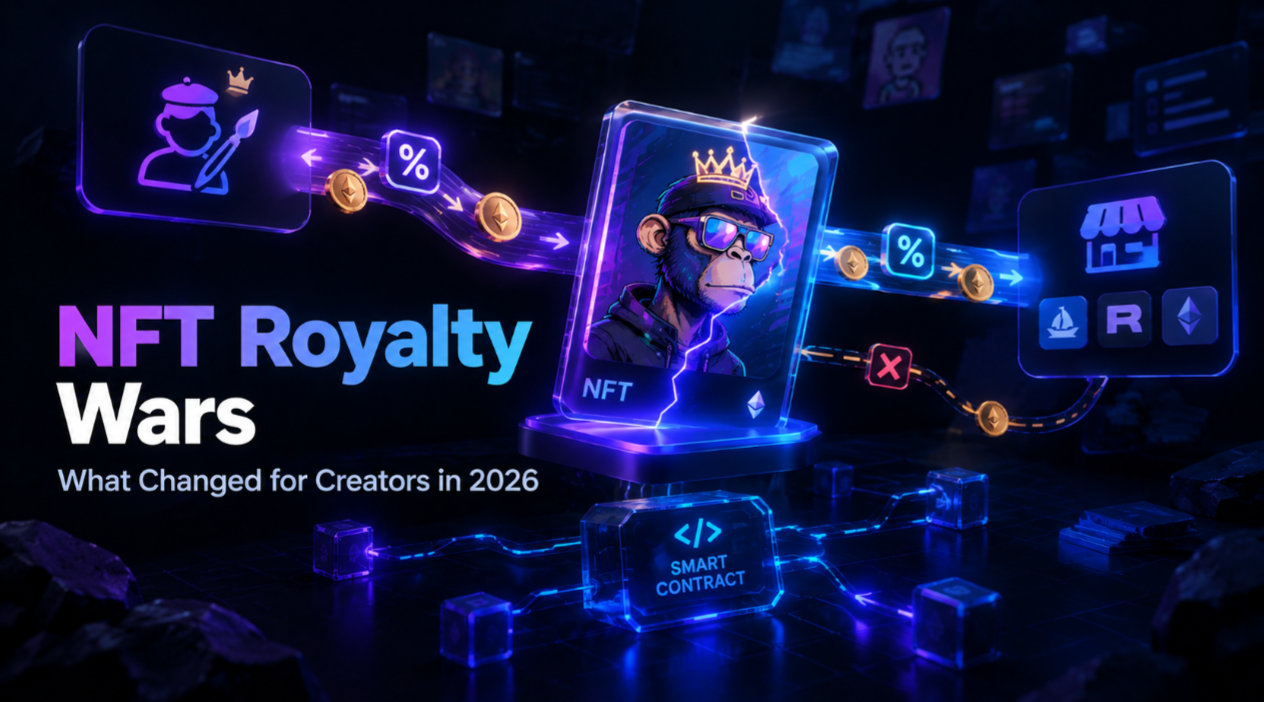
The community response was to build royalty enforcement directly into contracts rather than rely on marketplace goodwill. Several approaches emerged. The most aggressive is the "transfer hook" pattern: the NFT contract checks before every transfer whether the buyer is paying at least the royalty amount. Non-compliant transfers revert.
- ERC-721C (Limit Break): A contract extension that enforces royalties at the transfer level. Only works with marketplaces that support the security policy. Used by DigiDaigaku and others.
- ERC-2981 standard: The royalty info standard — encodes recipient and percentage on-chain but does not enforce payment. Most marketplaces read this but compliance is voluntary.
- Programmable royalties: Dynamic royalty rates that adjust based on sale price, time held, or number of previous sales — implemented via custom contract logic.
Where marketplaces stand in 2026
The landscape has partially stabilised. OpenSea reinstated optional royalty enforcement via a new "Creator Earnings" programme but does not mandate it. Blur enforces a minimum 0.5% royalty on all trades following community pressure. Magic Eden has adopted a more pro-creator stance on Solana and introduced royalty protection policies as a competitive differentiator against non-enforcing competitors.
The emerging consensus is a tiered model: marketplaces offer royalty enforcement as a feature that creators can opt into, with higher platform visibility or lower fees as an incentive. This is not the original automatic royalty promise — but it is more durable than the 2022–2023 race to zero.
The Solana royalty situation
Solana NFTs use Metaplex's Token Metadata standard. Creator royalties are encoded in the metadata but were never enforced at the protocol level — they were entirely a marketplace convention. When Magic Eden made royalties optional in late 2022 to compete with Solanart and Exchange.Art, Solana creator income collapsed.
Metaplex has since introduced Programmable NFTs (pNFTs) — a new token standard that enables rule-based restrictions at the program level, including royalty enforcement. Adoption has been gradual because it requires re-minting or upgrading existing collections. New collections launching on Solana in 2025–2026 increasingly use pNFTs for royalty protection.
What changed for creators: the financial impact
For top collections, the royalty collapse was painful but survivable due to IP licensing deals, merchandise, and brand partnerships. For mid-tier and emerging artists, the impact was severe — royalty income that had covered studio costs and living expenses evaporated when traders migrated to zero-royalty venues.
- Top 10 collections: royalty income down roughly 60% since peak 2022.
- Mid-tier PFP projects: many effectively stopped receiving royalties entirely.
- Art/1-of-1 segment: less affected — buyers of high-value unique pieces more likely to pay royalties voluntarily.
- Music NFTs: royalty enforcement more consistent on dedicated platforms like Sound.xyz.
The emerging model: utility-based royalties
The most sustainable royalty models in 2026 tie royalties to holder benefits rather than relying on goodwill or enforcement. Projects that gate access to exclusive content, events, or in-game assets based on royalty payment status have found buyers willing to comply. When the royalty is framed as a membership fee rather than a tax on trading, compliance improves.
Check marketplace policies before listing
Before listing on any platform, verify its current royalty policy. The NFT Marketplaces ratings tracks each major platform's royalty enforcement stance, fee structures, and creator tools. Policies change — what was true in 2023 may not apply today.
What the royalty wars revealed about NFT infrastructure
The royalty crisis exposed a fundamental design gap: the original NFT standards (ERC-721, ERC-1155) had no built-in payment mechanism for secondary sales. Royalties were a social convention that depended on marketplace goodwill. The lesson is that sustainable creator economics in Web3 require protocol-level enforcement, not marketplace promises.
Creator royalty policies change frequently. Always verify current terms directly with the marketplace before minting or listing.