What are Bitcoin Ordinals and why they matter
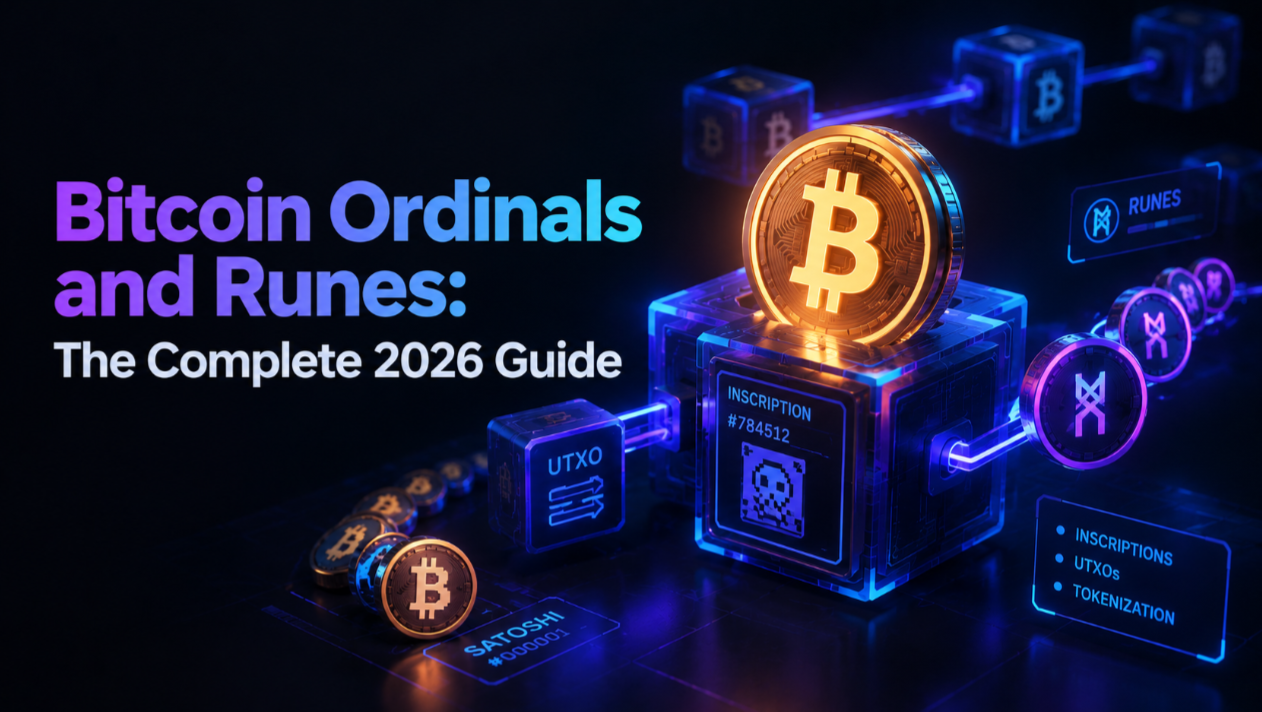
Bitcoin Ordinals are a method for inscribing data directly onto individual satoshis — the smallest unit of Bitcoin. Introduced by Casey Rodarmor in January 2023, the Ordinals protocol assigns a sequential number (an ordinal number) to each satoshi based on the order it was mined. Data inscribed onto a specific satoshi becomes permanently attached to that satoshi on the Bitcoin blockchain.
Unlike Ethereum NFTs, which store metadata off-chain (on IPFS or Arweave), Ordinals store the actual content — image, text, HTML, or even code — directly on-chain in the witness data of a Bitcoin transaction. This makes them fully on-chain in a way most Ethereum NFTs are not. The trade-off is blockchain bloat and the ongoing debate about Bitcoin's purpose.
How the Ordinals protocol works technically
The Ordinals protocol relies on two Bitcoin upgrades: SegWit (2017), which introduced the witness data field, and Taproot (2021), which expanded the witness data capacity and enabled more complex scripts. An inscription is a special Bitcoin transaction that embeds arbitrary data — an image, JSON, HTML, or video — in the Taproot witness of a transaction spending a single satoshi.
The ord client (the reference implementation) tracks the ordinal number of every satoshi ever mined by simulating the transfer of satoshis through every transaction. This ordinal theory assigns each satoshi a permanent, immutable serial number. When you "transfer" an Ordinal inscription, you are sending the specific satoshi it is attached to.
Rare satoshis: the rarity tiers
Rodarmor defined a rarity hierarchy for satoshis based on significant mining events. Common satoshis are the baseline. Uncommon satoshis are the first sat of each block. Rare satoshis are the first sat of each difficulty adjustment period (every 2,016 blocks). Epic satoshis are the first sat of each halving. Legendary satoshis are the first sat of each cycle (when halving and difficulty adjustment coincide).
- Common: Any satoshi — over 2.1 quadrillion total supply.
- Uncommon: First sat of each block — roughly 6.9 million total.
- Rare: First sat of each difficulty period — roughly 3,437 total.
- Epic: First sat of each halving — 32 total (including future halvings).
- Legendary: First sat of each cycle — only 5 total.
- Mythic: The genesis satoshi — exactly 1.
The Ordinals market: collections and trading
Major Ordinals collections emerged quickly after launch. Bitcoin Frogs, Ordinal Punks, Ordinals Maxi Biz, and NodeMonkes became the blue-chip references. Pricing is in BTC or sats (satoshis). The market is thinner than Ethereum NFTs — lower liquidity, wider spreads, and fewer tools.
Trading Ordinals requires a Bitcoin wallet that supports inscription-aware UTXO management. Standard Bitcoin wallets can accidentally spend the satoshi an inscription is attached to when constructing transactions. Dedicated wallets like Xverse, Unisat, and Magic Eden's Bitcoin wallet display inscriptions separately from spendable UTXOs. Compare trading venues at our NFT Marketplaces ratings.
Bitcoin Runes: the fungible token protocol
Runes launched at the April 2024 Bitcoin halving. Where Ordinals inscribe unique data onto specific satoshis, Runes is a protocol for creating fungible tokens on Bitcoin — the Bitcoin equivalent of ERC-20 tokens on Ethereum.
The Runes protocol uses Bitcoin's OP_RETURN opcode to store token data in an unspendable transaction output. This is more efficient than the BRC-20 standard (which used Ordinals inscriptions for fungible tokens and caused extreme mempool congestion). Runes transactions are Bitcoin-native, UTXO-based, and do not require a separate indexer beyond the Runes spec.
How to inscribe your first Ordinal
- Download and run the ord client, or use a web service like Unisat's inscription tool.
- Prepare your content: images under 60KB for reasonable fee cost, ideally under 10KB for minimal fees.
- Fund a taproot Bitcoin address with enough BTC to cover the inscription fee (0.00003 to 0.001 BTC depending on file size and current fee rate).
- Submit the inscription transaction. The content is embedded in two transactions: a commit transaction and a reveal transaction.
- Wait for both transactions to confirm (typically 1–3 Bitcoin blocks, 10–30 minutes).
- Your inscription appears in your wallet with a unique inscription number assigned in order of confirmation.
Marketplaces for Ordinals and Runes
Magic Eden expanded to Bitcoin and supports both Ordinals and Runes trading alongside its Solana and Ethereum markets. Unisat is the dominant specialised platform for Ordinals, with an inscription service, marketplace, and BRC-20/Runes support. OKX Wallet and its marketplace are also significant venues.
Liquidity remains lower than comparable Ethereum collections. Floor prices are quoted in sats rather than ETH, which can be confusing. Always verify inscription numbers via ord indexer or Ordinals.com — scam listings with fake inscription data are common.
The block space debate: Bitcoin purists vs Ordinals
Ordinals and Runes have been highly controversial within the Bitcoin community. Critics argue that using Bitcoin block space for images and meme tokens crowds out financial transactions and drives up fees for everyday Bitcoin users. During the Runes launch at the 2024 halving, average Bitcoin transaction fees temporarily exceeded $100.
Proponents argue that increased fee revenue benefits Bitcoin miners and strengthens network security as the block subsidy continues to halve. The debate mirrors broader questions about Bitcoin's role: digital gold and settlement layer only, or a general-purpose programmable base layer?
Comparing Ordinals to Ethereum NFTs
- Data storage: Ordinals store content fully on-chain in Bitcoin witness data. Ethereum NFTs typically store metadata on IPFS or Arweave with only the token record on-chain.
- Permanence: Bitcoin's longer track record and maximalist security assumptions make inscription permanence more credible to some collectors.
- Smart contracts: Ethereum NFTs support programmable royalties, dynamic metadata, on-chain rendering, and cross-protocol composability. Ordinals cannot execute code.
- Liquidity: Ethereum NFT markets are significantly more liquid with more marketplace options and higher volumes.
- Fees: Bitcoin inscription fees scale with file size and network congestion. Ethereum L2 fees are lower and more predictable for small files.
BRC-20 tokens and their legacy
BRC-20 was an informal token standard (not an official Bitcoin standard) that used JSON inscriptions to define fungible token operations. It drove massive inscription volumes and fee spikes in mid-2023. Most BRC-20 tokens have lost nearly all value, but the experiment proved demand for Bitcoin-native fungible tokens — which Runes now address more efficiently.
Investment risks specific to Bitcoin Ordinals
- Thin liquidity: small collections with wide bid-ask spreads are difficult to exit at fair prices.
- No smart contract features: no programmatic royalties, on-chain allowlists, or dynamic metadata.
- Wallet risk: using non-inscription-aware wallets can accidentally destroy inscriptions.
- Regulatory uncertainty: Bitcoin's regulatory treatment varies globally and could affect Ordinals markets.
Where to track Ordinals and Runes market data
The Blur NFT token reflects activity from the broader NFT trading infrastructure that now encompasses Bitcoin Ordinals alongside Ethereum collections. For Ordinals-specific price tracking, Ordinals.com, Magic Eden Bitcoin, and Unisat provide real-time floor and volume data.
Bitcoin Ordinals and Runes are experimental financial instruments. Always verify inscription authenticity independently before purchasing.