What is a DAO and how it works
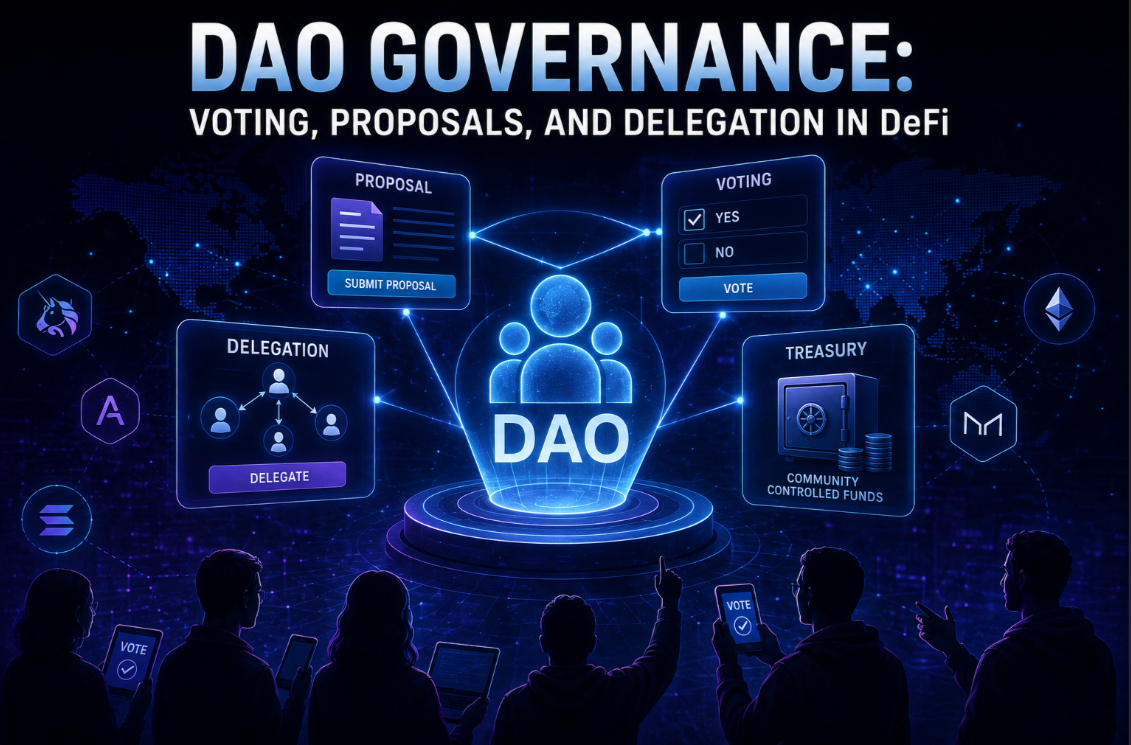
A Decentralised Autonomous Organisation (DAO) is a blockchain-based entity governed by token holders through on-chain voting rather than by a traditional board or management team. Smart contracts encode the rules: who can propose changes, how long voting lasts, what percentage of votes is needed to pass, and how decisions are executed automatically.
In DeFi, DAOs govern protocol parameters — interest rate models on Aave, fee switches on Uniswap, gauge weights on Curve, and treasury spending across hundreds of protocols. The DAO model replaces the trust in a company with trust in code and economic incentives.
Governance tokens: what they represent
Governance tokens grant voting rights proportional to the number held. One token typically equals one vote, though some protocols use quadratic voting or vote-escrow models to alter the distribution of power. Governance tokens may also capture protocol revenue through buybacks, staking rewards, or fee distribution — but many protocols have not yet activated any economic value accrual for their tokens.
AAVE token holders can vote on risk parameters, asset listings, and protocol upgrades for Aave. UNI token holders govern Uniswap's fee switch and grant programme treasury. veCRV holders direct Curve's liquidity mining emissions. Holding these tokens is not just speculative — it is holding a share of protocol decision-making power.
The lifecycle of a governance proposal
DeFi governance proposals typically follow a standardised process with several stages:
- Temperature check (off-chain): A forum post on the protocol's governance forum (Discourse, Commonwealth) gauges community sentiment. No binding outcome, but shapes whether a formal proposal is worth pursuing.
- Snapshot vote (off-chain): A gas-free signalling vote on Snapshot. Not binding on-chain but considered a strong signal. Most protocols require a minimum quorum.
- On-chain proposal: A formal transaction submitted to the governance contract with exact code changes. Requires meeting a proposal threshold (minimum token balance to submit).
- Voting period: Typically 3–10 days. Token holders vote For/Against/Abstain. Votes are counted by token weight.
- Timelock queue: If passed, the proposal enters a timelock delay (24–72 hours) before execution.
- Execution: After the timelock, the proposal is executed on-chain, automatically implementing the changes.
How to vote in DeFi governance
Participating in on-chain governance requires holding governance tokens in a self-custody wallet. The process:
- Acquire governance tokens (AAVE, UNI, CRV, etc.) and hold them in a self-custody wallet.
- Visit the protocol's governance portal (governance.aave.com, app.uniswap.org/vote, etc.).
- Connect your wallet.
- Browse active proposals — read the full proposal text before voting.
- Cast your vote (For/Against/Abstain). On-chain voting requires a small gas fee.
- Monitor the outcome and the execution after the timelock.
Off-chain Snapshot votes require only a signed message from your wallet — no gas cost. Most governance portals allow voting on both Snapshot and on-chain proposals from the same interface.
Delegation: voting without active management
Most governance systems allow token holders to delegate their voting power to another address — a known community member, a protocol contributor, or a professional delegate organisation. Delegation allows passive token holders to participate in governance without researching every proposal. The delegator retains ownership of their tokens; only the voting power is transferred.
Aave has a formalised delegate system where community delegates publish voting platforms — explaining their positions and conflicts of interest. Uniswap Accountability Committee, Gauntlet, Aaave Chan Initiative, and Chaos Labs are examples of professional delegate organisations that vote on behalf of delegators and publish transparent rationales.
Quorum and proposal thresholds: who actually has power
Most DAOs require proposals to meet a quorum — a minimum percentage of total token supply that must vote for the result to be binding. Low quorum requirements mean a small, coordinated group can pass or block proposals. High quorum requirements can make governance gridlocked if voter apathy is high.
Proposal thresholds — the minimum token balance required to submit an on-chain proposal — were originally designed to prevent spam but can concentrate power. If you need 80,000 AAVE (worth millions of dollars) to submit a proposal, governance becomes the preserve of large holders and institutional players. Many protocols are experimenting with delegated proposal rights to address this.
Governance attacks: how DAOs get exploited
DAO governance itself is an attack surface. Notable attack vectors:
- Flash loan governance attack: Borrow a huge amount of governance tokens in a flash loan, use them to pass a malicious proposal in the same transaction. Beanstalk lost $182m this way in April 2022. Timelock delays are the primary defence.
- Whale dominance: One large holder or coordinated group controls enough votes to pass or block anything. Common in early-stage protocols with concentrated token distributions.
- Low voter turnout: Apathy means small groups can achieve quorum and pass proposals that the broader community would reject if it participated.
- Malicious code in proposal: A proposal's on-chain code differs from what was described in the forum post. Users must read the actual code diff, not just the description.
- Bribery markets: Vote-buying is a formal market on some protocols (Hidden Hand, Votium for Curve). This is technically legal and common — but it shifts governance toward economic incentives over protocol health.
Vote-escrow and veToken governance models
Curve popularised the vote-escrow (ve) model: lock your CRV tokens for up to 4 years to receive veCRV, which grants boosted rewards and governance voting power. Longer locks give more veCRV, aligning voter incentives with long-term protocol health rather than short-term extraction. The longer you lock, the more governance power and yield boost you receive.
The veToken model has been widely copied: veBAL (Balancer), vePENDLE (Pendle), veAERO (Aerodrome). Critics argue it concentrates power among the wealthiest long-term holders and reduces liquidity. Supporters argue it dramatically improves governance participation quality.
Sub-DAOs and specialised committees
Large protocols have created sub-DAOs to manage specific functions without requiring full community votes for every decision. Aave has the Aave Chan Initiative for parameter changes, a Risk Committee for emergency pauses, and a Grants Committee for ecosystem funding. Uniswap has the Uniswap Foundation. These structures allow faster decision-making while preserving on-chain accountability for major decisions.
Sub-DAOs typically have bounded mandates and limited budgets, with their actions reviewable and revocable by the main DAO governance. This is a practical response to the governance overhead of managing a live financial protocol.
How to get involved in DeFi governance
- Start by reading governance forums for protocols you use or hold tokens in. Aave governance forum and Uniswap governance forum are both highly active.
- Participate in temperature check discussions — no token required, just a forum account.
- Delegate your tokens to an active, transparent delegate rather than leaving voting power idle.
- As you develop expertise in specific protocol areas, submit your own temperature checks.
- Apply to delegate programmes — Uniswap and Aave both have structured delegate campaigns with compensation for quality participation.
The health of a protocol's governance directly impacts its long-term value and security. Our DeFi ratings include governance quality as a scoring dimension. The Aave review covers how Aave's governance balances speed, security, and decentralisation.
Real governance examples: Uniswap and Aave in 2025–2026
Uniswap turned on its fee switch in late 2024 after years of debate, directing a portion of protocol fees to UNI stakers who have locked their tokens. The vote passed with 72% approval after three failed prior attempts. This marked a fundamental shift in UNI token value accrual.
Aave has expanded aggressively to new chains — Base, Scroll, ZkSync — entirely through governance votes. Each new chain deployment requires a full AIP (Aave Improvement Proposal) with risk parameter recommendations from Chaos Labs or Gauntlet. The speed of these deployments reflects how efficient Aave's governance infrastructure has become.
This article is for educational purposes only. Governance token ownership does not guarantee returns. DAO participation carries smart contract and governance attack risks. Not financial advice.