Why smart contract audits matter in DeFi
Smart contracts are immutable code that can hold hundreds of millions of dollars. Unlike a traditional software bug that crashes a web page, a bug in a DeFi smart contract can be exploited to drain all user funds in a single transaction — with no recourse, no FDIC insurance, and no legal remedy in most cases. Security audits are the primary safeguard between users and catastrophic loss.
Over $3 billion was lost to DeFi exploits in 2022 alone. Many of these attacks hit protocols that had been audited — but the exploits occurred in code that was added after the audit, or in interactions between contracts that were not audited together. Understanding what an audit does and does not cover is essential before depositing into any protocol.
What a smart contract audit actually covers
A smart contract audit is a systematic review of the protocol's code by an external security firm. Auditors check for:
- Reentrancy vulnerabilities: Code that can be re-entered during execution, allowing recursive theft (the classic DAO hack vector).
- Integer overflow/underflow: Arithmetic that wraps around in unexpected ways. Less common since Solidity 0.8 introduced automatic checks.
- Access control flaws: Functions that should be restricted to admins but are callable by anyone.
- Oracle manipulation: Price feeds that can be manipulated in a single transaction (flash loan attacks).
- Logic errors: The code does what it says but the design intention was wrong. Often missed even in audits.
- Centralisation risks: Admin keys or proxy patterns that allow a developer to rug-pull or freeze funds.
What audits do NOT cover: economic design flaws, social engineering of team members, and code added after the audit date.
Top DeFi audit firms and their reputations
Not all audit firms are equal. The most respected firms in DeFi security as of 2026:
- Trail of Bits: One of the most rigorous firms, often published detailed technical writeups. Audited Aave, Compound, Uniswap v3.
- OpenZeppelin: Audited more DeFi protocols than any other firm. Maintains the industry-standard smart contract library.
- ChainSecurity: Academic-background team, strong on formal verification. Audited Curve, MakerDAO.
- Consensys Diligence: Ethereum-focused, deep EVM expertise. Audited MetaMask, Aave, various L2 bridges.
- Spearbit / Cantina: Newer model using top independent researchers. Growing reputation for thoroughness.
- Sherlock / Code4rena / Immunefi: Audit contest platforms. Crowdsource researchers to find vulnerabilities for bounties — complement (but do not replace) traditional firm audits.
A protocol audited by two or more of these firms, with public reports, is substantially more trustworthy than one with a single audit from an unknown firm.
How to find a protocol's audit reports
Audit reports should be publicly accessible from the protocol's official documentation. Where to look:
- The protocol's official documentation site (docs.aave.com, docs.uniswap.org, etc.)
- The GitHub repository — audit PDFs are often in /audits or /security directories
- The audit firm's own website — most firms publish all completed reports
- DeFiSafety.com — aggregates safety scores and links to audit reports for hundreds of protocols
- L2Beat.com — specifically for Layer 2 bridge and rollup security assessments
If you cannot find a public audit report for a protocol, treat that as a significant red flag. Any protocol soliciting deposits without a public audit is asking users to trust unreviewed code.
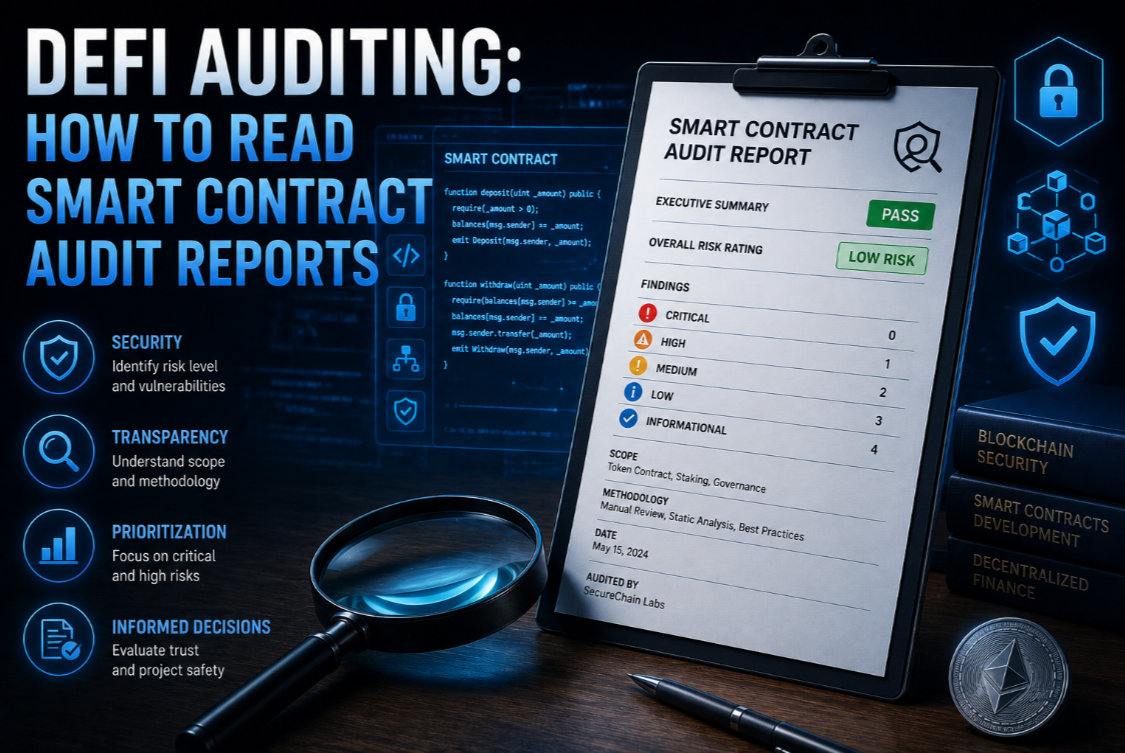
How to read a DeFi audit report: structure and findings
Audit reports typically follow this structure:
- Executive summary: Total finding counts by severity, overall assessment. Read this first.
- Scope: Exactly which contract files and commit hashes were reviewed. Critical — code outside scope is not covered.
- Findings: Each finding has a severity (Critical, High, Medium, Low, Informational/Gas), description, proof of concept, and recommended fix.
- Resolution: How the team responded — Fixed, Acknowledged (accepted risk), or Won't Fix.
- Appendix: Testing methodology, tools used, team members.
The most important section is Findings. Focus on Critical and High severity items. Any unresolved Critical or High finding is a serious red flag. Resolved findings are fine — audits are meant to find and fix problems.
Understanding finding severity levels
- Critical: Direct loss of funds or complete protocol takeover possible. Must be fixed before deployment.
- High: Significant impact — partial loss of funds, denial of service to the entire protocol, or severe privilege escalation.
- Medium: Limited financial impact or requires uncommon conditions to exploit. Should be fixed.
- Low / Informational: Best practices, code quality, minor efficiency issues. No immediate security risk.
- Gas Optimization: Reduce transaction costs — no security relevance.
When reviewing: count unresolved High+ findings. Zero unresolved High+ items after re-audit is the gold standard.
The re-audit: why it matters
An initial audit often finds several issues. The team fixes them, then the same firm performs a re-audit (or verification review) on the fixed codebase. This second audit confirms that the fixes were implemented correctly and did not introduce new issues. A protocol with only an initial audit but no re-audit has not had its fixes verified.
Bug bounty programmes: the ongoing security layer
Audits are point-in-time reviews. Bug bounty programmes provide continuous coverage by incentivising independent researchers to find and responsibly disclose vulnerabilities in exchange for payment. Immunefi is the dominant DeFi bug bounty platform. Leading protocols like Aave, Uniswap, and Curve have bounties ranging from $50,000 to $5,000,000 for critical vulnerabilities.
A protocol with a large, active bug bounty programme has significantly higher security credibility than one without. It signals that the team takes ongoing security seriously and has sufficient treasury to compensate researchers.
Admin key risks: who can change the code
Even a perfectly audited contract can be dangerous if a developer has unrestricted admin keys. Look for:
- Timelock contracts: Admin changes must wait 24–72 hours before taking effect. This gives users time to exit if a malicious upgrade is proposed.
- Multisig governance: Multiple keyholders must sign admin actions. Reduces single-point-of-failure risk.
- On-chain governance: Protocol upgrades require a token holder vote (like Aave's governance system). Most decentralised but slowest.
- Immutable contracts: No admin keys at all. Maximum security but no ability to patch bugs post-deployment. Uniswap v2 core contracts are immutable.
Check Aave review for how Aave's governance and upgrade system balances speed and security. Our DeFi ratings page covers governance models across top protocols.
Red flags that signal a dangerous protocol
- No public audit report
- Single audit from an unknown firm with no prior published work
- Unresolved Critical or High severity findings
- No re-audit after significant changes
- No bug bounty programme
- Anonymous team with no track record
- Admin key without timelock
- TVL grew 10x in less than a week (likely unsustainable emissions)
- Promises of guaranteed returns or "impermanent loss protection" with no mechanism explained
How established protocols like Aave and Curve score on security
Aave has been audited by Trail of Bits, OpenZeppelin, Sigma Prime, and ABDK — all with public reports. It maintains a $16 million active bug bounty on Immunefi. Protocol upgrades go through a 24-hour timelock after on-chain governance vote. This is the benchmark that other lending protocols are measured against.
Curve core pools use immutable contracts (no admin keys) with ChainSecurity and Trail of Bits audits. The factory for new pools is more mutable — a nuance that matters when evaluating newly deployed Curve pools versus the battle-tested core pools.
This article is for educational purposes only. Audits reduce but do not eliminate smart contract risk. Not financial advice.