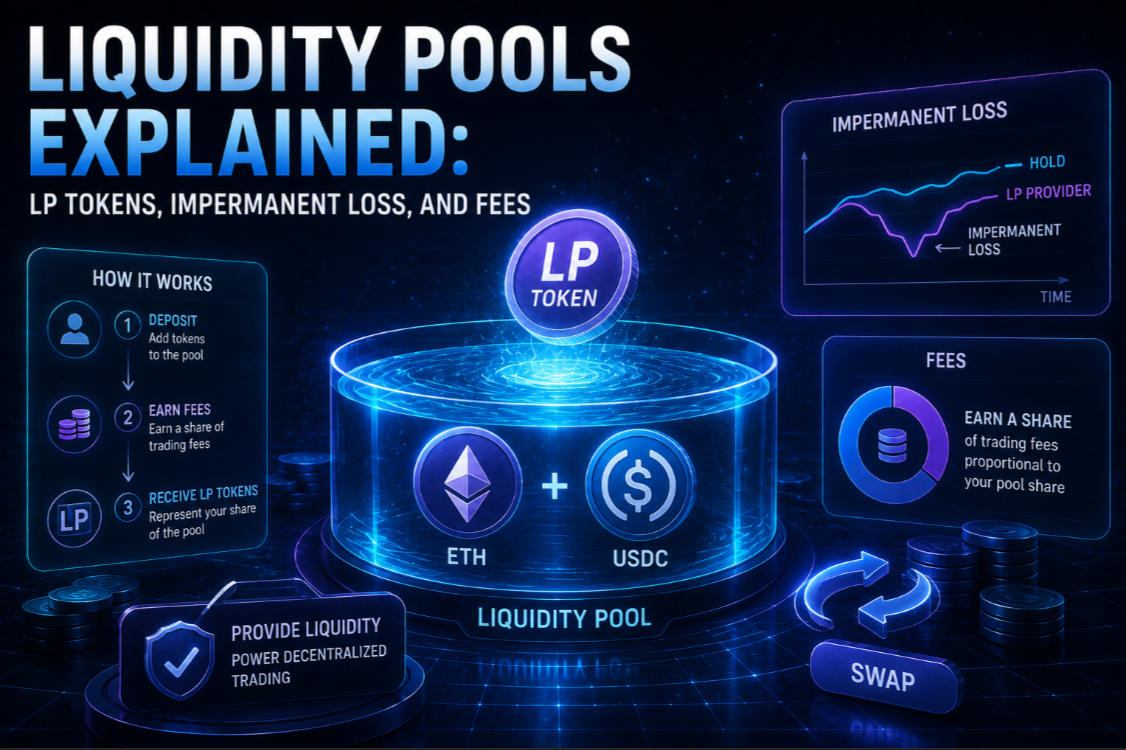
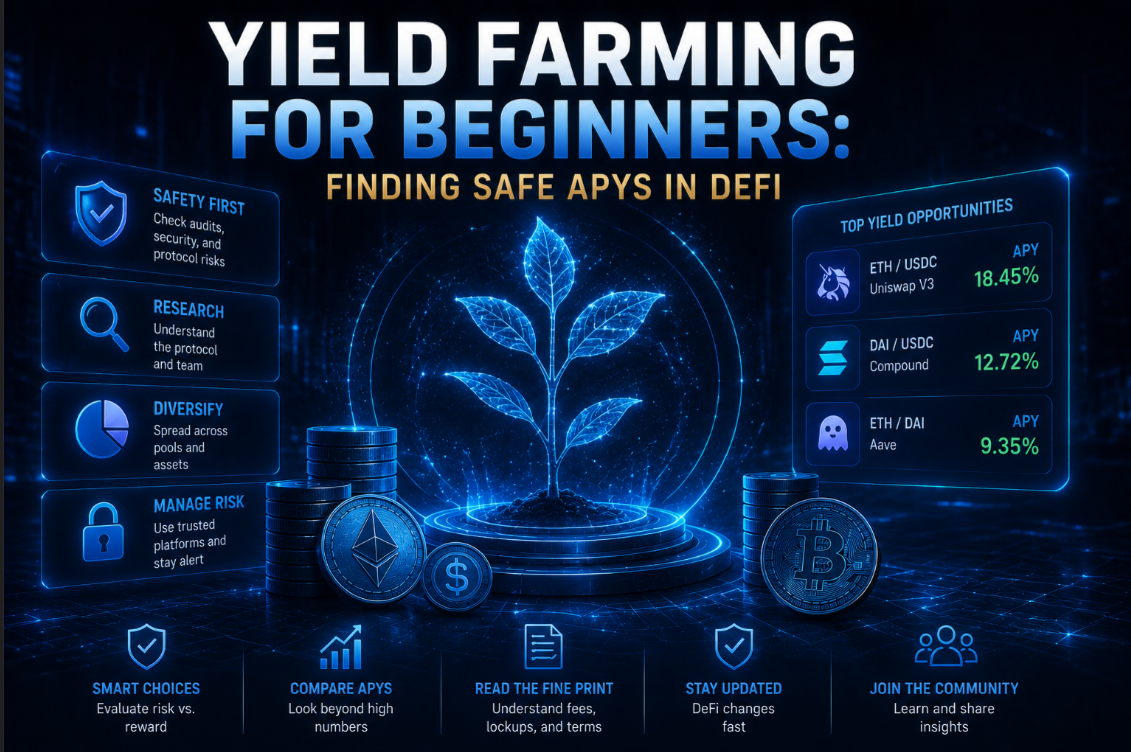
What is yield farming in DeFi
Yield farming is the practice of deploying crypto assets across DeFi protocols to maximise returns. It combines providing liquidity, lending, borrowing, and staking in ways designed to earn the highest possible yield on idle capital. The term became widely known in summer 2020 when Compound's COMP token distribution triggered a wave of liquidity mining programmes across Ethereum.
In 2026, yield farming has matured from a Wild West of unsustainable APYs into a more structured discipline. Genuine yields come from protocol fee revenue, lending interest, and sustainable token emissions. The thousand-percent APYs of 2020 were overwhelmingly driven by inflationary token printing — and most of those tokens lost 90%+ of their value.
How yield farming generates returns
Yield farming income has three distinct sources, and understanding which applies to any given strategy is essential:
- Protocol fees: Real revenue from trading, borrowing, or other protocol activity. Sustainable. Example: Uniswap LP fee income from swap volume.
- Lending interest: Real interest paid by borrowers. Sustainable. Example: supplying USDC to Aave at 5–9% APY.
- Token emissions: Newly minted governance tokens distributed as incentives to attract liquidity. Unsustainable if the token has no underlying value driver. Example: CRV emissions on Curve — partially sustainable because CRV has governance value, but emission rate declines over time.
The safest yield farming strategies are those backed primarily by fee revenue and interest — not token emissions. Emissions-dependent APYs often collapse when the incentive programme ends or the token price falls.
Beginner-safe yield farming strategies
For beginners, three strategies offer the best risk-adjusted returns with manageable complexity:
1. Stablecoin lending on Aave or Compound
Deposit USDC or USDT to a lending protocol and earn interest from borrowers. Risks are minimal: no IL (not an LP position), no price exposure (stablecoins), smart contract risk only. Current rates: 5–9% APY on USDC via Aave. Check the Aave review for a full breakdown of the platform's risk model.
2. Stablecoin LP on Curve
Deposit into Curve's 3pool (USDC/USDT/DAI) or similar stable pools. Earn trading fees plus CRV rewards. IL is near-zero because all three tokens stay near $1. Base returns: 3–6% from fees, plus CRV rewards boosted by veCRV locking.
3. ETH liquid staking
Stake ETH via Lido (receive stETH) or Rocket Pool (receive rETH). Earn ~4% APY in Ethereum staking rewards with no lockup. The stToken can also be deposited into Curve or Aave for additional yield. This is the lowest-risk yield strategy for ETH holders.
Advanced strategies: looping and leveraged yield
More experienced farmers use recursive strategies on lending platforms. The loop: supply USDC → borrow USDC → supply again → borrow again. Each loop amplifies both the APY and the risk. On Aave, supply rate may be 6% while borrow rate is 4%. With 3x leverage you earn roughly 6% on $300 while paying 4% on $200 borrow = net ~10% on original capital. But the health factor must be monitored — a rapid rate spike can trigger liquidation.
Understanding APY vs APR in yield farming
APR (Annual Percentage Rate) is the simple interest rate without compounding. APY (Annual Percentage Yield) includes the effect of compounding. Most DeFi protocols display APR; yield aggregators that auto-compound display APY. At 10% APR compounded daily, APY is approximately 10.52%. At high APRs the gap is dramatic: 100% APR compounded daily = ~171% APY.
Always check whether a displayed rate is APR or APY, whether token emission rewards are included, and at what token price those emissions are valued. High APY numbers often implode when the emission token depreciates.
How to assess if a yield farming APY is safe
When evaluating any farming opportunity, ask these questions:
- Where does the yield come from? Fee revenue and lending interest are sustainable. Token emissions alone are not.
- Has the protocol been audited? By which firms? How many audits? Are audit reports public?
- What is the TVL history? Rapidly inflating TVL with no organic use case is a red flag.
- Is the smart contract verified and open-source? Check Etherscan or the relevant chain explorer.
- Is there a time-lock or multisig on admin keys? Instant admin key control is a major risk.
- What is the token unlock schedule? Large upcoming unlocks can crash emission token prices and destroy APY.
- Is the APY net of gas costs? Small positions get eaten by transaction fees.
For deeper research on established DeFi protocols, see our DeFi ratings and lending ratings pages.
Yield aggregators: autocompounding your returns
Yield aggregators like Yearn Finance, Beefy Finance, and Convex automatically compound your farming rewards into more of the underlying asset. Instead of manually claiming and reinvesting CRV rewards, Convex handles it and takes a small performance fee. For passive farmers, aggregators reduce gas costs and remove the operational burden of active management.
Tax implications of yield farming
In most jurisdictions, yield farming income is taxable as ordinary income at the time of receipt. Every reward token claim is a taxable event at its fair market value on that date. Compounding inside an aggregator may or may not be a taxable event depending on jurisdiction (it depends on whether you receive new tokens or simply accrue value). Keep detailed records — every deposit, withdrawal, and reward claim with timestamps and USD values. Tools like Koinly, CoinTracker, or TaxBit specialise in DeFi transaction tracking.
Common beginner mistakes in yield farming
- Chasing the highest APY without researching the protocol — most extremely high APYs collapse within days.
- Ignoring gas costs — a $50 deposit on Ethereum mainnet can cost $30 in gas to enter and exit.
- Forgetting to track LP entry prices — you need the entry ratio to calculate IL accurately.
- Not accounting for token unlock schedules — large unlocks can crash emission token value overnight.
- Over-leveraging on lending loops — even a small rate spike can trigger liquidation.
- Using unaudited protocols for significant sums — one smart contract bug can zero your position.
A realistic starter portfolio for DeFi yield
- 40% — Aave USDC lending (~5–8% APY, minimal risk)
- 30% — Curve 3pool LP (~4–6% APY, near-zero IL)
- 20% — Lido stETH (~4% ETH staking yield)
- 10% — Higher-risk experiments in audited protocols you have researched personally
This allocation delivers 4–7% blended APY with very limited smart contract exposure to unproven code. Scale the experimental bucket only after you understand each protocol's risk model. See Uniswap market page for context on UNI token and Uniswap's protocol fundamentals.
This article is for educational purposes only. DeFi yields involve smart contract risk, impermanent loss, and potential token value loss. Not financial advice.