What is a liquidity pool and why it exists
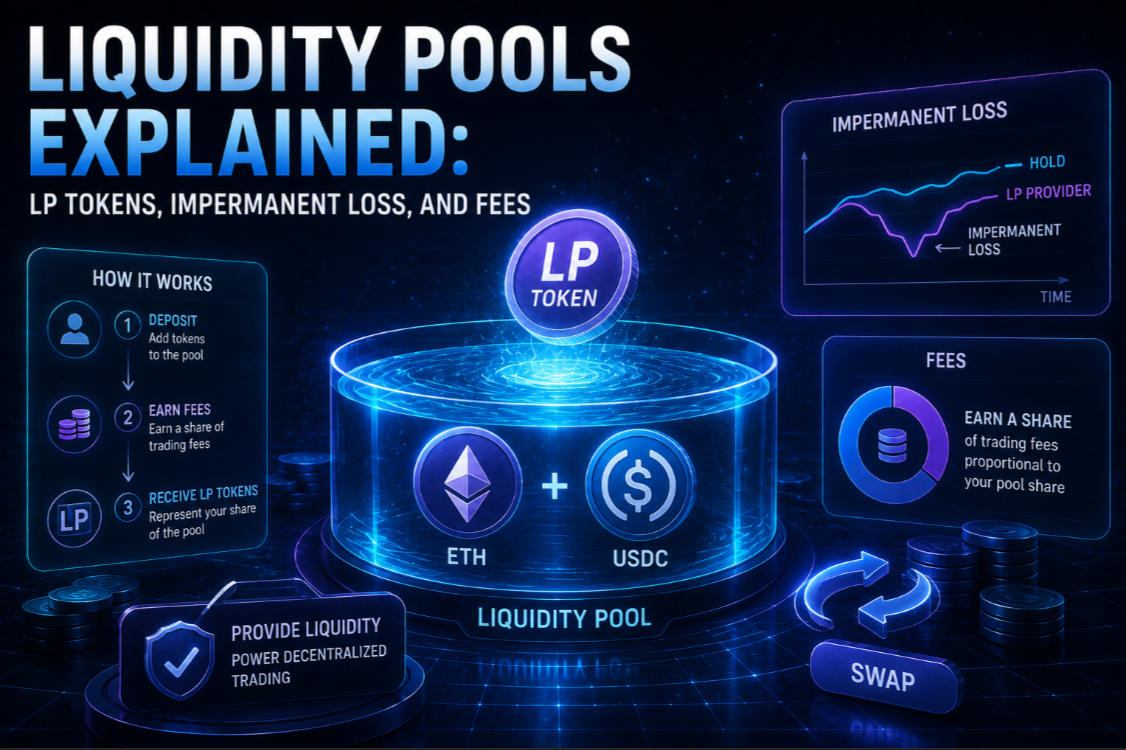
A liquidity pool is a smart contract holding two or more tokens that enables decentralised trading without a traditional order book. Instead of matching buyers with sellers, users trade against the pool. Anyone can deposit tokens into the pool to become a liquidity provider (LP) and earn a share of trading fees in proportion to their contribution.
Before liquidity pools, decentralised exchanges tried to replicate order books on-chain. This was impractical — placing and cancelling orders cost gas, and low liquidity led to huge spreads. Uniswap's introduction of the constant product automated market maker (AMM) in 2018 solved this by replacing the order book with a simple mathematical formula.
How the constant product AMM works (x × y = k)
Uniswap v2 and most basic AMMs use the formula x × y = k, where x is the quantity of token A, y is the quantity of token B, and k is a constant. Every trade moves the ratio of x to y, changing the price. The further you push the ratio in one direction, the more expensive each additional unit becomes — this is slippage.
Example: a pool holds 100 ETH and 300,000 USDC (k = 30,000,000). A trader buys 10 ETH. The pool must maintain k, so it now holds 90 ETH and 333,333 USDC. The trader paid 33,333 USDC for 10 ETH — an average price of $3,333 vs the initial $3,000 spot price. The larger the trade relative to pool size, the worse the execution price.
Concentrated liquidity: Uniswap v3 and beyond
Uniswap v3 (2021) introduced concentrated liquidity, allowing LPs to provide liquidity within a specific price range rather than across the entire 0 to infinity curve. This is far more capital-efficient — an LP can concentrate their $10,000 in the $2,800–$3,200 ETH price range and earn as much fee revenue as a $100,000 position in a v2 pool, assuming price stays in range.
The trade-off is complexity. When price moves outside your chosen range, your position stops earning fees and becomes 100% of the underperforming token. Managing v3 positions actively — adjusting ranges as price moves — is a full-time task for serious LPs. Several protocols (Gamma, Arrakis, Aperture) automate this for a fee.
Stablecoin liquidity pools: Curve Finance
Curve specialises in pools of assets with similar or pegged values — USDC/USDT/DAI, stETH/ETH, and similar. Its StableSwap formula maintains a much tighter curve than x*y=k, resulting in dramatically lower slippage for like-asset swaps. The tradeoff is that Curve is optimised for assets that stay near parity — if a stablecoin depegs significantly, Curve LPs absorb heavy losses.
Curve pools are the backbone of DeFi stablecoin liquidity. Over $3 billion in stablecoins flow through Curve daily. CRV token holders can vote to direct emissions (liquidity mining rewards) to specific pools — the "Curve Wars" where protocols bribe veToken holders to attract liquidity.
What are LP tokens
When you deposit into a liquidity pool, you receive LP tokens representing your proportional share of the pool. These tokens are transferable and composable — they can be staked in other protocols to earn additional rewards. When you withdraw, you burn the LP tokens and receive your share of the pool's current holdings.
LP tokens have become a building block of DeFi composability. Depositing Curve LP tokens into Convex Finance, for example, earns extra CRV and CVX rewards on top of base Curve fees — a common yield stacking strategy.
Impermanent loss: the most misunderstood DeFi risk
Impermanent loss (IL) is the difference between holding tokens outright versus providing them as liquidity. It occurs whenever the price ratio of the two pool tokens changes from when you deposited.
Example: you deposit $5,000 of ETH and $5,000 of USDC. ETH doubles in price. If you had held, you'd have $15,000. But as LPs arbitrageurs rebalance the pool, your position is now worth roughly $14,142 — a $858 loss relative to holding. That $858 is your impermanent loss. If ETH returns to its original price, the IL disappears — hence "impermanent." If you withdraw while prices are diverged, the loss is realised.
- 5% price change → ~0.1% IL
- 20% price change → ~0.5% IL
- 100% price change (price doubles) → ~5.7% IL
- 400% price change → ~20% IL
- Stablecoin pairs → near-zero IL (price ratio barely changes)
For volatile pairs, IL can easily exceed fee income. Most retail LPs underperform simple holding in strong bull markets.
How LP fees work and how to estimate returns
Every swap in a pool generates a fee (typically 0.01%–1% depending on pool tier). This fee is distributed proportionally to all LPs in the pool, accruing directly as an increase in the pool's token balances. The more volume a pool processes, the more fees LPs earn.
Estimated annual fee return = (daily volume × fee rate × 365) / pool TVL. A pool with $100m TVL, $10m daily volume, and 0.3% fees earns ($10m × 0.003 × 365) / $100m = 10.95% APY in fees alone — before IL and token reward bonuses.
Track real-time pool APYs on DeFiLlama, Uniswap app analytics, or Curve's own pool stats page. For DeFi lending rates see also our lending ratings.
Single-sided liquidity: avoiding IL entirely
Some protocols allow single-sided deposits where you provide only one token. The protocol handles internal rebalancing. Bancor v3 pioneered this with its "impermanent loss protection" mechanism. Tokemak, Maverick Protocol, and others offer single-sided models with different mechanics. The IL risk is not eliminated — it is socialised, shifted to the protocol treasury, or converted into token emission cost.
Liquidity pool risks beyond impermanent loss
- Smart contract exploit: A bug in the pool contract can drain all funds. Use only audited protocols.
- Rug pull: Malicious token projects drain pools by minting unlimited supply or calling backdoor functions. Stick to verified contracts.
- Stablecoin depeg: A stablecoin losing its peg in a Curve pool leaves LPs holding the depegged asset.
- Liquidity fragmentation: Low-TVL pools on new chains may have insufficient exits — you could be unable to withdraw at a fair price during stress events.
- Regulatory: Some jurisdictions treat LP fee income as taxable trading income. Confirm local tax treatment before depositing.
How to start providing liquidity: step by step
- Choose a pool with sufficient TVL (>$10m) and verified contract on an established protocol (Uniswap, Curve, Aave).
- Analyse the pool's fee tier, historical volume, and IL for the token pair at current prices.
- Obtain both tokens in the correct ratio (or use a zap tool to split a single token automatically).
- Connect your wallet to the protocol interface and approve each token.
- Deposit and receive LP tokens. Note your entry price ratio for IL tracking.
- Optionally stake LP tokens in a rewards programme for additional yield.
- Monitor your position regularly. Concentrated liquidity positions (Uniswap v3) need active range management.
Tools for liquidity providers
- DeFiLlama — pool TVL, APY, historical data across all chains
- Uniswap Analytics — volume, fees, position tracking for v3 LPs
- Curve.fi — pool stats, CRV rewards, gauge weights
- Revert Finance — Uniswap v3 position analytics and performance tracking
- APY.vision — historical IL and fee return tracking by position
Is providing liquidity worth it in 2026
For stable-pair pools (USDC/USDT on Curve, ETH/stETH), the IL risk is minimal and fee income of 3–8% APY is competitive with CeFi yield. For volatile pairs, LP income frequently underperforms simply holding the underlying tokens during bull markets. The sweet spot for most participants is concentrated stablecoin or correlated-asset pools with established protocols — accessible via our DeFi ratings.
This article is for educational purposes only. Providing liquidity carries significant financial risk including impermanent loss and smart contract exploits. Not financial advice.