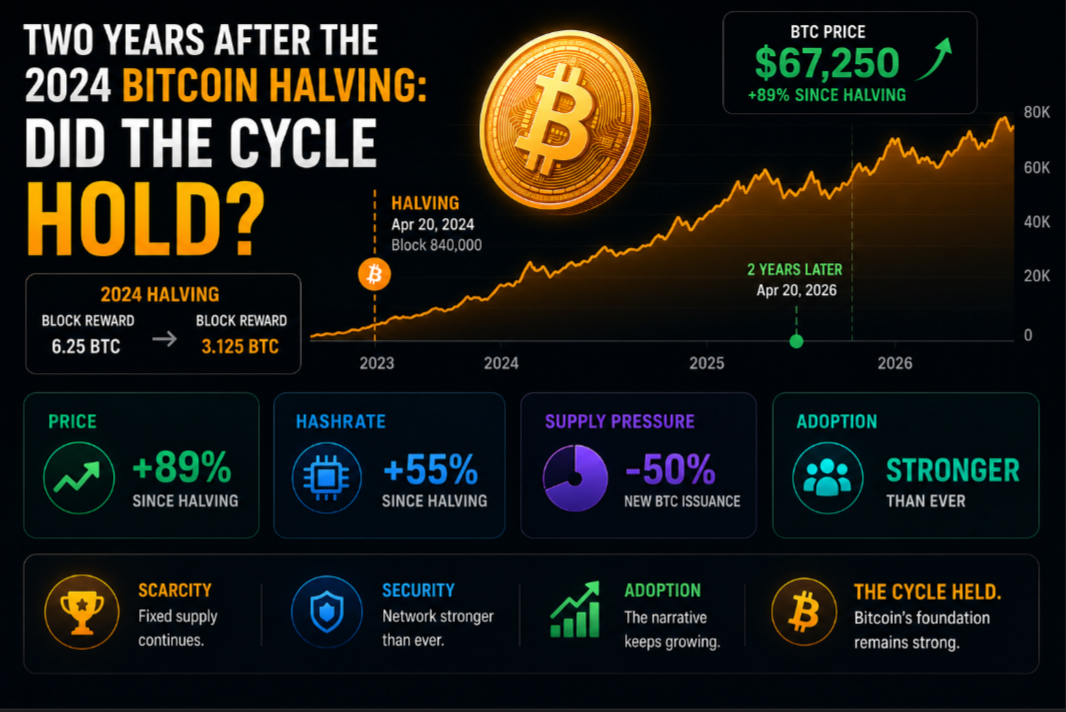
The Bitcoin halving of April 2024 has now faded into the rearview mirror. Two years later, the price has moved from $63,000 at the halving event to an all-time high of $108,000 in late 2026, followed by a correction and recovery. But did the halving cycle hold up as a reliable pattern? We examine the timeline, the data, miner profitability, ETF inflows, and what the past three halving events tell us about what to expect in 2028.
Timeline: The First Two Years After April 2024
The fourth Bitcoin halving occurred on April 19, 2024, when the block reward dropped from 6.25 BTC to 3.125 BTC per block. This was the most widely anticipated halving in Bitcoin history — a year of price speculation preceded it, and institutional investors watched closely. The event itself happened without incident; the network simply continued, mining now generating half the coin supply per unit time.
What followed was not immediate. The price did not jump on halving day itself. Instead, 2024 saw a drawn-out consolidation. Bitcoin moved sideways for most of the second and third quarters, hovering between $60,000 and $70,000. Skeptics noted that previous halvings had preceded multi-month rallies, but this time the pattern felt broken. Then, in the final quarter of 2024, as broader macro conditions shifted and rate-cut expectations resurfaced, Bitcoin began to accelerate.
By January 2025, BTC had broken above $100,000 for the first time in history. The rally continued into early 2026, peaking near $108,000 in March before a sharp 20% correction. Since then, Bitcoin has recovered to the mid-$90,000 range and remains elevated relative to the halving price. The narrative so far: the halving worked, but on a longer timeline than the impatient market expected.
Price Trajectory and What It Means for Miners
Halving events are deflationary shocks to mining economics. When the block reward drops, a miner's revenue from newly issued coin falls by half overnight. Without a price increase, a halving would make mining half as profitable — causing many older, less efficient miners to shut down and hash rate to plummet.
The April 2024 halving was no exception. Immediately after the event, Bitcoin hash rate did dip as the lowest-cost operators were squeezed. But price action mattered. By the time Bitcoin reached $100,000 in early 2025, even miners using older hardware found it economically viable to keep running. A 60% increase in price (from $63k to $100k+) more than compensated for a 50% reduction in supply reward.
Miner profitability by April 2026 — two years on — sits near historical highs. A Bitcoin mined today generates revenue of $100,000 to $110,000 (at current spot price plus transaction fees). Miners who held their BTC from 2024 have realized significant unrealized gains. This profitability has encouraged new mine construction, particularly in regions with cheap renewable energy. The 2024 halving did not kill mining; it culled the weakest players and reinforced Bitcoin's economic security.
ETF Adoption and the Institutional Tailwind
The US spot Bitcoin ETF approval in January 2024 was the pivotal structural change. By the time of the April halving, eleven Bitcoin ETFs were already trading and accumulating substantial assets. The halving, in retrospect, landed in the middle of an institutional adoption wave — not the beginning or end of one.
From April 2024 to April 2026, cumulative net ETF inflows reached approximately $40 billion, slightly ahead of the $35 billion in the first year post-approval. This steady, high-volume institutional demand provided a floor under the price and likely accelerated the rally past the previous cycle high. Without the ETF conduit, a $63,000 Bitcoin would have been a tempting short for macro traders; with it, the passive, long-only capital was large enough to overwhelm selling pressure.
BlackRock's IBIT and Fidelity's FBTC now hold over 600,000 BTC combined — approximately 3% of the circulating supply. A decade ago, this seemed like fantasy. Today, it is a reflection of how far Bitcoin has moved from novelty to asset class. The halving and the ETF approval did not cause this shift alone, but they amplified each other.
How the 2024 Halving Stacks Up Against Previous Cycles
Bitcoin's first three halvings occurred in November 2012, July 2016, and May 2020. All three preceded a multi-month to multi-year rally. But the lag time and the magnitude varied.
- November 2012 halving: Price was $5. It doubled to $10 by year-end, then climbed to $1,100 by late 2013. Lag: under 4 months to first major move.
- July 2016 halving: Price was $650. It took eight months — until March 2017 — to break above $4,000. Lag: 8+ months.
- May 2020 halving: Price was $9,500. It surged to $20,000 by November 2020. Lag: 6 months.
- April 2024 halving: Price was $63,000. It reached $100,000+ by January 2025. Lag: 9 months. Peak-to-halving-price gain: 71%.
The 2024 halving followed the historical pattern, but with a modern twist. Institutional ETF flows meant the price did not need to run as hard to attract fresh capital. The 71% gain from halving to all-time high was smaller than the 1,900% gain in the 2012–2013 cycle, but the base was so much larger that the nominal dollar inflows dwarfed earlier cycles.
Why the 2024 Halving Took Longer to Trigger a Rally
The biggest surprise was not the rally itself but the 9-month delay. In 2012 and 2016, halvings sparked urgent price moves within four to eight months. What changed?
- Macro headwinds: The Federal Reserve was still in rate-hiking mode through mid-2024. Bitcoin, despite being uncorrelated to equities on most days, is not immune to broad risk-off sentiment.
- Efficient markets: With millions of traders analyzing halving effects in real time, "buy before the halving" crowded out the price already. The actual halving event was less shocking than the months of anticipation.
- ETF saturation: Rather than a single explosive move, ETF flows were more linear. Passive capital does not FOMO; it accumulates steadily.
- Regulation uncertainty: Ongoing UK and EU regulatory announcements created noise through 2024, delaying conviction.
By early 2025, when rate-cut expectations returned and the macro backdrop shifted, Bitcoin finally accelerated. The halving did its job — reducing supply — but price discovery took longer.
What to Watch for the 2028 Halving and Beyond
If history is a guide, the next Bitcoin halving lands in spring 2028, when the block reward drops from 3.125 BTC to approximately 1.5625 BTC. By then, roughly 20.95 million of 21 million Bitcoin will be mined. The supply story becomes even more acute — almost nothing new will be produced, and fees will become the primary miner revenue.
The institutional landscape by 2028 will likely be even more established. Today's nascent Bitcoin ETFs will be mature. Spot Bitcoin trading may be available in every major global market. A handful of nations or sovereign wealth funds may hold Bitcoin as official reserves. If any of this materializes, the 2028 halving could trigger a more immediate market reaction because large pools of capital will be positioned in advance.
Risks remain. Regulation could tighten. Macro recession could dampen risk appetite. Mining economics could shift if electricity costs spike. But the pattern now spans 12 years, four halvings, and multiple market cycles. The halving is not magic; it is a transparent supply shock. The market has learned to price it in, but price discovery still takes time.
For a detailed price forecast and longer-term Bitcoin outlook, see our Bitcoin price forecast. For live market data, check the Bitcoin market page.
Halving cycles are not guarantees. Past performance does not predict future results. Always do your own research before making investment decisions.