Bitcoin has always been the base layer: the settlement chain, the store of value, the reserve asset. For most of its existence, attempts to add programmability on top were marginal experiments or custodial hacks. That changed in 2024-2026 as a cohort of serious Layer 2 protocols — Stacks, BOB, Bitlayer, and Babylon — each took a meaningfully different architectural approach to the same problem: how do you build DeFi on Bitcoin without compromising Bitcoin's properties? The Bitcoin market page and Bitcoin price forecast now increasingly reflect L2 activity as a component of fundamental demand.
Stacks: Clarity Smart Contracts Anchored to Bitcoin
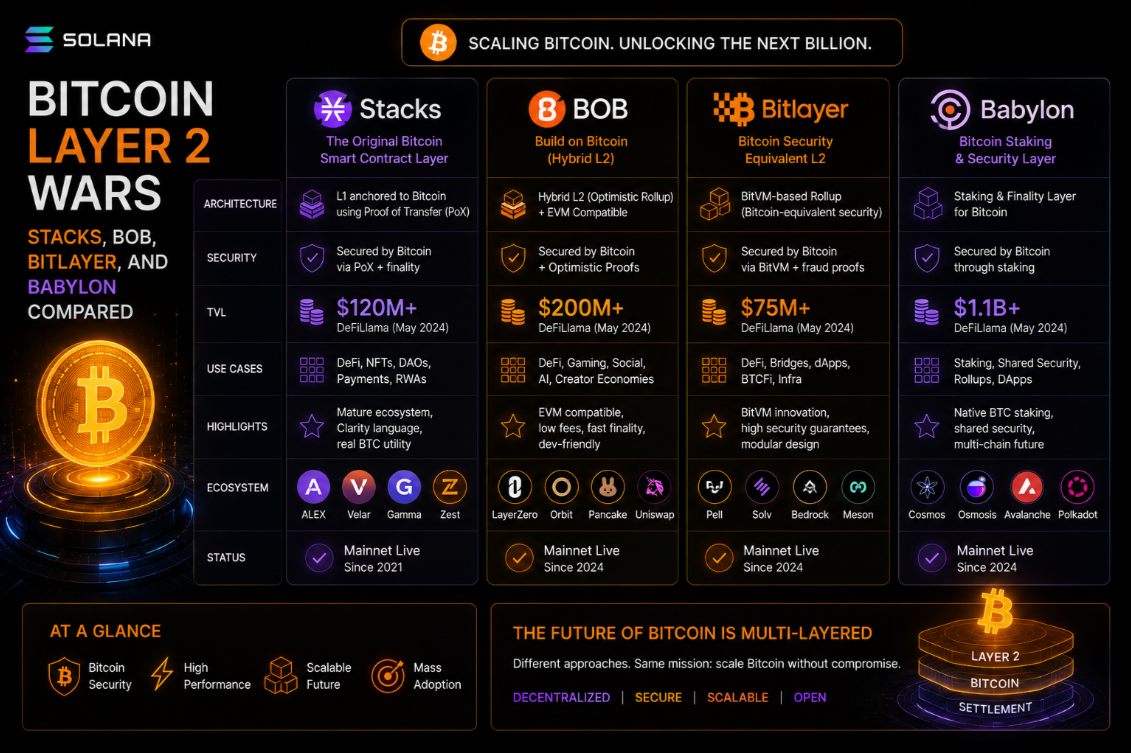
Stacks is the oldest of the four protocols with a mainnet dating to 2021, giving it the most mature developer ecosystem. Its Proof of Transfer (PoX) consensus mechanism has Bitcoin miners and Stacks validators exchange BTC for STX, cryptographically linking Stacks block history to Bitcoin's own. Every Stacks block hash is anchored to a Bitcoin transaction — meaning Stacks benefits from Bitcoin's immutability without being a direct rollup.
The flagship primitive is sBTC: a 1:1 Bitcoin peg managed by a decentralised threshold signing committee rather than a single custodian. sBTC allows Bitcoin holders to deposit BTC into the Stacks ecosystem, use it in Clarity-based DeFi protocols (lending, AMMs, perpetuals), and withdraw back to native Bitcoin with a 24-48 hour delay tied to Bitcoin finality.
Stacks DeFi TVL crossed $1.8 billion in Q1 2026, led by ALEX (the largest Stacks DEX), Arkadiko (stablecoin protocol), and several lending markets. Developer tooling has matured significantly: Clarity's decidability property means smart contract behaviour can be formally verified, a safety guarantee unavailable on Ethereum or Solana.
BOB: Build on Bitcoin With EVM Compatibility
BOB (Build on Bitcoin) takes an engineering pragmatist's approach: rather than building Bitcoin-native smart contract infrastructure from scratch, it uses the OP Stack (same as Base and OP Mainnet) to deploy a fully EVM-compatible L2 that settles to Ethereum but uses Bitcoin-anchored security via BitVM proofs. The result is a chain where Ethereum developers can deploy Solidity contracts without modification while interacting with native Bitcoin liquidity.
BOB's BTC bridge uses a federated custody model augmented by optimistic BitVM verification: a committee of signers manages the BTC peg, but any signer misbehaviour can be challenged and penalised through a BitVM circuit published to the Bitcoin main chain. This is weaker than a fully trustless rollup but substantially stronger than a simple multisig bridge.
The EVM compatibility is BOB's killer feature for developer adoption. Teams building on Binance Smart Chain or Ethereum L2s can migrate to BOB with minimal code changes, bringing their existing user bases into a Bitcoin-secured environment. BOB TVL was approximately $340 million in early 2026, growing at roughly 20% month-over-month.
Bitlayer: ZK-Verified Bitcoin Rollup Ambitions
Bitlayer is the most technically ambitious of the four: it aims to be a genuine Bitcoin rollup using zero-knowledge proofs verified by Bitcoin script. The fundamental challenge is that Bitcoin's script language is deliberately limited — it cannot natively verify arbitrary ZK proofs. Bitlayer's solution uses a combination of BitVM's optimistic challenge-response framework and a custom ZK verifier, achieving near-rollup security properties while remaining compatible with Bitcoin consensus.
The trade-off is complexity and performance: Bitlayer's ZK proof generation adds latency and cost compared to optimistic approaches. However, the security guarantees are stronger — malicious sequencers cannot escape accountability even without an honest challenger present, unlike purely optimistic systems.
- TVL: ~$210 million (April 2026)
- Finality: ~30 minutes (ZK proof generation + Bitcoin confirmation)
- EVM compatibility: full (EVM bytecode execution)
- Security model: ZK proofs + BitVM challenge, anchored to Bitcoin
- Primary DeFi: lending (LayerBank fork), DEX, BTC-backed stablecoins
Babylon: Native Bitcoin Staking Without Bridges
Babylon Protocol takes a fundamentally different approach to the Bitcoin L2 problem. Rather than running smart contracts on a Bitcoin-secured chain, Babylon enables Bitcoin holders to use their BTC as cryptographic collateral for external Proof-of-Stake networks — without ever moving the BTC off the Bitcoin main chain.
The mechanics work through UTXO locking: a Bitcoin holder creates a transaction that locks their BTC with specific spending conditions. If the staker behaves honestly on the PoS chain they are securing, they can reclaim the BTC after an unbonding period. If they misbehave (double-vote, equivocate), a pre-signed slashing transaction burns a portion of their BTC — creating real economic penalties enforced by Bitcoin script, not a separate chain's governance.
Babylon's lead among Bitcoin L2s by TVL — $4.5+ billion — reflects the simplicity of its value proposition for long-term BTC holders: earn yield on Bitcoin without wrapping, bridging, or leaving the main chain. The primary risk is smart contract bugs in Babylon's finality gadget and the economic security of early-stage PoS chains that rely on Babylon stakers.
Architectural Trade-offs: A Side-by-Side View
How do these four approaches compare along the key dimensions that matter for Bitcoin DeFi?
- Security model: Stacks (PoX anchor) < BOB (BitVM + OP Stack) < Bitlayer (ZK + BitVM) ≈ Babylon (native UTXO locking)
- EVM compatibility: BOB and Bitlayer (full EVM) vs Stacks (Clarity, not EVM) vs Babylon (no smart contracts, staking only)
- BTC bridging friction: Babylon (none — BTC stays on L1) < Stacks sBTC (24-48h) < BOB and Bitlayer (hours to days)
- Developer ecosystem maturity: Stacks > BOB ≈ Bitlayer > Babylon
- TVL (April 2026): Babylon ($4.5B) > Stacks ($1.8B) > BOB ($340M) > Bitlayer ($210M)
What Bitcoin L2 Growth Means for BTC Demand
Each of these protocols creates a new demand vector for BTC: Stacks locks BTC in sBTC peg contracts; BOB and Bitlayer lock BTC in bridge custody; Babylon locks BTC in staking UTXOs. Combined, Bitcoin Layer 2 protocols have removed approximately 90,000 BTC from liquid circulation — a figure that will grow as adoption expands.
The long-term thesis for Bitcoin L2s is that they expand Bitcoin's utility without compromising its base-layer properties. Bitcoin remains the settlement chain; L2s add programmability, yield, and DeFi on top. If successful, this model could challenge Ethereum's dominance in DeFi by routing capital through Bitcoin's security model rather than Ethereum's separate validator set.
Investors seeking on/off ramps to these ecosystems should review custody options at Coinbase review and the broader exchange rankings for platforms supporting native BTC deposits into L2 protocols.