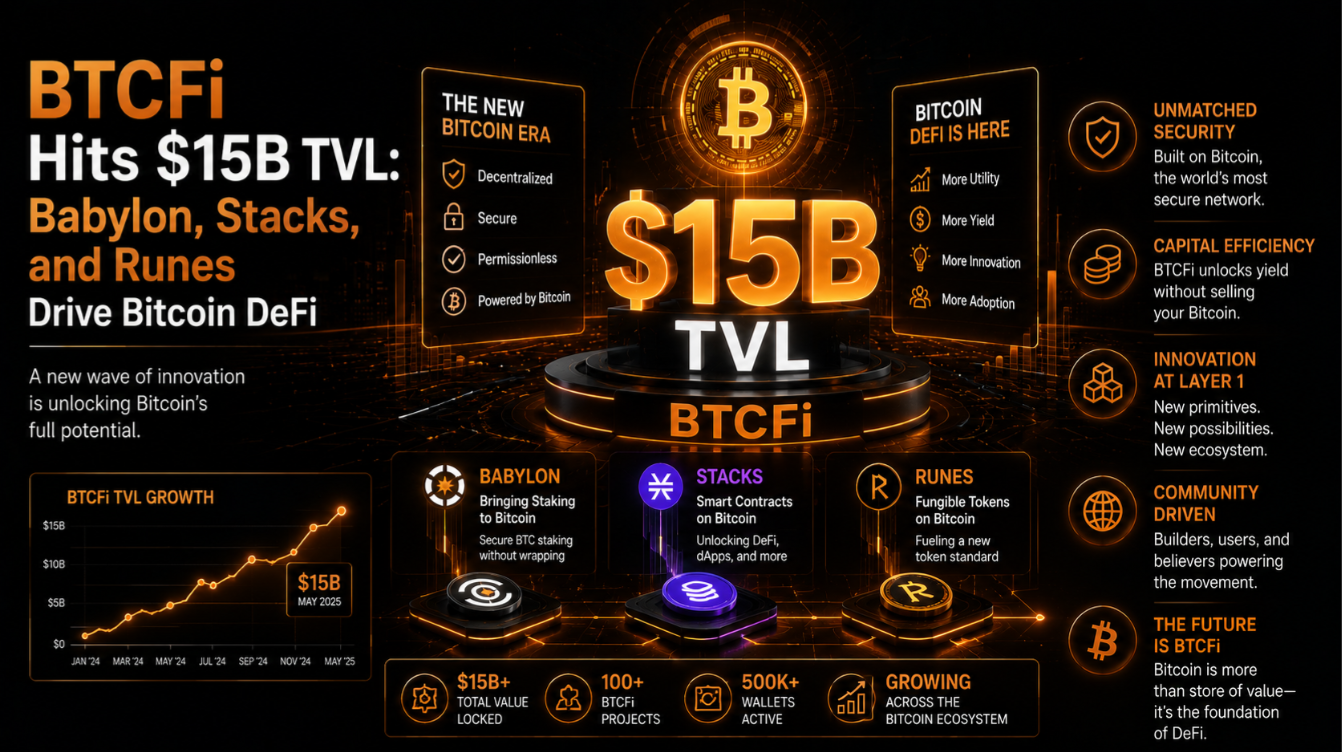
Bitcoin DeFi has emerged as one of the fastest-growing segments in cryptocurrency, with total value locked (TVL) surpassing $15 billion across various protocols and solutions. This explosive growth is driven by innovations enabling decentralized finance directly on Bitcoin—from native staking mechanisms pioneered by Babylon Protocol to sidechain infrastructure like Stacks, alongside the rising popularity of Ordinals and Runes inscriptions. The BTCFi renaissance reflects market demand for Bitcoin-based yield strategies and represents a pivotal moment for Bitcoin's evolution beyond pure settlement and store of value.
BTCFi TVL Milestone: The $15B Inflection Point
Bitcoin DeFi reached a historic milestone in April 2026, accumulating over $15 billion in total value locked across all major protocols and sidechain solutions. This represents roughly a 5x increase from just 18 months earlier, when BTCFi TVL hovered around $3 billion. The acceleration reflects maturation of Bitcoin staking infrastructure, increased institutional interest in Bitcoin-native financial products, and technological breakthroughs enabling complex DeFi primitives on Bitcoin's conservative consensus layer.
The $15 billion milestone is particularly significant because it demonstrates that investors and protocols view Bitcoin not merely as a digital commodity, but as foundational infrastructure capable of supporting sophisticated financial applications. This paradigm shift validates years of development effort by teams building Bitcoin scaling and DeFi solutions, and signals a new chapter in Bitcoin's narrative—from "number go up" to "Bitcoin as a financial operating system."
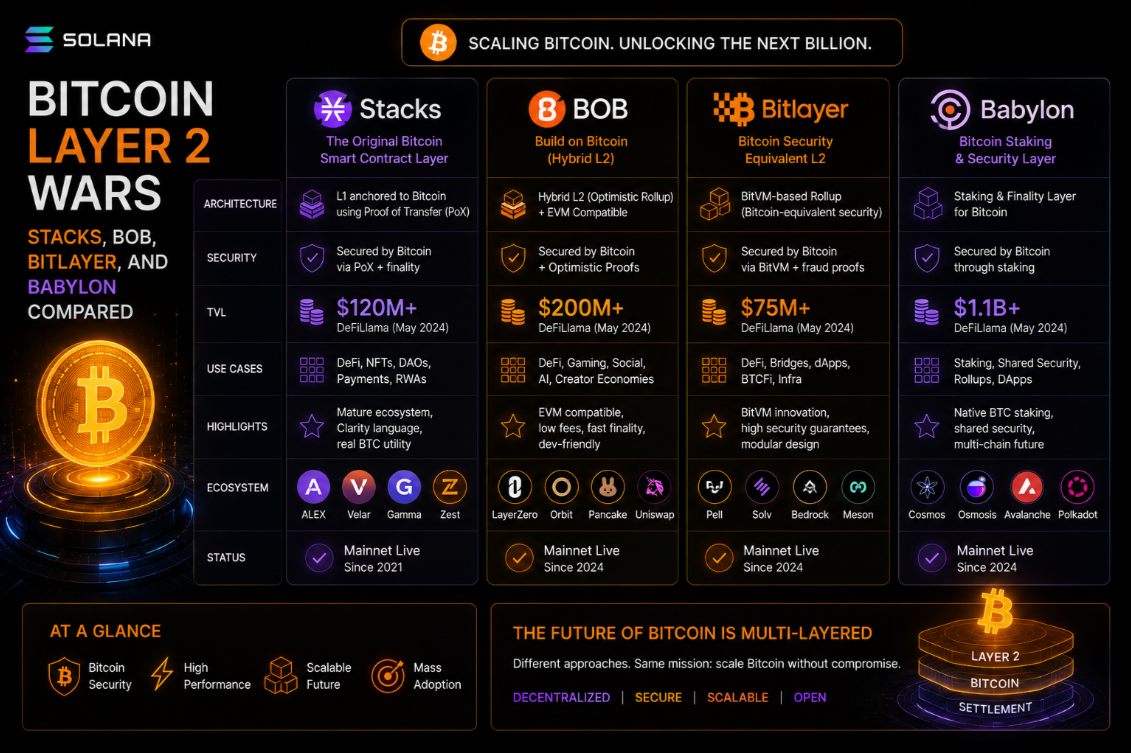
Babylon Protocol: Bitcoin Staking Reaches $5B TVL
Babylon, the most significant Bitcoin staking protocol launched in 2024, has grown to approximately $5 billion in TVL by April 2026. The protocol enables Bitcoin holders to stake their BTC directly without wrapped tokens or custodial intermediaries, earning yields through blockchain validation while maintaining security guarantees through Bitcoin's proof-of-work consensus.
Babylon's architecture is revolutionary: it allows Bitcoin to function as a dual-layer security provider for other blockchains (Cosmos chains initially, expanding further). Stakers receive staking rewards while their Bitcoin remains in self-custody, eliminating counterparty risk traditionally associated with delegated staking pools. This design appeals to Bitcoin maximalists concerned about custodial exposure while offering yield previously unavailable to BTC holders.
Key metrics driving Babylon's dominance in BTCFi:
- $5 billion BTC locked natively (not wrapped)
- ~7-12% annual staking yields denominated in BABI token + staking rewards
- Minimum stake: 1 BTC with no lockup period beyond unbonding window
- 200+ validator operators participating in network
- Zero liquidation risk—Bitcoin backing always secure on-chain
Babylon's success has triggered interest from other ecosystems seeking Bitcoin security. Ethereum, Cosmos, and emerging Layer 2s are exploring integration with Babylon's staking infrastructure, potentially elevating Bitcoin's role as a canonical security layer. This multi-chain positioning could drive TVL growth to $10+ billion within 24 months.
Stacks and sBTC: Smart Contracts on Bitcoin
Stacks, the original Bitcoin Layer 2 smart contract platform, hosts approximately $2 billion in TVL and has emerged as the leading platform for Bitcoin-native DeFi applications. The introduction of sBTC—a trustless, two-way bridge connecting BTC on the Bitcoin mainchain to smart contract Bitcoin on Stacks—has fundamentally altered the utility proposition for Bitcoin developers.
Prior to sBTC, Stacks users had to rely on wrapped BTC (xBTC or others), introducing custodial risk and trust assumptions. sBTC removes these barriers by enabling 1:1 conversion between Bitcoin and smart contract BTC, with atomic settlements via Bitcoin's consensus layer. This breakthrough allows developers to write DeFi applications (DEXs, lending, synthetic assets) that settle directly on Bitcoin.
Stacks ecosystem highlights:
- Alex, Arkadiko, and others deployed as premier DeFi protocols
- sBTC bridging mechanism: Bitcoin-native, no third-party custody
- $2 billion TVL concentrated in DeFi and native token staking
- Clarity language: Bitcoin-safe smart contract language designed for clarity
- Subnets: Layer 3 applications scaling Stacks further, launching in 2026
The Stacks ecosystem is particularly attractive for Bitcoiners skeptical of other Layer 2s or sidechains. Because Stacks settles all transactions on Bitcoin mainchain every block, security guarantees flow directly from Bitcoin's hash power—no separate consensus mechanism required. This Nakamoto-aligned design resonates with Bitcoin's security-first philosophy.
Runes and Ordinals Fee Revenue: New Bitcoin Economics
The explosion of Runes (a fungible token protocol on Bitcoin) and continued growth of Ordinals inscriptions have dramatically increased Bitcoin network fees, creating a secondary revenue stream for miners. This development reshapes Bitcoin's long-term tokenomics and incentive structure.
In March-April 2026, Runes trading volume reached billions of dollars weekly, with individual transactions paying $50-200 in network fees during peak demand. This activity has generated over $300 million in fees over recent months—orders of magnitude higher than fees from traditional Bitcoin transactions. While volatility remains high, the fee market demonstrates that Bitcoin blocks are valuable real estate for digitally-native assets.
Implications for Bitcoin mining economics:
- Network fees now substantial ($100M+ monthly) supplementing block subsidy revenue
- Miners incentivized to support Runes/Ordinals as genuine fee-generating activity
- Long-term security: as block subsidy halves to zero by 2140s, transaction fees become primary miner income
- Market discovery: Runes fee market establishing actual scarcity value for Bitcoin blockspace
This evolution is controversial among Bitcoin purists, who argue Runes clutter the blockchain with non-essential data. However, from an economic perspective, the fee market demonstrates that Bitcoin's security can be funded through multiple revenue channels—not solely through newly-issued Bitcoin. This strengthens the case for Bitcoin's long-term sustainability independent of appreciation.
Native BTC vs. Wrapped BTC: The Trust Model Debate
A central tension in BTCFi is the distinction between native Bitcoin locked on the mainchain versus wrapped Bitcoin on sidechains and Layer 2s. This debate has profound implications for DeFi safety and capital efficiency.
Solutions like Babylon and sBTC champion native Bitcoin — BTC locked directly on mainchain with smart contract integration through cryptographic proofs (Babylon's approach) or direct consensus-layer settlement (Stacks/sBTC). This eliminates custodial counterparty risk; participants trust Bitcoin's security model, not a bridge operator or federation.
In contrast, earlier wrapped Bitcoin solutions (Renbridge, tokenized BTC on Ethereum/Solana) require trust in bridge operators or multi-sig custodians. While these bridges have been generally safe, they introduce single points of failure—a key vulnerability highlighted by multiple bridge hacks across L2 ecosystems.
Institutional capital increasingly favors native Bitcoin solutions because of this security clarity. A $100M position in Babylon carries only Bitcoin consensus risk, whereas the same position in wrapped BTC carries both Bitcoin risk and bridge operator risk. As BTCFi matures, protocols utilizing native Bitcoin are likely to command higher valuations and TVL.
Lightning Network Growth: Off-Chain Scalability
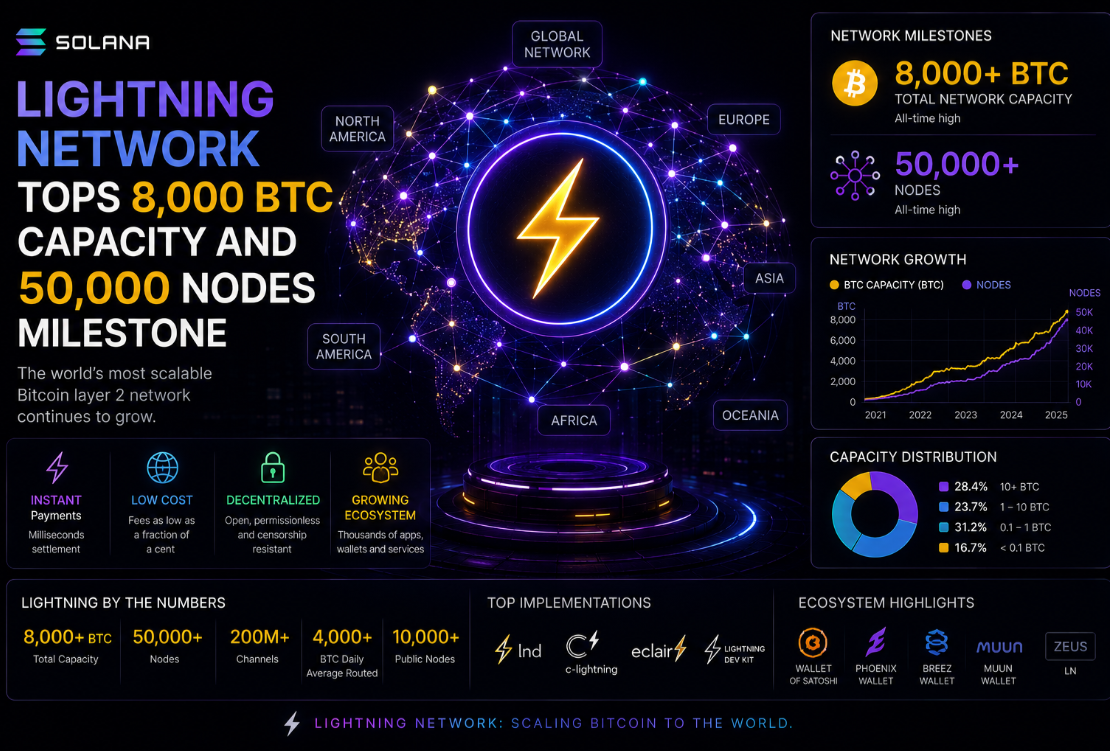
While Layer 2s and sidechains capture headlines, the Lightning Network continues expanding as Bitcoin's primary off-chain scaling solution. With over 100,000 payment channels and $400+ million in capacity, Lightning enables near-instant, low-cost Bitcoin payments at global scale.
Lightning's role in BTCFi is expanding beyond payments into DeFi:
- Liquidity pools: DEXs like Stacks and others integrate Lightning for cross-chain swaps
- Atomic swaps: enabling trustless peer-to-peer trading without intermediaries
- Payment channels: funding mechanism for Runes/Ordinals transactions
- Scalability: enabling millions of transactions on Bitcoin with only mainchain settlements
Lightning's advantage is that it requires no changes to Bitcoin's consensus rules and operates as a second-layer protocol. This preserves Bitcoin's decentralization and security while enabling transaction throughput rivaling centralized payment processors. As mobile wallets improve, Lightning could become the dominant Bitcoin transaction layer for retail users.
Risks and Trust Model Challenges in BTCFi
Despite rapid growth, BTCFi faces significant risks and open questions about long-term viability:
- Smart contract risk: protocols like Stacks implement Turing-complete smart contracts, introducing complexity and potential vulnerabilities despite careful design
- Bridge risk: any sidechain or Layer 2 requiring wrapped BTC introduces custodial or cryptographic risk
- Validator concentration: emerging BTCFi protocols may have small validator sets, increasing centralization risk
- Regulatory uncertainty: Bitcoin-native financial products may face regulatory scrutiny in major jurisdictions
- Yield sustainability: 7-12% staking yields in Babylon depend on ecosystem growth; if growth stalls, yields compress
- Bitcoin philosophy tension: some argue DeFi on Bitcoin contradicts Cypherpunk ethos of simplicity and decentralization
These risks are not disqualifying, but they merit serious consideration for investors and developers. The most resilient BTCFi protocols will be those with minimal trust assumptions, strong cryptographic guarantees, and clear long-term economic models.
Looking Forward: Multi-Billion Dollar BTCFi Future
The $15 billion BTCFi milestone represents an inflection point, not a ceiling. Analysts project BTCFi could reach $50-100 billion TVL within 3-5 years, driven by:
- Institutional Bitcoin allocation: pension funds and endowments exploring Bitcoin-native staking yields
- Regulatory clarity: clear framework for Bitcoin-based financial products in major jurisdictions
- Technological maturity: subnets, cross-chain bridges, and Lightning improvements enabling complex DeFi
- Market cycle: 2026-2027 bull market potentially driving speculative capital toward yield opportunities
- Global adoption: Bitcoin DeFi in developing countries where traditional finance is unavailable
The most important development may not be TVL growth itself, but Bitcoin's evolution into a native financial network capable of supporting yield generation, asset transfers, and complex financial instruments. This transition positions Bitcoin not as a competing alt-chain, but as foundation layer security and settlement for a global financial system.
The BTCFi renaissance is only beginning. As Babylon, Stacks, Lightning, and innovative protocols mature, Bitcoin's role in decentralized finance will likely expand far beyond current imagination. The $15 billion milestone is simply the first chapter of what could become a multi-trillion-dollar ecosystem.