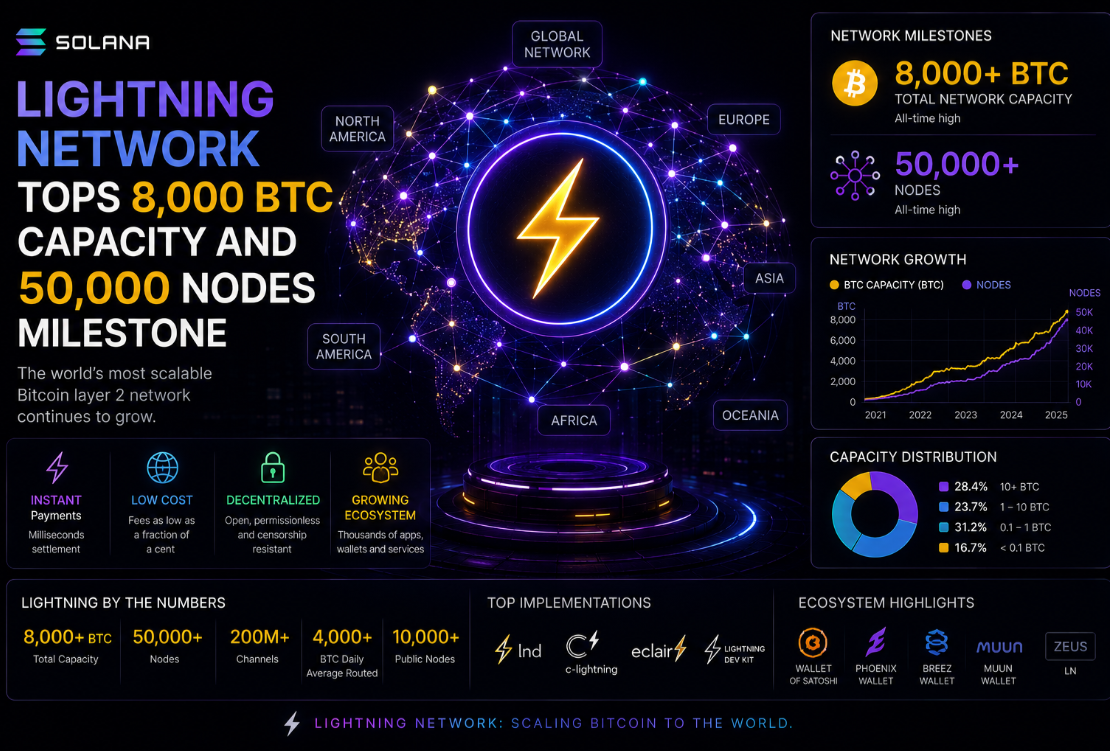
The Bitcoin Lightning Network quietly crossed two significant milestones in April 2026: public channel capacity exceeded 8,000 BTC and the routing node count surpassed 50,000 for the first time. These numbers represent growth of roughly 35% year-over-year and validate years of engineering work on payment channels, liquidity management, and routing algorithms. As a Layer 2 payment protocol built directly on Bitcoin, Lightning has achieved a network size that supports serious commercial deployment.
How Lightning Network Works: A Brief Primer
Lightning channels are two-party escrow contracts on the Bitcoin main chain. When Alice and Bob open a channel by locking 1 BTC together, they can exchange payments back and forth off-chain indefinitely — each update modifying the balance split without touching the blockchain. When they close the channel, the final settlement is broadcast and confirmed on-chain.
The power of Lightning comes from multi-hop routing. Alice doesn't need a direct channel with every person she wants to pay; she can route through intermediaries who each earn tiny routing fees (typically 1-10 sat/hop). A well-connected routing node might facilitate thousands of payments per day, earning satoshi-sized fees that aggregate into meaningful revenue. This graph structure is what makes Lightning a network rather than just a bilateral payment arrangement.
What 50,000 Nodes and 8,000 BTC Capacity Actually Mean
The 50,000-node milestone is significant because network effects in payment routing are superlinear: each additional well-capitalised node creates new paths, reduces routing failures, and improves payment reliability for the entire network. Routing reliability (the percentage of attempted payments that succeed on first try) has improved from roughly 65% in 2021 to over 90% for payments under $500 in 2026.
The 8,000 BTC in public channel capacity (approximately $720 million at current prices) understates true Lightning liquidity. Private channels — not broadcast to the public routing graph — may add another 30-50% on top. Several large custodial Lightning services (Strike, Cash App, River Financial) run private liquidity pools that route payments internally without exposing channel balances.
- Public routing nodes: ~50,000 (up from ~37,000 in Q1 2025)
- Public channels: ~95,000 (up from ~71,000 in Q1 2025)
- Average channel capacity: ~84,000 satoshis ($75 at $90K BTC)
- Largest routing hubs by capacity: ACINQ (Phoenix), River, Voltage
- Countries with most nodes: United States (~28%), Germany (~14%), France (~8%)
Merchant Adoption: Where Lightning Is Being Used
Real-world Lightning adoption has accelerated across three vectors. First, Bitcoin-friendly fintech integrations: Strike's API, connected to point-of-sale systems in 30+ countries, processes millions of Lightning payments monthly. Second, remittances: corridors between the United States and Latin America, Africa, and Southeast Asia use Lightning to transmit value in seconds for costs under $0.01 — a fraction of Western Union or bank wire fees.
Third, micropayments: content monetisation platforms, podcast streaming apps (via Podcasting 2.0 Value4Value), and API metering services use Lightning to charge per-article, per-second, or per-API-call fees that would be economically irrational on any legacy payment rail. This use case remains niche but demonstrates a genuinely novel capability that no credit card or stablecoin system offers equivalently.
The Bitcoin price forecast increasingly factors Lightning's payment volume as a fundamentals indicator alongside on-chain metrics.
Technical Challenges Still Facing Lightning
Despite the milestones, Lightning faces persistent challenges. Channel liquidity management remains difficult: senders need outbound liquidity; receivers need inbound liquidity; and keeping channels balanced requires active intervention or automated tools. Solutions like splice-in/splice-out (adding or removing liquidity without closing channels) and liquidity service providers (LSPs) improve the experience but add complexity.
Routing reliability for large payments (above ~0.1 BTC) degrades significantly because few channels have sufficient capacity to route the full amount in a single path. Multi-path payments (MPP), which split a large payment across several routes, address this partially but increase complexity and failure surface.
Watchtowers — services that monitor channels on behalf of offline users to prevent malicious channel closes — are now widely deployed but require trust or additional infrastructure. Privacy on Lightning is also an ongoing concern: routing nodes can infer payment flows even without learning exact amounts.
Competition and Complementarity With Other Bitcoin Layer 2s
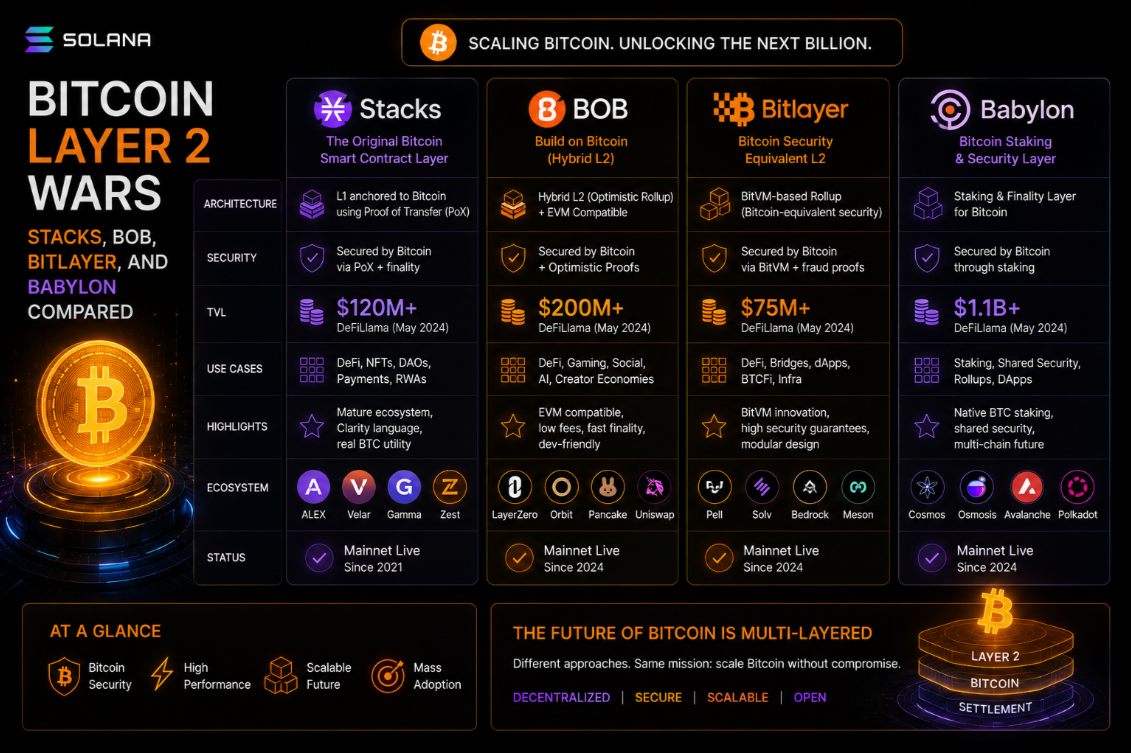
Lightning's focus on payments puts it in a different category from newer Bitcoin Layer 2 projects like Stacks, Rootstock (RSK), and Babylon Protocol, which aim to bring DeFi, smart contracts, and staking to Bitcoin. These systems are not really competitors to Lightning — they target different use cases on different time horizons.
However, projects like Ark Protocol and Fedimint offer alternative models for off-chain Bitcoin payments that trade some Lightning properties (non-custodial by default) for better scalability or user experience. The next few years will determine whether these approaches complement or partially replace Lightning in specific market segments. For a full comparison, see the Bitcoin Layer 2 comparison article and exchange ratings for custodians supporting Lightning withdrawals.