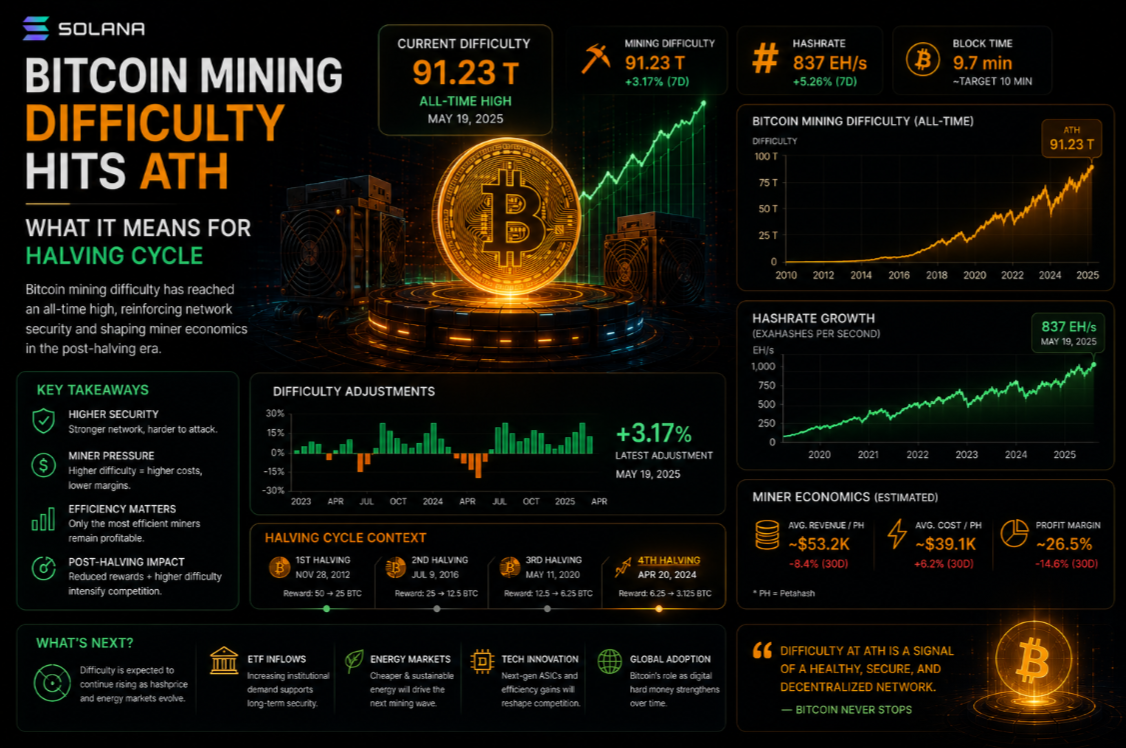
Bitcoin's mining difficulty adjusted upward to an all-time high in early April 2026, confirming that the global hash rate has never been higher. The adjustment — an increase of roughly 4.7 % — reflects the continued deployment of next-generation ASIC hardware and the expansion of large-scale mining operations in North America, the Middle East, and parts of Africa. For investors monitoring on-chain fundamentals, this milestone reinforces the security underpinning of Bitcoin's market position.
Understanding the Difficulty Adjustment Mechanism
Bitcoin's difficulty adjustment is one of Satoshi Nakamoto's most elegant engineering decisions. Every 2,016 blocks — approximately two weeks — the protocol automatically recalculates the difficulty target based on how long those blocks actually took. If miners found them faster than ten minutes on average, the target tightens (difficulty rises); if slower, it loosens. The result is a self-correcting system that maintains predictable issuance regardless of how much or how little compute is dedicated to the network.
The current difficulty of approximately 115 trillion (measured as the number by which a block hash must be less than) means miners collectively perform around 720 exahashes per second — 720 quintillion cryptographic operations every single second. To put that in perspective: the entire global internet traffic is measured in petabytes per month; Bitcoin's hash rate represents a computational effort several orders of magnitude beyond any other distributed system ever built.
Drivers of Record Hash Rate in 2026
Three forces converged to push hash rate and difficulty to new highs in this cycle. First, the April 2024 halving incentivised miners to replace older-generation machines (S19s, M30s) with new-generation hardware (Bitmain S21 XP, MicroBT M66S) that deliver two to three times better efficiency. Capital markets supported this capex cycle: publicly listed miners raised over $3.4 billion in equity and debt during 2024-2025 specifically to fund ASIC purchases.
Second, cheap stranded energy sources became accessible. Miners have co-located with flared gas operations in Texas, the Permian Basin, and the Canadian oil sands, turning methane that would otherwise be vented into revenue-generating compute. These operations face near-zero fuel costs, dramatically improving unit economics and enabling continuous operation regardless of BTC price.
Third, the political environment in the United States shifted favourably. Several states — Wyoming, Tennessee, and Texas — passed legislation protecting miners' right to operate and connect to the grid, reducing regulatory uncertainty that had throttled investment in prior years.
Miner Economics at the ATH Difficulty Level
Record difficulty creates a wide spread between efficient and inefficient miners. At current difficulty, energy prices above approximately $0.07 per kWh render most pre-2023 generation ASICs unprofitable even with BTC at $90,000. Operators running modern hardware on sub-$0.04 electricity — primarily nuclear, hydro, and flared-gas sources — enjoy margins of 60-70 %.
- Break-even BTC price for S19j Pro at $0.06/kWh: ~$82,000
- Break-even BTC price for S21 XP at $0.04/kWh: ~$41,000
- Break-even BTC price for S21 XP at $0.02/kWh (stranded gas): ~$21,000
- Estimated share of network on modern hardware (2024+): ~68%
Public miners have responded to margin pressure by diversifying revenue streams. Several have pivoted GPU clusters to AI inference workloads during Bitcoin price troughs, monetising idle power infrastructure without selling BTC. This revenue diversification reduces the probability of forced BTC sales that historically amplified bear-market corrections.
Hash Rate and the Post-Halving Cycle Playbook
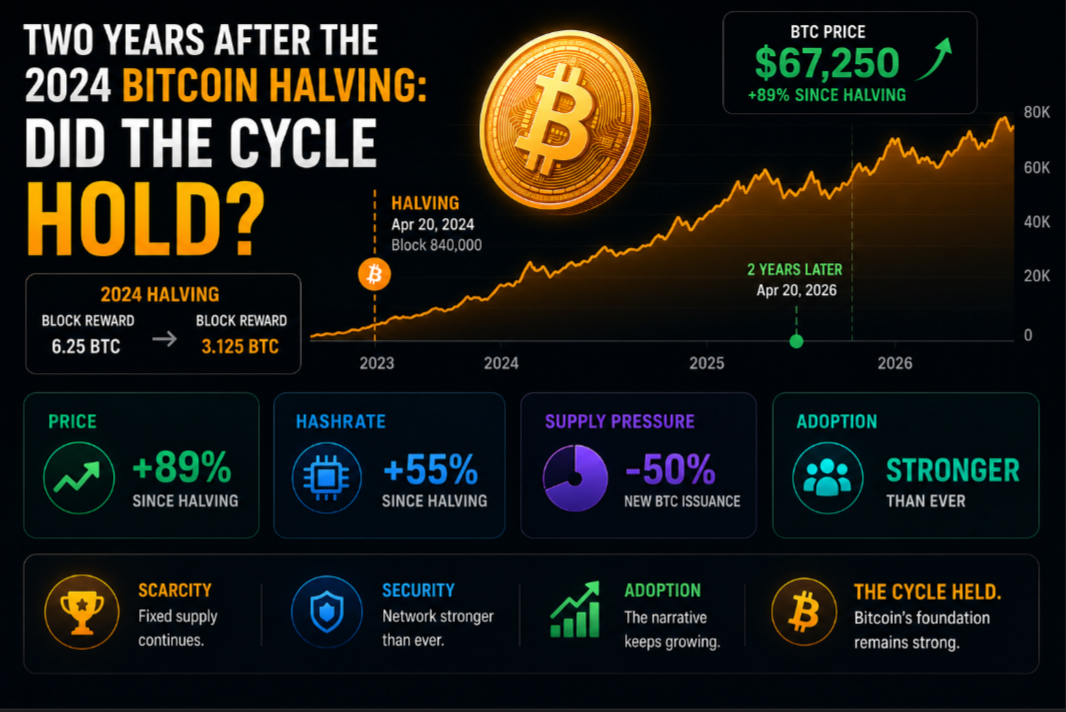
Three previous halvings provide a consistent pattern: difficulty typically peaks one to two months before the halving as miners rush to deploy hardware ahead of the reward cut; it dips modestly in the immediate aftermath as marginal operations shut down; then it resumes an upward trend as the BTC price appreciation that typically follows a halving restores miner margins and attracts new capital.
The 2026 ATH difficulty came approximately 24 months post-halving — precisely the phase in historical cycles when hash rate peaks before the next cycle's difficulty plateau. The Bitcoin price forecast models that incorporate hash rate as an input signal interpret this level as consistent with peak cycle conditions, though timing divergence is always possible.
Transaction Fee Revenue: The Long-Term Security Budget
Bitcoin's long-term security model requires that transaction fee revenue eventually replace block subsidies as the primary miner incentive. At current fee levels (~$2-8 per transaction), fees represent only 3-6% of miner revenue. For the security budget to remain adequate after multiple future halvings, either fees must rise substantially or the dollar price of BTC must keep pace with declining issuance.
Ordinals, Runes, and other inscription protocols that use Bitcoin blockspace have provided a fee surge mechanism in recent years, demonstrating fee market responsiveness. Critics argue these use cases are transient; proponents note that any application that values Bitcoin's settlement finality will rationally pay to settle there, creating a sustainable fee floor.
Institutional investors evaluating Bitcoin's long-term risk profile through platforms reviewed in the exchange ratings should factor the security budget transition into multi-decade holding horizons.