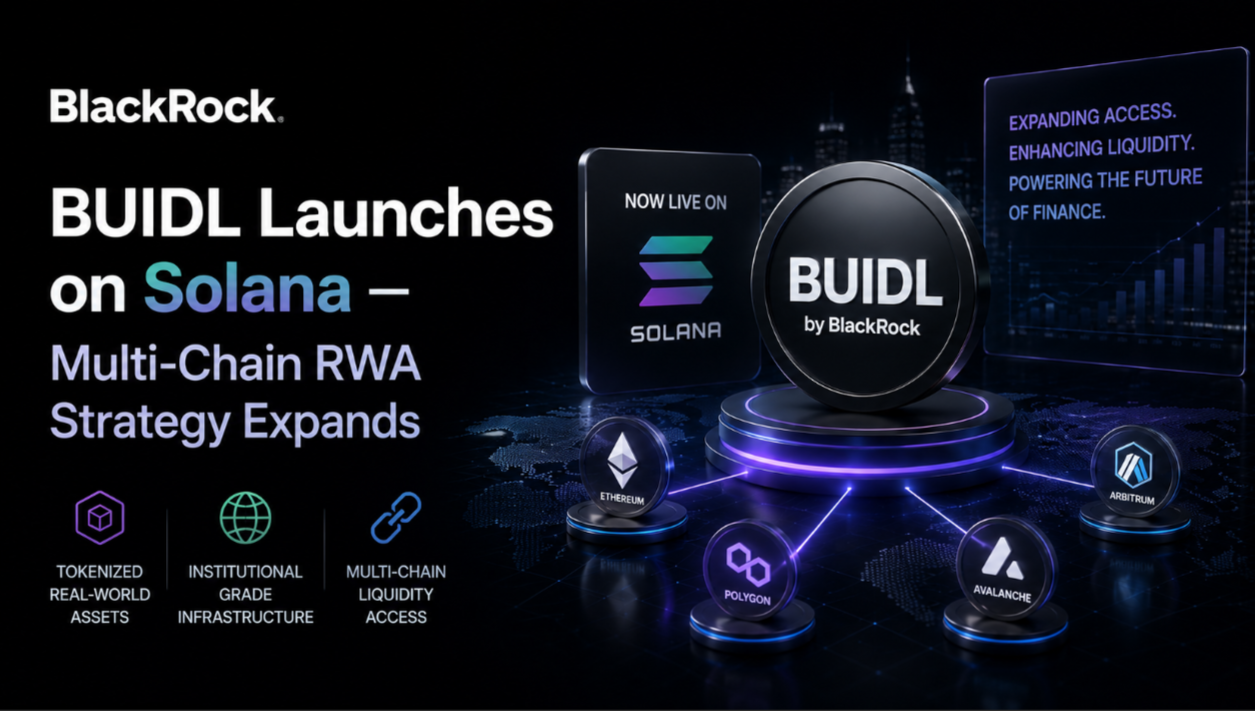
BlackRock's tokenized money-market fund BUIDL has officially launched on Solana, extending its multi-chain strategy beyond Ethereum, Avalanche, Polygon, and Arbitrum. The move marks the clearest institutional endorsement of Solana's high-throughput infrastructure to date and accelerates the race to establish a dominant venue for real-world asset tokenization. For on-chain price context, see Ondo Finance market data — Ondo's OUSG product competes directly with BUIDL for institutional Treasury yield.
From Ethereum to Multi-Chain: BUIDL's Expansion Timeline
BlackRock and tokenization platform Securitize launched BUIDL on Ethereum mainnet in March 2024 with a $100 million seed. Within six months, the fund crossed $500 million in AUM, becoming the largest tokenized Treasury product in history. The speed of institutional adoption surprised even the most optimistic market participants — and immediately raised the question of whether Ethereum's gas costs and settlement latency were optimal for a product designed around daily yield accrual and T+0 redemptions.
The multi-chain expansion began in late 2024 with Avalanche, chosen for its Evergreen institutional subnet framework that allows customised compliance rails. Polygon and Arbitrum followed in early 2025, targeting DeFi-native protocols that wanted BUIDL as a yield-bearing collateral asset. Solana represents the most technically distinctive addition: its shared global state and parallel transaction execution make it fundamentally different from the EVM chains that preceded it.
Ondo Finance was among the first protocols to integrate BUIDL as a backing asset for its OUSG token on Solana, creating a composable on-chain yield layer. For investors evaluating Ondo's long-term potential, see the Ondo Finance price forecast.
Why Solana Makes Technical Sense for Money-Market Tokenization
Money-market funds accrue yield daily and process redemptions on request. On Ethereum mainnet at peak demand, a single redemption transaction can cost $15-50 in gas, materially eroding yield for small-to-medium positions. Solana's median fee of $0.0003 per transaction makes daily rebasing and frequent redemptions economically viable for a much wider range of position sizes.
Sub-second finality also matters for institutional treasury operations. A corporate treasury team managing daily liquidity needs to know that a $50 million redemption request will settle in seconds, not the 12+ seconds of Ethereum finality or the multi-minute delays of optimistic rollups. Solana's deterministic finality, combined with its Firedancer validator client's throughput improvements rolling out in 2026, positions it for serious institutional treasury infrastructure.
- BUIDL Ethereum AUM (April 2026): ~$2.4 billion
- BUIDL Solana AUM at launch: $150 million (seed from institutional partners)
- Transaction fee per redemption — Ethereum: ~$8-40 | Solana: ~$0.0003
- Finality time — Ethereum: 12-15 seconds | Solana: ~0.4 seconds
- Minimum investment: $5 million (both chains)
Compliance Architecture: How KYC Works Across Chains
One of the most technically interesting aspects of BUIDL's multi-chain deployment is how Securitize maintains consistent KYC/AML compliance across different blockchain environments. Every BUIDL holder address must be whitelisted in Securitize's compliance registry — and that registry must be synchronised across all chains where BUIDL is deployed.
Securitize solves this through a combination of on-chain access control contracts and off-chain compliance state maintained in their regulated transfer agent infrastructure. When a Solana address attempts to receive or transfer BUIDL tokens, the token program checks against an on-chain allowlist that Securitize's compliance system manages. Additions and removals from the allowlist require regulatory-grade verification, creating a permissioned layer on top of Solana's otherwise permissionless infrastructure.
For DeFi protocols that want to integrate BUIDL, the compliance layer means only whitelisted smart contract addresses can hold the token — effectively restricting integrations to KYB'd protocols. Maple Finance is among the first DeFi credit platforms to have completed this process, accepting BUIDL as collateral in its institutional lending pools.
Market Impact: What BUIDL on Solana Means for RWA Tokenization
BlackRock's Solana deployment carries outsized market signalling value. When the world's largest asset manager commits engineering and compliance resources to a specific blockchain, it implicitly certifies that chain's institutional readiness. Expect a wave of second-tier asset managers — Fidelity, Franklin Templeton, WisdomTree — to evaluate Solana for their own tokenized fund products following BlackRock's lead.
The broader RWA tokenization market is projected to grow from approximately $12 billion in 2026 to over $100 billion by 2030, according to multiple institutional forecasts. Multi-chain infrastructure — not any single chain — is the likely architecture for that growth. Protocols and chains that build robust compliance infrastructure and institutional-grade tooling now will be best positioned to capture the institutional inflows.
For investors: BUIDL's expansion validates the thesis that on-chain yield-bearing assets will increasingly compete with traditional money-market funds. Protocols like Centrifuge that tokenize private credit assets are the logical next layer — visit Centrifuge market data for current price and ecosystem metrics.