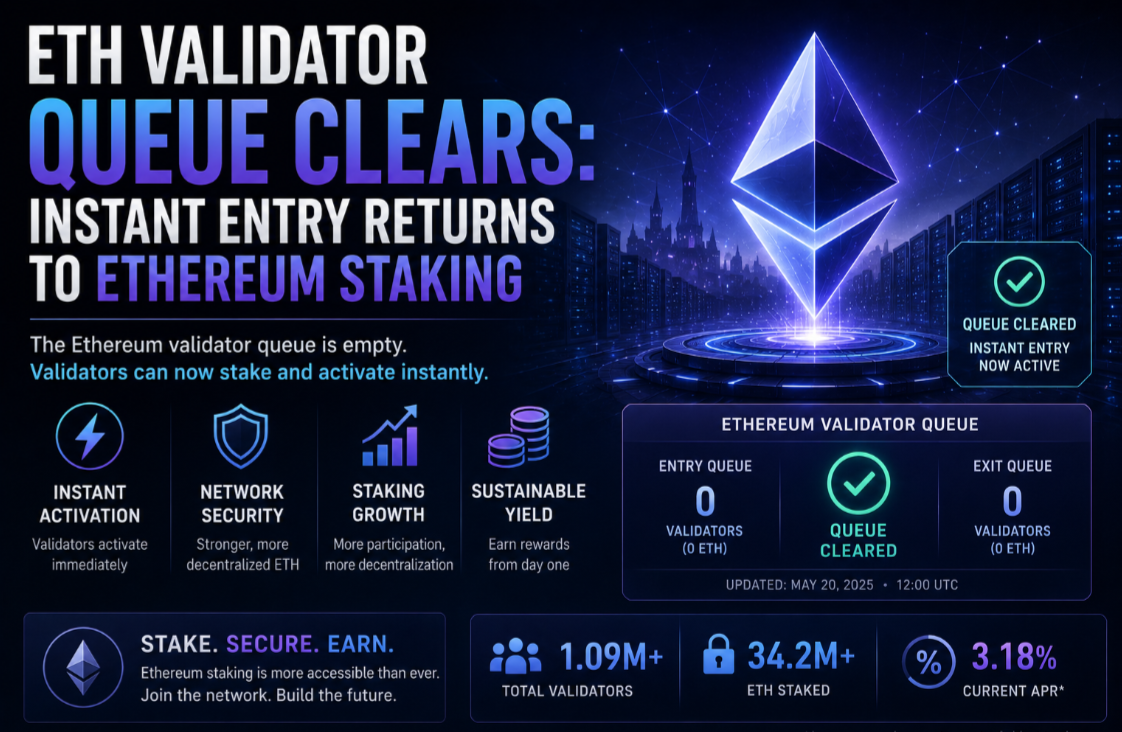
Ethereum's validator activation queue — a bottleneck that at its worst stretched to over 40 days in 2023 — cleared completely in late April 2026, dropping wait times to under five minutes for new 32-ETH validator deposits. The development marks the first full clearance since the mass staking inflows that followed the Merge in September 2022 and signals a new equilibrium in the Ethereum staking market: growth has decelerated, Pectra consolidation has reduced structural demand for new slots, and the network has found a steady state. Track live Ethereum staking statistics alongside protocol options on the staking ratings page.
A Brief History of the Validator Queue Problem
The validator activation queue was not designed to be a persistent feature — it is a security mechanism. By limiting how quickly the active validator set can grow, Ethereum prevents rapid stake accumulation that could destabilise consensus before validators are properly onboarded. Under normal conditions, the queue is expected to be empty or have a handful of pending entries. The problem is that the churn limit algorithm, set conservatively at launch, proved badly mismatched with the pace of institutional adoption.
At the 2023 peak, over 96,000 validators were queued, representing approximately 3 million ETH and a wait time exceeding six weeks. Depositors faced a painful choice: stake and wait, accept the illiquidity premium in liquid staking tokens, or stay on the sidelines. Liquid staking protocols benefited enormously from this dynamic — since stETH and similar tokens activate and trade immediately regardless of queue position, they offered instant economic exposure even when native staking was backlogged.
EIP-7514, deployed as an emergency measure in 2023, capped the maximum churn limit at 8 per epoch, preventing the queue from growing even faster but not clearing the backlog. The full resolution required a combination of the Pectra upgrade's consolidation mechanism and the natural deceleration of new entrants.
How Pectra's EIP-7251 Reduced Queue Pressure
The Pectra upgrade, deployed on Ethereum mainnet in early 2025, fundamentally changed queue dynamics through EIP-7251: the maximum effective balance (maxEB) increase. Before Pectra, every 32 ETH required a separate validator entry — a node operator running 1,000 ETH needed 31 separate validator processes, each consuming consensus bandwidth and requiring individual attestation. After Pectra, a single validator can hold up to 2048 ETH.
Large institutional validators and liquid staking protocols immediately began consolidating. Lido alone consolidated thousands of 32-ETH validators into a much smaller number of 2048-ETH validators over Q3-Q4 2025. Each consolidation exit + re-entry, while adding a temporary queue entry, reduced the long-term structural demand for new activations because the same ETH now occupies fewer validator slots. The net effect on queue depth was significant: the consolidation wave absorbed much of the nominal queue backlog.
- Estimated validators consolidated via EIP-7251 by April 2026: ~180,000
- Reduction in active validator count from consolidation: ~14%
- Net queue clearance: first time fully clear since Q2 2022
- Current wait time for new 32-ETH validator: under 5 minutes
- Current wait time for institutional 2048-ETH validator: under 30 minutes
Implications for Staking Capital Efficiency
Instant activation has meaningful economic consequences. Previously, the cost of queuing was real: a new depositor waiting six weeks to activate was forgoing six weeks of staking APR on their 32 ETH — roughly $200-300 at average APR and recent ETH prices. This friction created a premium for liquid staking tokens (which provided immediate economic exposure) and for secondary markets in validator activation queue position.
With the queue clear, the liquid staking premium compresses slightly. Depositors who previously paid the liquid staking fee structure (Lido's 10%, Rocket Pool's 14% commission split) primarily to avoid queue friction now have an alternative: native staking activates almost immediately at zero protocol fee. Whether this translates into meaningful market share shifts for liquid staking will depend on whether capital efficiency or DeFi composability is the primary motivation for most depositors.
For most retail depositors, DeFi composability still wins: stETH and similar tokens remain usable as collateral, yield sources, and liquidity pool assets in ways that native staking cannot match. For institutional stakers primarily seeking yield with minimal DeFi exposure, native staking with solo or managed validators becomes more attractive. The Lido review covers protocol fee structures and scenarios where native staking may be preferable.
Validator Set Statistics at Queue Clearance
At the moment of queue clearance, Ethereum's active validator set stood at approximately 1.06 million validators, representing roughly 34 million ETH — about 28% of total ETH supply. The base staking APR at this validator count is approximately 3.9%. Including MEV rewards (averaging around 0.6% annually for validators running MEV-Boost), effective yield for optimised validators is approximately 4.5%.
Geographic and infrastructure diversity has improved since the 2022-2023 centralisation concerns. The share of validators on AWS cloud infrastructure has declined from a peak of 43% to approximately 29%, driven by professional node operators migrating to bare-metal and dedicated cloud providers. Ethereum client diversity has also improved: Prysm's dominant share has declined in favour of Lighthouse, Teku, and Nimbus.
What Happens Next: Queue Dynamics in a Post-Consolidation Market
The cleared queue is likely temporary — each major positive catalyst for ETH price tends to attract new staking inflows that can rebuild a queue. However, the post-Pectra structural environment suggests queue peaks will be shorter-lived: consolidation has reduced the headcount of existing validators, freeing up churn limit capacity for new entrants, and the overall growth rate of new stakers has moderated as most interested large holders have already entered.
The next potential queue pressure point would be a major protocol upgrade that dramatically increases staking yield — for example, if EigenLayer AVS rewards begin distributing meaningfully or if a new staking incentive mechanism is introduced. Until then, near-instant validator activation represents a genuine quality-of-life improvement for the ecosystem. New stakers can compare protocols using live APR data at the staking ratings page or evaluate custodial staking options at Coinbase review.