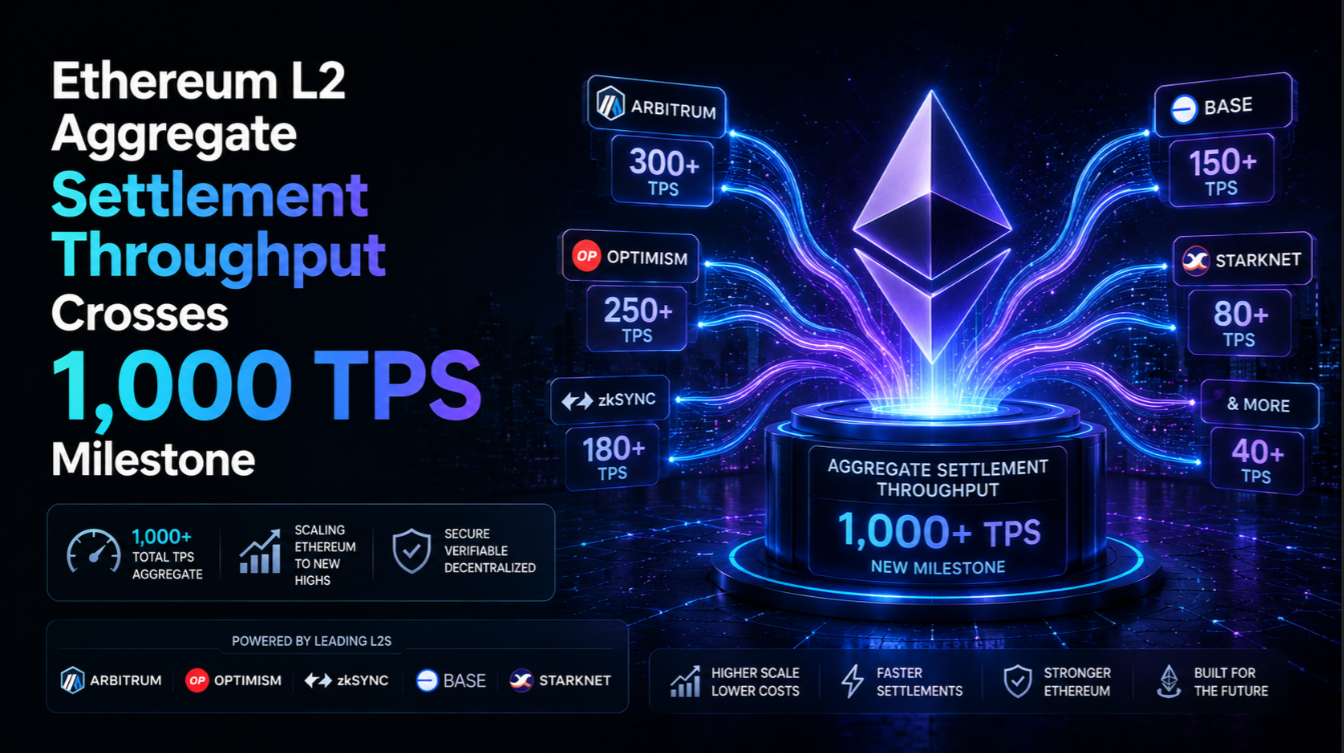
On-chain analytics platforms L2Beat and Dune Analytics confirmed this week that combined settlement throughput across Ethereum's Layer 2 ecosystem exceeded 1,000 transactions per second (TPS) on a 7-day rolling average. The milestone was crossed during a period of elevated DeFi and gaming activity, with the peak instantaneous figure reaching 1,240 TPS on April 19. Visa, by comparison, processes an average of 1,700 TPS with a claimed capacity of 65,000 TPS — making Ethereum's L2 ecosystem now within the same order of magnitude as legacy payment rail averages.
Breaking Down the 1,000 TPS: Which Networks Contribute
The aggregate figure is distributed across a dozen active L2 networks:
- Base: ~320 TPS (32 % of aggregate)
- Arbitrum
- : ~250 TPS (25 %)
- Optimism: ~110 TPS (11 %)
- zkSync Era: ~95 TPS (9.5 %)
- Linea: ~70 TPS (7 %)
- Scroll: ~55 TPS (5.5 %)
- Other L2s combined: ~100 TPS (10 %)
Base's leading share reflects its position as the preferred destination for consumer dapps and meme coin trading, which generate high transaction counts at low individual values. Arbitrum's contribution is driven by DeFi protocols with larger transaction values and lower but consistent volume.
What Drives Throughput: Blob Expansion and App Migration
Two technical forces explain the throughput surge. First, Pectra's blob expansion doubled the data available to L2s per slot, removing the primary constraint on transaction batching. Second, a wave of application migrations in Q1 2026 brought several high-volume dapps from alternative L1s onto Ethereum L2s, drawn by the combination of lower fees, stronger security guarantees, and access to Ethereum's deep liquidity.
The migration wave included:
- Three major gaming studios moving their asset and achievement contracts to Base
- Two stablecoin issuers adding native issuance on Arbitrum
- A mid-sized perpetuals exchange migrating from an alternative L1 to zkSync
- Multiple NFT marketplaces adding L2 support to reduce minting costs
Each migration adds sustained baseline TPS even during low-activity periods, creating a "sticky" throughput floor that grows with each new deployment.
Lido and EigenLayer: Staking Infrastructure at Scale
The throughput milestone has direct implications for staking protocols operating on Ethereum. Lido DAO processes thousands of stETH transfers and rebase transactions daily; EigenLayer restaking operations involve complex multi-step interactions that benefit from L2's lower gas costs.
Both protocols have announced plans to expand their smart-contract infrastructure to L2 networks in H2 2026, citing the 1,000 TPS milestone as the threshold of confidence they required before committing engineering resources to L2 deployment. This signals that the most capital-intensive DeFi protocols — which have historically been conservative about L2 moves — now consider the ecosystem mature enough for production use.
Security and Decentralisation: The Remaining Challenges
Throughput milestones invite scrutiny of the assumptions underlying the numbers. Several caveats apply:
- Most L2 sequencers remain centralised — a single operator orders transactions before submitting to L1
- Fraud proof windows (7 days for optimistic rollups) mean 1,000 TPS does not equal 1,000 finalised TPS
- Cross-L2 composability is limited — atomic transactions spanning two different L2s remain experimental
- Blob data is pruned after ~18 days; long-term data availability relies on external DA layers
The sequencer decentralisation roadmap is progressing: Arbitrum's BOLD fraud proof system launched in Q4 2025, and Optimism's permissionless fault proof was activated in 2024. But full decentralisation across all major L2s remains 12–24 months away on optimistic timelines.
The Road to Full Danksharding: 100,000+ TPS
The 1,000 TPS milestone is a waypoint, not a destination. Ethereum's endgame scaling vision — full danksharding — targets 100,000+ TPS by providing orders-of-magnitude more blob space per block. The path requires several more hard forks after Pectra:
- Fulu-Osaka (expected late 2026/early 2027): Introduces PeerDAS (peer data availability sampling), which allows nodes to verify blob availability without downloading the full blob — a prerequisite for dramatically increasing blob count.
- Fusaka (2027–2028): The first increment of full danksharding with 128 blobs per slot, targeting ~10,000 TPS aggregate.
- Full danksharding (2029+): Final architecture with 256+ blobs per slot, enabling the 100,000 TPS vision.
Each milestone builds on the previous one, making today's 1,000 TPS achievement both a celebration of progress and a reminder of how far the roadmap extends. For detailed projections on how throughput growth affects ETH value, visit the Ethereum forecast page and the Ethereum market overview.
Comparing Ethereum L2 to Competitor Chains
The 1,000 TPS figure deserves context in the competitive landscape:
- Solana mainnet: ~3,000–4,000 TPS (single-shard, centralised validator set)
- BNB Smart Chain: ~500–600 TPS
- Avalanche C-Chain: ~400–500 TPS
- Ethereum mainnet alone: ~15–30 TPS
- Ethereum + all L2s combined: 1,000+ TPS (April 2026)
Solana's throughput advantage reflects its monolithic architecture, which trades decentralisation for raw speed. Ethereum's modular approach routes complexity to the L2 layer while maintaining L1 security — a fundamentally different trade-off. As blob capacity scales with future hard forks, the throughput gap with Solana will narrow without requiring L1 architectural changes.