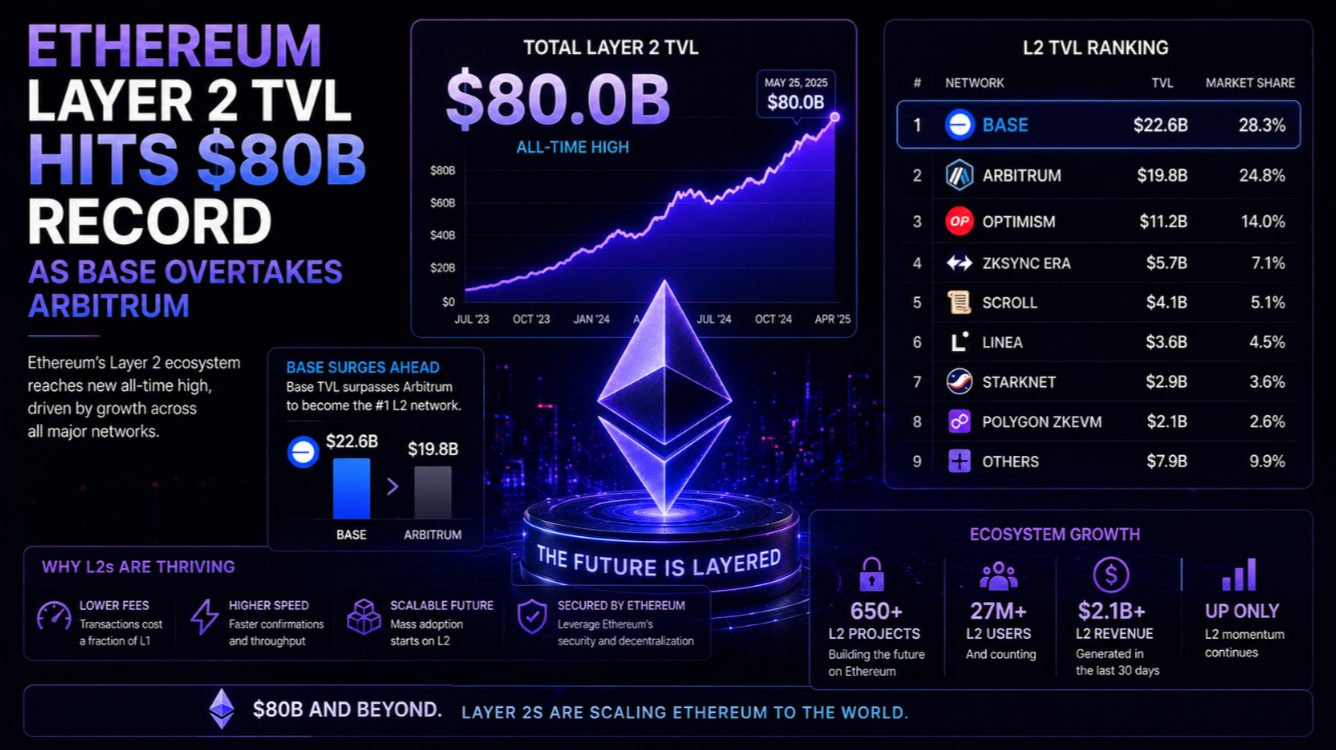
Ethereum Layer 2 networks have reached a historic milestone, with combined total value locked (TVL) surpassing $80 billion for the first time. This surge reflects explosive growth in the ecosystem as developers and users increasingly adopt scaling solutions to access faster transactions and lower fees. The TVL milestone underscores the maturity of L2 infrastructure and its critical role in Ethereum's long-term scalability strategy.
TVL Milestone: The $80B Breakthrough
The cumulative TVL across all Ethereum Layer 2 networks crossed the $80 billion threshold in April 2026, marking a significant inflection point for the ecosystem. This represents more than a 10x increase from just two years ago, when L2 TVL hovered around $7-8 billion. The growth reflects both organic protocol development and strategic incentives designed to attract liquidity and users to these scaling solutions.
Arbitrum, the long-time leader, holds approximately $28 billion in TVL, though its dominance has been challenged by emerging competitors. Optimism maintains strong position with over $12 billion, while other networks including zkSync, Linea, and Scroll continue to gain ground. The diversification of TVL across multiple L2s signals healthy ecosystem maturity and reduces systemic risk.
Base Overtakes Arbitrum: Coinbase's Onchain Summer Effect
Base, Coinbase's Layer 2 solution built on the OP Stack, has experienced meteoric rise and now ranks as the fastest-growing L2 network. Base TVL surged from $2 billion to over $5 billion in recent months, fueled by Coinbase's "Onchain Summer" initiative and massive marketing push. This campaign successfully attracted new users and developers to the ecosystem, leveraging Coinbase's 100+ million retail customer base.
The rise of Base demonstrates the power of centralized exchange infrastructure in driving L2 adoption. By making on-chain activities seamless from the Coinbase interface, the platform removed friction points that previously deterred retail users. Key metrics:
- Base now hosts over 800 dapps and protocols
- Transaction volume regularly exceeds $5 billion weekly
- Gas fees remain under 1 cent for most transactions
- Coinbase Smart Wallet integration drives institutional adoption
Arbitrum's Response and Market Consolidation
Despite recent competition, Arbitrum remains the largest Ethereum L2 by TVL and maintains a substantial ecosystem moat. The network has responded to competitive pressure through enhanced developer incentives, governance improvements, and ecosystem grants. Arbitrum DAO allocated $200 million toward developer grants and ecosystem expansion, signaling long-term commitment to platform growth.
Arbitrum's advantages include a mature ecosystem with 4,000+ deployed smart contracts, largest liquidity pools for trading pairs, and the strongest institutional partnerships. However, the network faces challenges from newer L2s offering lower gas costs and competing development grants.
Optimism Superchain and Cross-L2 Liquidity
Optimism and its growing ecosystem of Superchain chains (OP Sepolia, Base, and upcoming chains) represent an ambitious vision for native interoperability. The Superchain architecture allows liquidity and applications to be shared across multiple chains while maintaining unified security and governance.
This approach contrasts with traditional L2 competition and instead promotes collaboration. Base's success as a Superchain member validates the model, while other projects build their own Superchain-compatible networks. This network effect could reshape Layer 2 landscape from zero-sum competition to complementary ecosystem growth.
Blob Fee Dynamics Post-Pectra: Efficiency Gains
The Dencun upgrade (March 2024) introduced proto-danksharding (EIP-4844), which created a dedicated blob market for Layer 2 transaction data. This mechanism dramatically reduced L2 fees by up to 95%, as the blob space is orders of magnitude cheaper than traditional calldata.
Post-Pectra (anticipated 2026-2027), further upgrades to blob capacity and EIP-7623 will improve L2 economics. These changes will:
- Increase blob capacity from 6 blobs to 10+ per slot
- Reduce L2 transaction costs to near-zero for stablecoin transfers
- Enable sustainable zero-fee tier for micropayments and notifications
- Free up valuable L1 blockspace for settlement and security
Current blob fees typically cost $0.001-0.01 per transaction on L2, compared to $20-50 for direct Ethereum transactions. This economics makes retail payments viable and supports emerging use cases in payments, gaming, and social media.
Zero-Knowledge Rollups: The Next Scaling Wave
While optimistic rollups (Arbitrum, Optimism, Base) dominate TVL today, zero-knowledge rollups are gaining momentum. zkSync, Linea, and Scroll represent the next generation of L2 technology, offering faster finality and stronger cryptographic guarantees.
ZK-rollups provide several advantages over optimistic rollups:
- Instant finality without dispute windows
- Lower withdrawal latency (minutes vs. 7 days)
- Stronger security properties (cryptographic proof vs. fraud proof game)
- Native cross-L2 composability possibilities
However, ZK-rollups face challenges including higher computational complexity, less developer-friendly tooling, and smaller existing ecosystems. As these technical hurdles diminish and developer adoption grows, ZK-rollups could capture significant TVL share. Current ZK-rollup TVL stands at approximately $5-7 billion combined, with rapid growth expected.
ETH Burn Mechanics and L2 Value Capture
Ethereum burns a portion of each L2 transaction through EIP-1559, creating deflationary pressure on ETH supply. When Layer 2s move to full Dencun utilization and blob markets mature, this burn rate could reach 100,000+ ETH annually — directly reducing ETH issuance and supporting long-term tokenomics.
This value capture mechanism creates alignment between L2 growth and Ethereum security. As L2s scale and usage grows, the base layer becomes more secure and valuable through reduced issuance. For long-term ETH holders, this represents a structural tailwind independent of price speculation.
Current burn rate from L2 transactions: ~5,000-10,000 ETH monthly, with acceleration expected as blobs become fully utilized and additional L2s migrate to blob infrastructure.
Implications for DeFi and Institutional Adoption
The $80 billion TVL milestone reflects not just speculative capital but genuine economic utility. DeFi protocols on L2s serve real users seeking lower fees and faster execution. The maturation of L2 infrastructure removes regulatory and technical uncertainties that previously limited institutional participation.
Institutional players including hedge funds, RWA (real-world asset) protocols, and staking infrastructure now operate primarily on Layer 2 networks. This shift indicates that L2s are transitioning from experimental scaling solutions to essential infrastructure for Ethereum's ecosystem.
Looking forward, continued TVL growth depends on sustained developer innovation, user experience improvements, and macroeconomic factors. The $80 billion milestone is neither a ceiling nor guaranteed; rather, it represents a foundation for the next phase of Ethereum scaling and mainstream adoption.