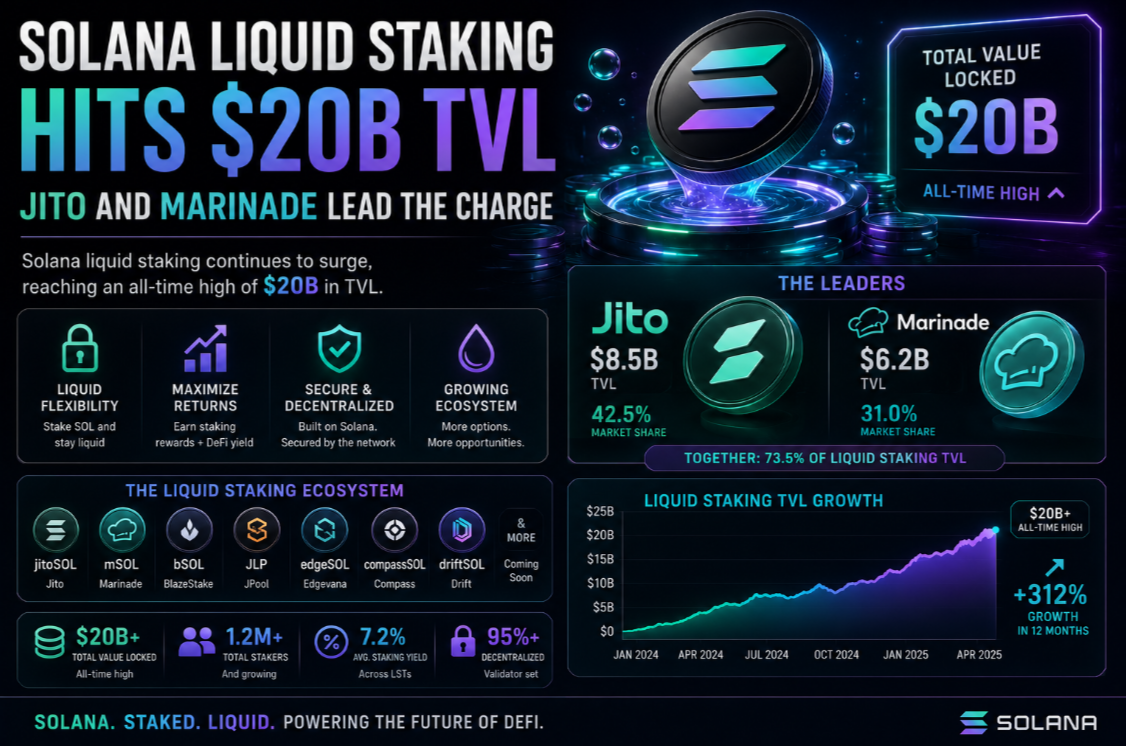
The Solana liquid staking ecosystem crossed a combined $20 billion TVL milestone in Q2 2026, marking a turning point for a market that barely existed two years ago. Jito and Marinade Finance together account for roughly 65% of deposits, but a growing cohort of competitors — Sanctum, Jupiter Stake, BlazeStake, and Helius-backed protocols — is diversifying the landscape. For holders seeking yield on SOL, the options now rival what was available to ETH stakers two years ago. Track live data on the staking ratings page.
The Architecture of Solana's Staking Boom
Solana's staking growth has three structural drivers. First, the SOL price cycle: with SOL trading above $200 for most of 2025-2026, the dollar value of staked assets rose faster than the token count. Second, DeFi integration: JitoSOL and mSOL are now accepted as collateral on Kamino Finance, MarginFi, and Drift Protocol — the leading Solana lending and perps platforms — giving liquid stakers additional yield on top of base APR. Third, MEV distribution: Jito's block auction system monetises transaction ordering in a way that shares value with ordinary stakers rather than concentrating it among validators and searchers.
The SOL staking base APR sits around 6.8% in early 2026, reflecting network inflation and validator commissions. JitoSOL adds roughly 0.8% MEV yield on top, bringing total APR to approximately 7.6%. mSOL's diversified delegation strategy targets similar overall performance but without the MEV premium, compensating with slightly more consistent validator uptime scores. BlazeStake offers a hybrid model with both MEV capture and custom delegation to validator cohorts of the depositor's choosing.
Jito: MEV as Staking Yield
Jito Labs built its reputation not as a staking protocol but as a Solana validator client. By running a separate transaction bundle auction — essentially a private mempool where arbitrage bots and liquidators bid to have their transactions included first — Jito's validators capture priority fees that standard Solana validators miss. The mechanics are analogous to Ethereum's Flashbots MEV-Boost system, adapted for Solana's parallel transaction execution model.
JitoSOL passes the auction revenue to depositors proportionally. The average MEV yield has ranged from 0.4% to 1.8% annualised depending on market conditions: high DeFi activity and large liquidation events produce MEV windfalls; quiet markets produce little. Over rolling 90-day periods, JitoSOL has consistently outperformed plain SOL staking by 0.7–1.0% APR, which at $20B scale represents hundreds of millions of dollars per year distributed to stakers.
The JTO governance token, which Jito airdropped to early users in December 2023, has given JitoSOL holders a say in protocol parameters. Recent governance votes have focused on expanding the Jito restaking system — called Jito Vault — which mirrors EigenLayer's architecture on Solana, allowing JitoSOL to be re-deployed as economic security for Solana appchains.
Marinade Finance: The Diversification Approach
Marinade Finance takes a different philosophy: rather than maximising yield through MEV, it prioritises validator decentralisation. Its algorithmic delegation strategy scores each Solana validator on commission rate, uptime history, stake concentration, and the Nakamoto coefficient impact of adding more delegation. Validators that are already receiving large delegations get penalised in the score, pushing stake toward smaller, independent operators.
This approach is philosophically valuable for Solana's security but has a real trade-off: Marinade's mSOL yield is typically 0.3–0.5% below JitoSOL. Marinade has tried to close the gap through partnerships with validators that participate in both the standard Solana staking rewards and ancillary revenue programs like MEV sharing, but JitoSOL's structural advantage persists.
Marinade Native, launched in 2024, offers an alternative product without the mSOL token — stakers simply receive their proportional share of delegation rewards plus a Marinade-optimised validator selection, without any tokenisation. This product targets institutional stakers who want optimised validator selection without liquid token exposure.
The Sanctum Ecosystem: Liquid Staking as Infrastructure
Sanctum has emerged as a layer of infrastructure beneath the liquid staking market rather than a protocol competing directly with Jito and Marinade. Sanctum's Router allows instant redemption of any Solana LST for SOL by tapping a shared liquidity pool — solving the de-peg and illiquidity problem that has historically been a risk for smaller LSTs. By making all LSTs interchangeable at near-zero cost, Sanctum has democratised the liquid staking market and enabled dozens of validators to launch their own branded LSTs.
The Sanctum model is particularly important for DeFi: protocols like Kamino and Drift can now accept any SOL LST as collateral without worrying about liquidity or redemption delays, since Sanctum's router provides an instantaneous backstop. This infrastructure layer effectively raises the floor for all Solana liquid staking tokens and is part of why TVL has grown so rapidly.
Implications for Solana's Validator Ecosystem
The $20B liquid staking milestone has significant implications for Solana's security model. More SOL staked means higher economic cost to attack the network — an attacker would need to acquire and stake over $6.7B in SOL to control 33% of voting weight. However, concentration among a handful of liquid staking protocols creates new governance vectors: the protocols that control delegation decisions effectively influence which validators gain economic power.
Solana's Superminority — the set of validators whose combined stake exceeds 33% of the total — is monitored closely by the ecosystem. As Jito and Marinade grow, their delegation decisions meaningfully affect this metric. Marinade's explicit Nakamoto-coefficient optimisation is one response to this responsibility; Jito has faced more criticism for delegating heavily to high-performance validators regardless of existing concentration.
Compare Solana staking platforms alongside Ethereum options at the staking ratings page, or review institutional custodians that support both ecosystems at Coinbase review.