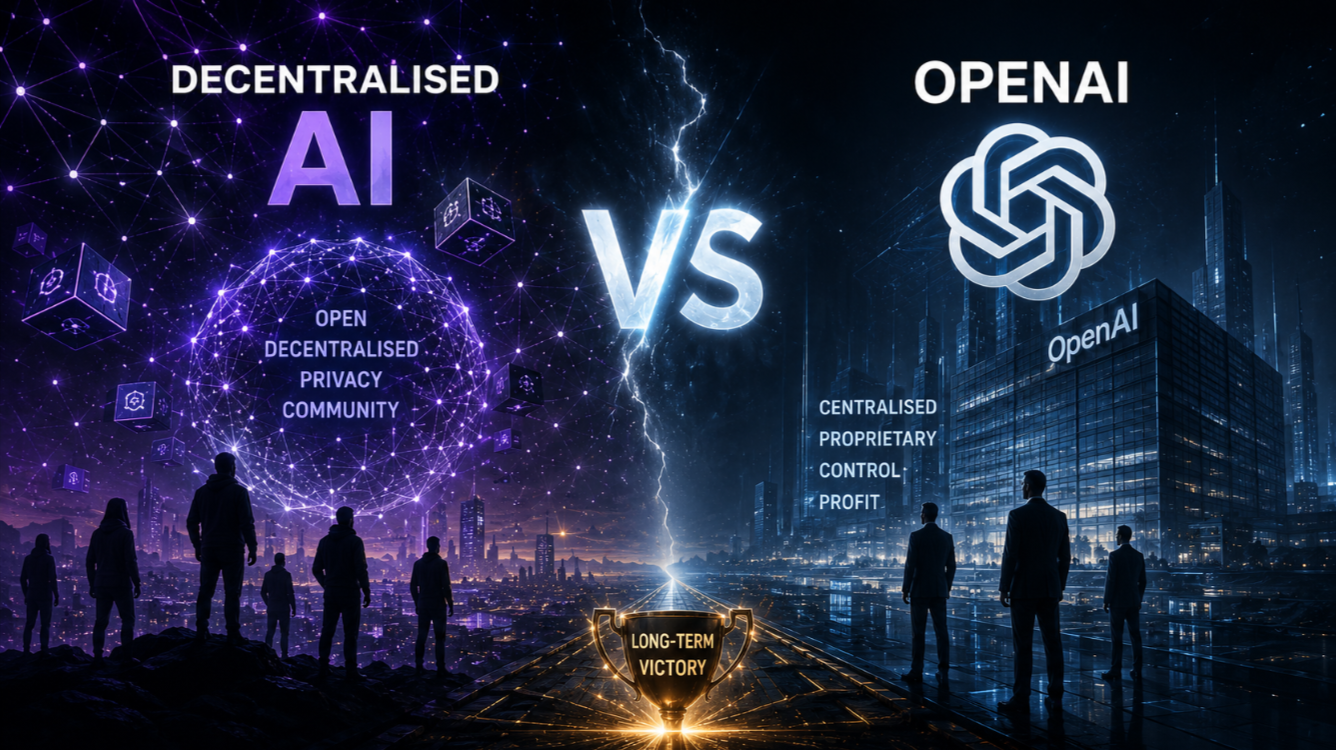
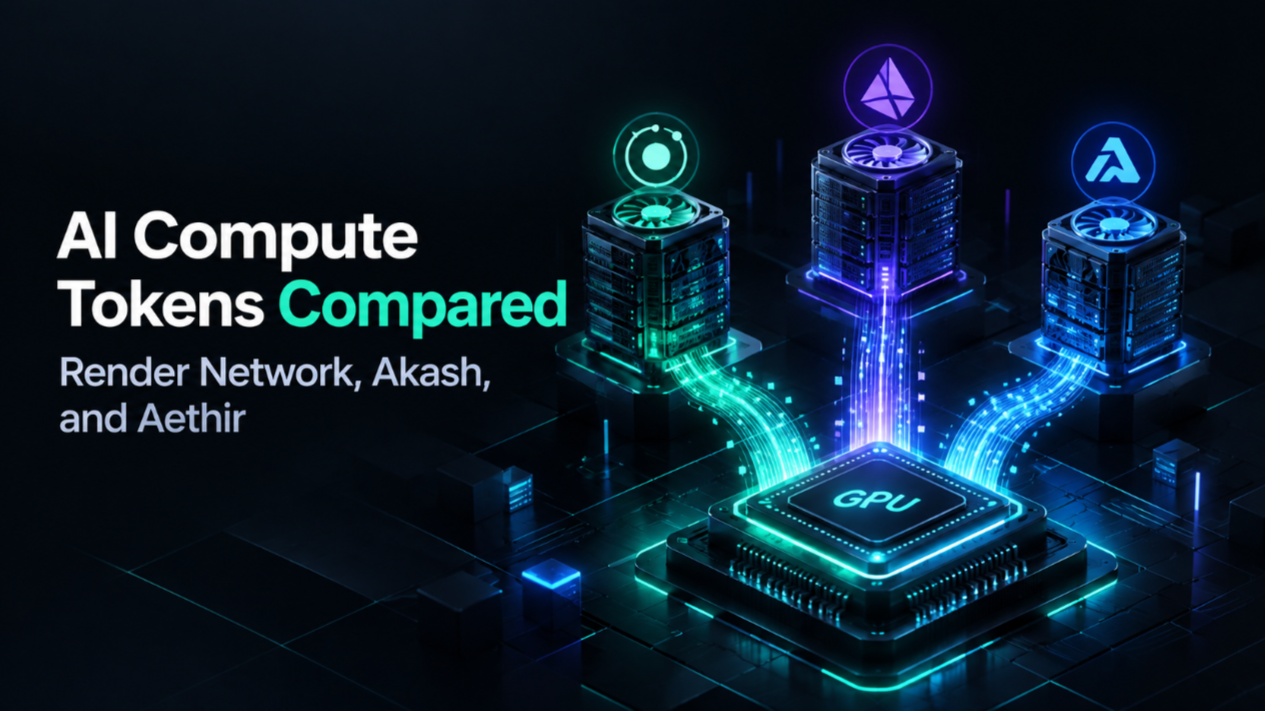
Why AI compute is the battleground for decentralised AI
Every AI interaction — whether you are asking ChatGPT a question, generating an image with Midjourney, or running an AI agent — consumes GPU compute. The global demand for AI compute is growing at 40–60% per year, and the infrastructure required to meet that demand is one of the largest capital allocation opportunities in technology history.
The incumbent answer is hyperscaler cloud: Amazon Web Services, Microsoft Azure, and Google Cloud control the majority of AI compute capacity. Decentralised compute networks are building an alternative: a global marketplace of GPUs operated by independent providers, coordinated and paid through crypto tokens.
How decentralised compute networks work
All three major decentralised GPU networks share a similar architecture:
- GPU providers (nodes) register their hardware on the network and stake tokens to commit to service level agreements.
- Compute buyers submit jobs — AI training runs, inference requests, 3D rendering — and pay in the network token.
- A matching engine routes jobs to available nodes based on price, geographic location, and hardware spec.
- A verification layer confirms that the work was done correctly before releasing payment.
- Token incentives reward node operators for reliability and penalise downtime or fraudulent results.
The theoretical cost advantage is significant: decentralised networks aggregate existing GPU capacity that would otherwise sit idle in data centres, gaming rigs, and crypto mining farms. Their overhead is lower than hyperscalers that must build and maintain proprietary hardware.
Render Network (RENDER): the GPU rendering pioneer
Render Network launched in 2017 as a decentralised GPU rendering platform for 3D artists, visual effects studios, and game developers. It established real product-market fit in this niche before AI made GPU compute a mainstream investment theme.
In 2023, Render migrated from Ethereum to Solana, improving transaction throughput and reducing fees dramatically. The network has since expanded into AI inference and model serving, adding support for machine learning workloads alongside its traditional 3D rendering jobs.
Render Token market data — including current price, market cap, and 24h volume — is available on the market page.
- Strengths: established product-market fit, real creative industry usage, Solana migration improved scalability, strong brand recognition in the GPU compute narrative.
- Weaknesses: originally designed for rendering rather than AI training; AI workload support is newer and less proven; competition from purpose-built AI networks is intensifying.
- Token ticker: RENDER (formerly RNDR). Market cap consistently among the top 50 crypto assets by size.
Akash Network (AKT): the decentralised cloud marketplace
Akash is the most general-purpose decentralised compute network. It is not GPU-specific; it offers containerised compute (CPU and GPU) via a Kubernetes-compatible interface, making it accessible to developers who already know how to deploy Docker containers on AWS or Google Cloud.
The value proposition is price: Akash consistently quotes AI and ML workloads at 80–90% discounts compared to equivalent AWS instances. The network runs on the Cosmos blockchain, using the AKT token for payments and governance.
- Strengths: broadest compatibility (any Docker container), deepest AWS price discount, Cosmos ecosystem integration, growing GPU provider base.
- Weaknesses: less consumer-facing brand recognition than Render; the UX is more technical (comfort with containers and CLI required); AI-specific features are less developed than purpose-built networks.
- Token ticker: AKT. Smaller market cap than Render or Aethir but with a large and growing developer community.
Aethir: enterprise GPU-as-a-service
Aethir is the newest and most enterprise-focused of the three. It raised $9 million in a token sale in early 2024 and has signed supply agreements with multiple data centre operators to bring institutional-grade GPUs onto its network.
Aethir targets two main use cases: cloud gaming (streaming games from remote GPUs) and AI inference at enterprise scale. Its architecture separates the container host (the GPU provider), the checker (which verifies work quality), and the scheduler (which routes jobs) — a more complex but more accountable design than simpler peer-to-peer compute networks.
- Strengths: enterprise relationships bring higher-quality, more reliable hardware; hybrid cloud gaming + AI inference use case; institutional-grade SLA commitments.
- Weaknesses: younger project with less on-chain history; cloud gaming is a highly competitive market; token distribution was heavily weighted toward early investors according to initial tokenomics disclosures.
- Token ticker: ATH. Smaller market cap, higher beta relative to Render and Akash.
Head-to-head comparison: Render vs Akash vs Aethir
Comparing the three on key dimensions:
- Target workload: Render — 3D/AI rendering and inference. Akash — general containerised compute. Aethir — enterprise AI inference and cloud gaming.
- Primary blockchain: Render — Solana. Akash — Cosmos. Aethir — Ethereum Layer 2.
- Developer friendliness: Akash (Docker/Kubernetes) > Render (SDK + Blender plugins) > Aethir (enterprise API).
- Price discount vs AWS: Akash 80–90%, Render 30–60% depending on workload, Aethir 40–70% for contracted enterprise pricing.
- Token liquidity: Render highest, Akash mid, Aethir lowest among the three.
How to evaluate a compute token investment
Use these six metrics to assess a compute token's investment case:
- Gross compute value (GCV): the total dollar value of compute jobs processed. Growing GCV means real demand, not just token speculation.
- Provider count and hardware spec: more providers with newer GPUs means better reliability and job routing.
- Token take rate: what percentage of each job payment flows to the protocol vs node operators. Higher take rate = more token value accrual, but also incentivises providers to seek alternatives.
- FDV/GCV ratio: analogous to price-to-sales, it measures how expensively the market is valuing each dollar of compute processed.
- Price per GPU-hour vs AWS equivalent: the fundamental cost competitiveness metric.
- New integrations: AI frameworks (PyTorch, Hugging Face), agent platforms, and model serving layers that integrate the network create stickier demand.
The AI demand tailwind and what it means for compute tokens
Every AI model release cycle increases baseline GPU demand. GPT-5, Llama 4, Gemini Ultra — each generation requires more compute to train and serve than the last. The compute demand curve is not flattening; if anything, the pace of model scaling is accelerating.
Decentralised compute networks benefit from this tailwind but face a ceiling: hyperscalers can respond to demand by building new data centres faster than any decentralised network can onboard new providers. The key question is whether the price gap between decentralised and centralised compute remains large enough to compensate for the quality and reliability difference.
Risks specific to compute tokens
- Hardware obsolescence: the GPU model that is competitive today may be outperformed by next-generation hardware in 12–18 months, reducing the value of existing provider networks.
- Verification challenges: it is technically difficult to verify on-chain that a GPU completed a complex AI training job correctly without running the job again — which doubles the cost. Cryptographic proof systems (ZK proofs for ML) are being developed but are not yet mature.
- Regulatory risk around compute: export controls on advanced AI chips (Nvidia A100/H100) create compliance complexity for decentralised networks operating across jurisdictions.
- Liquidity and exit risk: smaller compute tokens have limited order book depth. A large position is difficult to exit without significant price impact.
Which compute token is right for different investor profiles?
- Conservative crypto investor: Render, due to its longer track record, real creative-industry usage, and highest liquidity.
- Developer building on decentralised compute: Akash, for its Docker compatibility, AWS-competitive pricing, and developer-friendly documentation.
- High-risk growth investor: Aethir, for its enterprise positioning and higher upside potential if the cloud gaming + AI inference thesis plays out.
- Diversified exposure: a basket of all three, weighted by market cap, provides exposure to the full compute sector without single-project concentration risk.
For broader AI crypto context beyond compute, see our market pages for Bittensor (TAO) and Fetch.ai (FET), which operate higher up the AI stack.
This article compares AI compute tokens for educational purposes. It is not investment advice. Cryptocurrency investments carry substantial risk of loss. Always conduct independent research.