What does AI actually mean in the context of crypto?
Artificial intelligence and blockchain are two of the most transformative technology waves of the 2020s — and they are now converging in ways that are reshaping how both industries work. AI tokens represent projects that use blockchain infrastructure to decentralise some component of AI: training compute, inference, data labelling, model ownership, or autonomous agent coordination.
The term "AI crypto" covers a wide spectrum. At one end you have pure infrastructure plays — decentralised GPU networks and data marketplaces. At the other end you have agent protocols: software systems that can autonomously browse the web, write code, manage wallets, and execute transactions on-chain without human input.
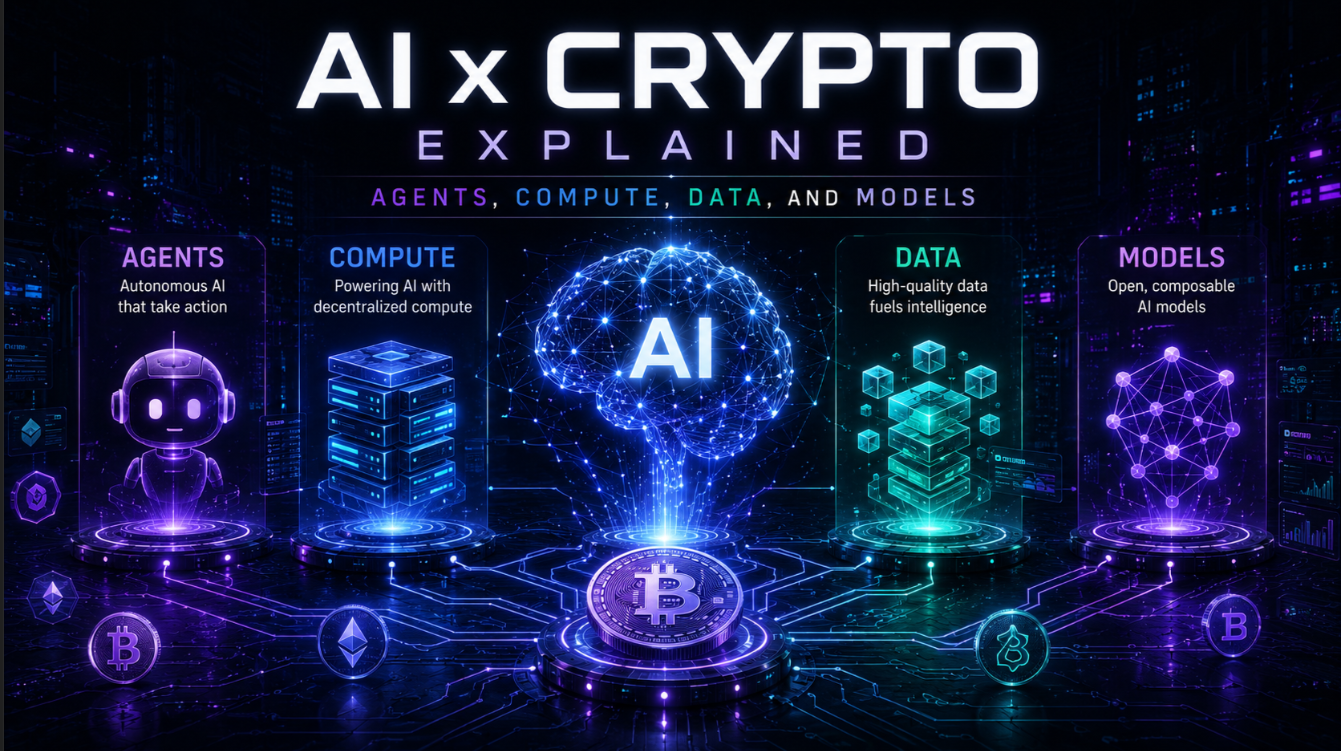
The four pillars of the AI x crypto stack
Every serious AI crypto project sits in one or more of these four layers:
- Compute — renting out GPU/TPU capacity to train or run AI models. Projects like Render and Akash Network let idle hardware owners earn tokens by contributing processing power to AI workloads.
- Data — curating, labelling, and licensing training datasets on-chain. Ownership of data is tokenised, so individuals can be paid for contributing information rather than giving it away to centralised platforms.
- Models — open-sourcing or tokenising AI models themselves, letting communities own and govern a model collectively. Bittensor is the leading example: miners submit models and are rewarded in TAO if their output beats the incumbent.
- Agents — autonomous software programs that perceive inputs, reason about them, and execute actions. Fetch.ai and Virtual Protocol focus on agent coordination, letting agents negotiate with each other and transact on-chain.
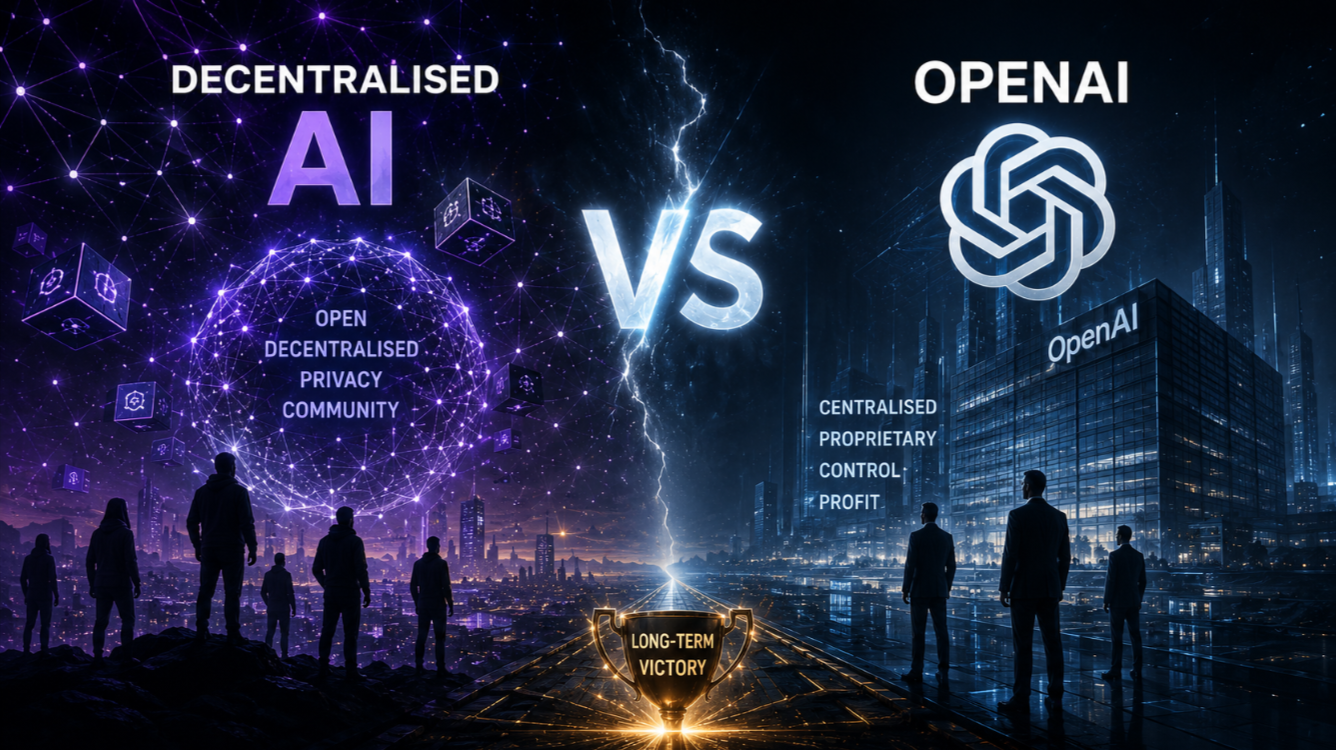
Understanding which layer a project occupies tells you what it actually does and who its competitors are. A compute token competes with AWS and Google Cloud. An agent protocol competes with OpenAI's custom GPT ecosystem and Microsoft's Copilot platform.
Compute tokens: the backbone of decentralised AI
Training a frontier AI model requires enormous amounts of GPU time. GPT-4 reportedly cost over $100 million in compute to train. Most of that compute was rented from centralised cloud providers, creating a dependency that critics argue stifles innovation and concentrates power.
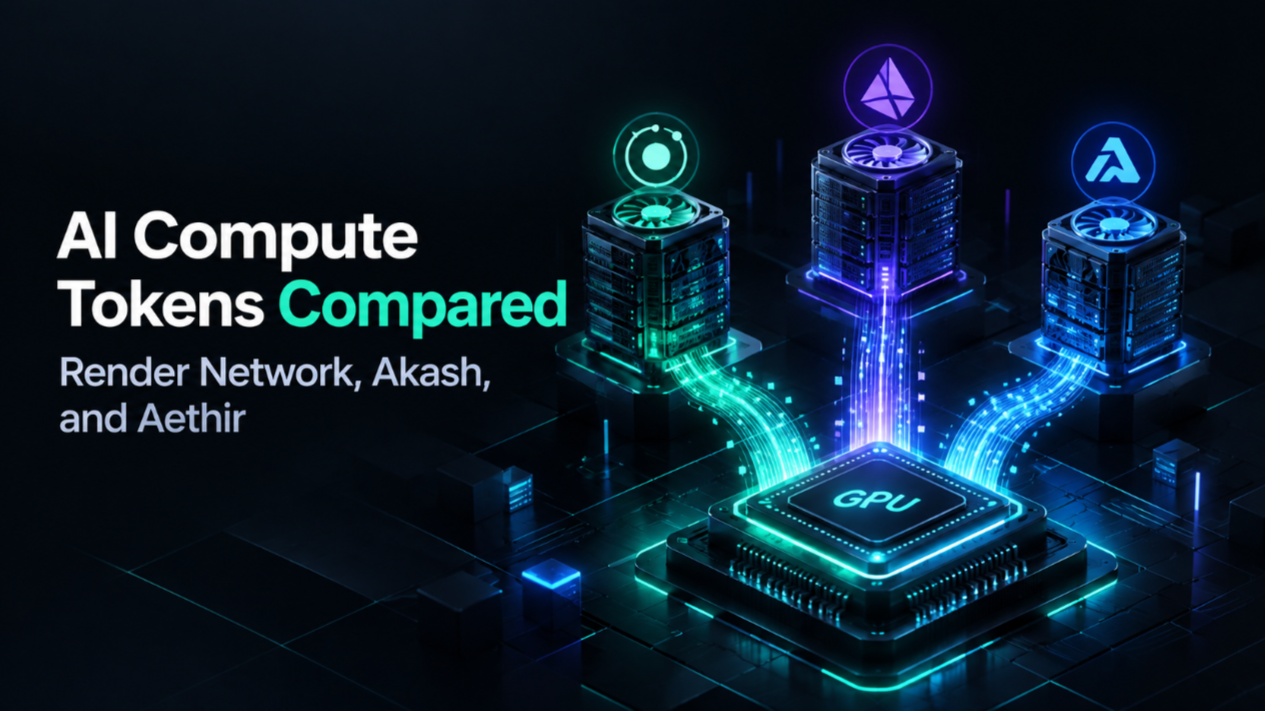
Decentralised compute networks aim to fix this by aggregating idle GPUs from data centres, gaming rigs, and crypto mining operations. The token is used to pay for compute jobs; node operators earn it for completing verified work. See our deep dive on Render Token for a detailed breakdown of how this model works in practice.
- Render Network (RNDR/RENDER) focuses on GPU rendering and AI inference, originally popularised by 3D artists and now expanding into AI workloads.
- Akash Network (AKT) is a general-purpose decentralised cloud, offering containerised compute at 80–90% discounts compared to AWS.
- Aethir focuses on enterprise-grade GPU-as-a-service, targeting gaming and AI inference at scale.
Data tokens: who owns the training data?
AI models are only as good as the data they are trained on. The problem is that almost all high-quality training data is owned by a handful of large corporations — Google's search index, Meta's social graph, Amazon's purchase history. This data moat is one of the biggest barriers to competing with frontier models.
Data tokens try to redistribute ownership. Users contribute data, an on-chain contract records provenance, and the contributor receives tokens whenever their data is used for training. Ocean Protocol is the oldest example; newer entrants are building data DAOs that collectively license datasets to AI labs.
The challenge is quality verification: a blockchain can prove who submitted data but cannot easily verify whether that data is accurate, relevant, or free of bias. Most projects rely on human curation layers or cryptographic proofs of computation for this.
Model tokens: can a community own an AI?
Bittensor (TAO) is the most ambitious attempt at a decentralised AI model marketplace. Its subnet architecture means that anyone can launch a specialised AI task — text generation, image recognition, financial prediction — and attract miners to compete on quality. The best-performing miner gets the majority of block rewards.
The result is a market for intelligence: buyers pay in TAO to query subnets, miners earn TAO for producing good outputs, and validators stake TAO to score the miners honestly. The Bittensor market page tracks live TAO price and network metrics.
Critics point out that Bittensor's incentive mechanism can be gamed — submitting outputs from OpenAI to pass as your own model — and that the quality bar across subnets varies enormously. But the vision of a permissionless, incentive-aligned AI marketplace has attracted serious developer attention.
Agent tokens: AI that acts autonomously on-chain
The most frontier segment of AI crypto is autonomous agents. These are software systems that can plan multi-step tasks, call external APIs, write and deploy smart contracts, and manage their own crypto wallets — all without human intervention in the loop.
Fetch.ai (FET) is one of the original agent protocols, building a network where agents can discover each other, negotiate prices, and transact. The project merged with Ocean Protocol and SingularityNET into the ASI Alliance in 2024, targeting a combined AGI infrastructure stack. Check the Fetch.ai market page for current token data.
Virtual Protocol (VIRTUAL) takes a different angle: it allows anyone to mint an "AI virtual" — a personalised agent with its own token and personality — on the Base blockchain. These agents can be deployed across games, social platforms, and commerce contexts.
NEAR Protocol and the AI-native blockchain thesis
NEAR Protocol has positioned itself as the AI-friendly Layer 1. Its account model, named accounts, and JavaScript compatibility make it accessible to web2 developers building AI-adjacent apps. The NEAR AI initiative provides compute subsidies and tooling for AI agents to run on-chain.
The thesis is that AI agents need a blockchain with fast finality, low fees, and human-readable addresses to operate at scale. NEAR argues it is better suited to this than Ethereum (high fees) or Solana (complex account model). See the NEAR market page for price and ecosystem metrics.
How the AI and crypto markets move together
AI tokens are among the most correlated sub-sector in crypto. When ChatGPT released GPT-4, AI token prices spiked across the board. When tech stocks sell off, AI tokens often fall harder than Bitcoin. The sector trades partly on crypto market sentiment and partly on broader AI narrative cycles.
This dual-beta characteristic means AI tokens can deliver outsized returns in bull markets and outsized losses in risk-off environments. Investors who treat them as pure crypto bets often miss the AI narrative driver; those who treat them as AI equity proxies often underestimate the crypto volatility overlay.
Key risks to understand before investing
- Technology risk: most projects are early-stage and may never achieve product-market fit.
- Tokenomics risk: many AI tokens have high inflation schedules to reward miners, which can dilute holders.
- Competitive risk: OpenAI, Google, and Microsoft are spending billions. A decentralised alternative needs a compelling reason to win.
- Regulatory risk: if AI agents can execute financial transactions autonomously, regulators may classify them as unlicensed brokers.
The long-term bull case for AI x crypto
The bull case rests on two ideas. First, AI will become the most economically valuable technology in history, and the infrastructure to run it should be owned by its users rather than a handful of corporations. Crypto provides the coordination mechanism and incentive layer to make that work.
Second, autonomous AI agents will need to transact value without a bank account or a human counterpart. Blockchain provides the settlement layer — a permissionless, global, always-on payment rail that agents can use without asking permission from a centralised platform.
What to watch in 2025–2026
- Bittensor subnet growth: if quality subnets attract serious users, TAO becomes a genuine AI infrastructure token.
- Agent frameworks maturing: whether Fetch.ai / ASI Alliance, Virtual Protocol, or a new entrant becomes the default coordination layer for AI agents.
- Regulatory clarity on autonomous agents transacting on-chain.
- Whether decentralised compute can close the price/performance gap with AWS for real AI workloads.
This article is for informational purposes only and does not constitute investment advice. Cryptocurrency investments carry significant risk of loss.