
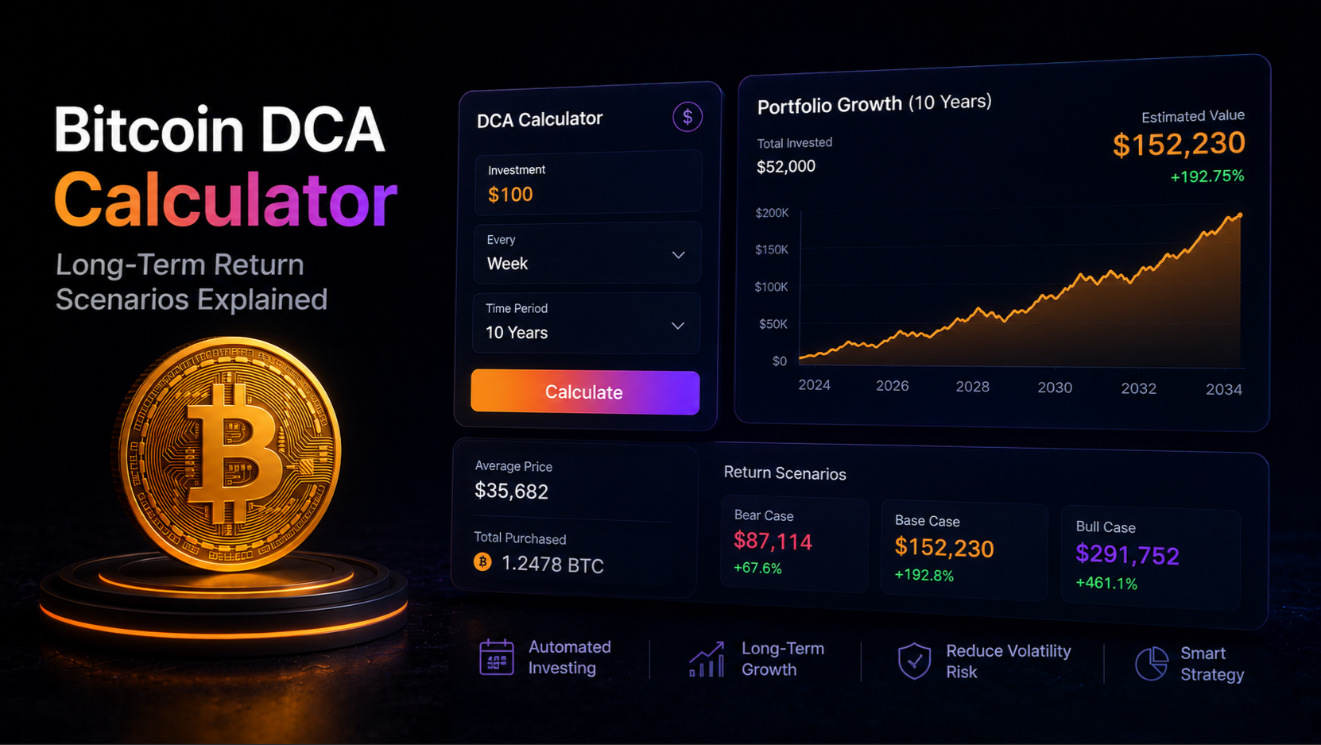
What is dollar-cost averaging (DCA) and why does it suit Bitcoin?
Dollar-cost averaging (DCA) is an investment strategy in which you purchase a fixed dollar amount of an asset at regular intervals — weekly, biweekly, or monthly — regardless of the current price. When prices are high, your fixed amount buys fewer units. When prices are low, the same amount buys more. Over time, the average cost per unit is lower than the average price during the same period.
Bitcoin's extreme volatility makes DCA particularly well-suited to it as a strategy. Trying to time Bitcoin's market cycle — buying at exact bottoms and selling at exact tops — has historically failed for the vast majority of retail investors. DCA removes the need to predict timing and turns volatility into an advantage: bear markets become forced accumulation periods.
For current Bitcoin market data to contextualise these scenarios, visit the Bitcoin market page. For forward-looking price estimates, our Bitcoin forecast page covers analyst projections.
Historical DCA returns: what the data shows
Bitcoin's historical price data makes for some of the most compelling DCA case studies in investment history. An investor who purchased $100 of Bitcoin every week from January 2017 through December 2021 — through the brutal 2018–2019 bear market — would have invested approximately $26,000 and accumulated a position worth over $100,000 at the 2021 peak.
Even a DCA strategy begun at one of the worst possible entry points — the January 2018 peak near $20,000 — would have produced positive returns by 2020 as the accumulation during the bear market lowered the average cost basis significantly below the 2021 cycle peak.
This is DCA's core psychological and mathematical advantage: you cannot invest at the worst possible price with a regular purchase schedule, because only one week or month in the entire cycle can represent the absolute peak.
DCA scenario 1: $50 per week over 4 years (one full cycle)
Total invested: $10,400 over 208 weeks.
Starting point: the 2020 Bitcoin halving in May 2020, price approximately $8,700.
Estimated outcome at the 2021 cycle peak (November 2021, ~$69,000): the weighted average purchase price across the bear-to-bull transition would have been approximately $25,000–$30,000, yielding a final portfolio value of approximately $23,000–$29,000 against a $10,400 investment — a return of approximately 120–180%.
Continuing through the subsequent bear market without selling and measuring at the 2024 pre-halving ATH ($73,000): accumulated coins through the $15,500–$20,000 range during the 2022–2023 bear market would further lower average cost. The final portfolio at $73,000 would represent an even stronger return on the full $21,000+ invested across nearly four years.
DCA scenario 2: $200 per month over 2 years
Total invested: $4,800 over 24 months.
Starting point: January 2022 — one of the worst possible times to begin, with Bitcoin at approximately $47,000 and about to enter an 11-month decline to $15,500.
By December 2023, Bitcoin had recovered to approximately $44,000. The DCA investor who purchased monthly through the entire bear market — including sub-$20,000 prices in mid-2022 and $15,500 in November 2022 — would have an average cost basis near $26,000–$28,000. At a $44,000 price, the $4,800 invested would be worth approximately $8,000–$8,500 — a gain of roughly 65–77% despite starting at near a cycle peak.
This scenario illustrates DCA's resilience against bad timing. A lump-sum purchase of $4,800 in January 2022 at $47,000 would have been worth only about $4,500 at December 2023 — still not back to breakeven.
DCA scenario 3: $500 per month over 10 years
Total invested: $60,000 over 120 months.
Starting point: January 2015, Bitcoin at approximately $250. Ending point: December 2024.
An investor using this strategy would have purchased Bitcoin through the 2017 bull run, the 2018–2019 bear market, the COVID crash of March 2020, the 2021 bull run, the 2022 FTX-driven bear market, and the 2023–2024 recovery. The diverse entry points would result in an average cost basis well below $10,000.
At the 2024 pre-halving ATH of approximately $73,000, this $60,000 total investment would represent a portfolio worth several hundred thousand dollars depending on exact timing — one of the highest risk-adjusted long-term returns of any asset class over the same period.
How to calculate your own DCA results
To estimate your personal DCA returns, you need four variables:
- Start date: when you began or intend to begin purchasing.
- Purchase amount: the fixed dollar amount per period.
- Purchase frequency: weekly, biweekly, or monthly.
- Evaluation date: the price date at which you want to measure the result.
Free tools such as dcabtc.com, Bitcoin DCA Calculator, and CoinGecko's DCA tool allow historical back-testing with these inputs. For forward projections, see our Bitcoin price forecast page which models analyst scenarios for 2026–2028.
DCA vs lump-sum investing: which performs better for Bitcoin?
Research on traditional assets typically shows that lump-sum investing outperforms DCA approximately two-thirds of the time in rising markets — because time in market beats timing the market. However, Bitcoin's uniquely high volatility and cyclical structure makes the calculus different.
In Bitcoin's four-year halving cycles, the difference between buying at a cycle peak versus a cycle trough can be 70–85%. A lump-sum investor who bought at the November 2021 peak ($69,000) would have waited until 2024 to break even. A DCA investor who started at the same time would have broken even significantly sooner due to accumulation in the $15,000–$25,000 range.
For most retail investors without the ability to time cycle bottoms reliably, DCA provides significantly better psychological sustainability and comparable or superior risk-adjusted returns over full cycles.
Setting up an automated Bitcoin DCA: step by step
- Choose a regulated exchange that supports recurring purchases. Look for low fees on recurring buy orders — some exchanges charge premium fees for automated buys.
- Set your amount and frequency: weekly purchases reduce per-unit price variance more than monthly; the difference is modest for amounts under $500/month.
- Enable auto-invest or recurring buy features. Major platforms including Coinbase, Binance, and others offer this functionality.
- Decide on custody: leave accumulated Bitcoin on the exchange (convenient, counterparty risk) or withdraw to a hardware wallet periodically (more secure, small withdrawal fee).
- Set a review schedule: quarterly is sufficient. Avoid checking daily — DCA's psychological benefit disappears if you obsessively track short-term prices.
Our Coinbase review covers the auto-invest features and fee structure for recurring purchases in detail. Binance review covers the alternative platform with generally lower trading fees.
Common DCA mistakes to avoid
- Stopping during bear markets: the worst time to stop DCA is exactly when it is most psychologically difficult — during a crash. Bear market purchases lower the average cost and are mathematically the most valuable.
- Over-allocating: DCA works best with an amount you can genuinely commit to for years without financial stress. Too high an amount leads to panic selling during drawdowns.
- Ignoring tax implications: each DCA purchase creates a separate tax lot. Keeping records of purchase dates and prices is essential for cost basis calculation. Use a crypto tax tool or exchange reports.
- Forgetting custody: keeping years of accumulated Bitcoin on an exchange exposes it to the exchange's counterparty risk. Periodic withdrawals to a hardware wallet are advisable above a certain threshold.
- Treating DCA as a guarantee: DCA significantly improves entry price and reduces timing risk, but it does not eliminate the possibility of long-term losses if Bitcoin's adoption trajectory changes.
DCA with Bitcoin vs other assets: volatility as a tool
The same DCA approach applied to the S&P 500 over 10 years has historically produced strong returns, but the volatility that makes DCA so powerful in Bitcoin simply does not exist in diversified stock indices. Bitcoin's 80%+ bear market drawdowns are precisely what make DCA so effective: each dollar invested in a deep bear market buys magnitudes more Bitcoin than the same dollar invested near the top.
For context on where Bitcoin is in its current market cycle — which informs how "cheap" a current DCA entry point might be — the Bitcoin market page tracks on-chain metrics and price history.
DCA exit strategies: the often-neglected half
Most DCA guides focus entirely on the accumulation phase. The exit — when and how to sell or deploy accumulated Bitcoin — is equally important and equally prone to emotion-driven mistakes.
Common exit approaches include: selling a fixed percentage of holdings at a predetermined price target, reverse-DCA (selling a fixed amount per period above a price threshold), and lifecycle rebalancing (converting a portion of Bitcoin gains into stable assets as retirement approaches).
For long-term accumulators using ETFs in retirement accounts, the exit is often not a sale at all — it is a required minimum distribution from a traditional IRA or simply inherited by the next generation from a Roth. See our ETF guide for tax implications in different account types.
This article is for educational purposes only and does not constitute financial advice. All investment strategies involve risk. Past DCA returns in Bitcoin do not guarantee future results.