Why AI tokens attract investor interest
AI tokens sit at the intersection of the two biggest technology narratives of the decade. The global AI software market is projected to exceed $1 trillion by 2030. If even a fraction of that value flows through decentralised protocols rather than centralised platforms, the tokens powering those protocols could be worth multiples of their current prices.
That upside potential — combined with the speculative nature of crypto markets — has made AI tokens one of the most actively traded sub-sectors since 2023. But the same characteristics that make them exciting also make them dangerous for unprepared investors.
Understanding what you are actually buying
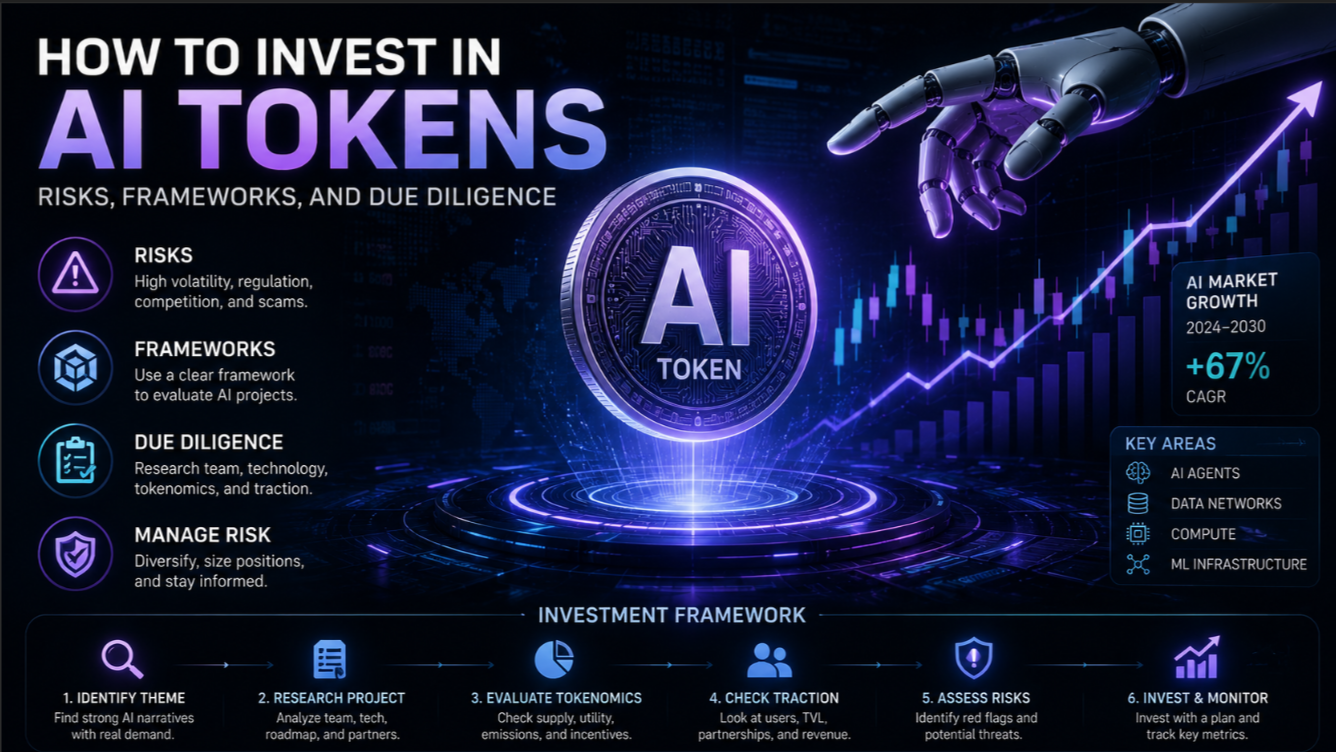
Before allocating capital to any AI token, you need to understand what claim the token gives you on the underlying project. AI tokens generally fall into four economic models:
- Work tokens: must be staked to perform work in the network (e.g. validating, mining). Value accrues if demand for the work exceeds supply of staked tokens.
- Fee tokens: used to pay for services on the platform. Value accrues if the platform generates real fee revenue that is burned or distributed to stakers.
- Governance tokens: give voting rights over protocol parameters. Value is largely speculative unless governance controls real treasury assets.
- Equity proxies: represent a financial interest in a project, sometimes structured via revenue sharing or buyback mechanisms. Higher regulatory risk.
Most AI tokens combine elements of multiple models. Bittensor's TAO is a work token (miners stake to participate) and a fee token (subnets pay in TAO). Check the Bittensor market page for current staking metrics.
Building an AI token research framework
Before buying any token, answer these seven questions:
- What does the network actually do, and is there evidence of real usage (active wallets, transaction volume, revenue)?
- Who are the validators/miners and what are their incentives? Are rewards sustainable without inflationary token issuance?
- What is the token unlock schedule? A token that unlocks 40% of supply in the next 12 months will face persistent sell pressure.
- Does the project have a moat — data, network effects, protocol integrations — that makes it hard to replace?
- Who are the team and investors? Have they built and shipped products before?
- What is the fully diluted valuation (FDV) and how does it compare to revenue or usage? Many AI tokens trade at FDV-to-revenue ratios above 1,000x.
- What is the regulatory exposure? Tokens that resemble securities or involve unlicensed financial services face the most risk.
Position sizing for high-volatility assets
AI tokens are genuinely high-risk assets. A 70–80% drawdown from peak to trough is not unusual; some projects lose 95%+ and never recover. A sound position-sizing approach acknowledges this reality.
- Never allocate more than 5–10% of a total investment portfolio to AI tokens collectively.
- Within the AI token allocation, diversify across the stack: a compute token, a model token, and an agent token have different risk drivers.
- Consider dollar-cost averaging over 3–6 months rather than buying in a single lump sum, especially after a major price rally.
- Set a mental stop — a price level or thesis invalidation trigger — before you buy, so decisions are made rationally rather than under emotional pressure.
The compute layer: Render Token and the GPU economy
Render Network is one of the most established AI compute tokens. Originally a GPU rendering platform for 3D artists, it has expanded into AI inference and training workloads. Its migration to Solana improved transaction throughput significantly.
The investment thesis: as AI inference demand grows (every AI query is a compute job), a decentralised GPU marketplace that is cheaper than AWS should attract volume. The Render Token market page shows live price, market cap, and network metrics to evaluate the thesis in real time.
The agent layer: Fetch.ai and Virtual Protocol
Fetch.ai merged into the ASI Alliance in 2024, combining with Ocean Protocol and SingularityNET to build a shared AI infrastructure stack. The FET token is used to pay for agent services and stake on the network. FET live data is available on the market page.
Virtual Protocol (VIRTUAL) is a newer entrant focused on permissionless AI agent creation on Base. Each agent is launched with its own token, creating a long-tail of micro-markets around individual agents. It is a high-beta play on the AI agent narrative. See Virtual Protocol on the market page.
Reading on-chain metrics for AI tokens
Unlike traditional assets, AI tokens have on-chain data that can supplement price analysis. Useful metrics include:
- Active addresses / daily transactions: rising activity suggests genuine usage growth.
- Staking ratio: a high percentage of supply staked reduces liquid sell pressure and signals confidence.
- Revenue / fee burns: actual protocol revenue is the most fundamental valuation anchor.
- New subnet / agent deployments: for network-effect projects, the pace of new deployments measures ecosystem health.
- Token unlock calendar: use platforms like TokenUnlocks.app to overlay upcoming unlock events on your price charts.
Tax and accounting considerations
In most jurisdictions, trading AI tokens is a taxable event. Staking rewards are often treated as income at the time of receipt. If a project migrates tokens (as the ASI Alliance did with FET, OCEAN, and AGIX), the migration itself may trigger a taxable disposal depending on your jurisdiction.
Keep records of every purchase, sale, and staking event with timestamps and prices. Crypto tax software like Koinly, CoinTracker, or Accointing can automate most of this, but manual review of complex DeFi interactions is still often required.
Common investor mistakes in the AI token sector
- Buying on narrative alone without checking tokenomics — many AI tokens have 5–10x more supply scheduled to unlock over the next two years.
- Confusing the success of centralised AI (OpenAI, Google) with the success of decentralised AI tokens. The two markets are not directly linked.
- Ignoring liquidity risk: smaller AI tokens can have $100k–$500k daily volume. A large position is hard to exit without significant price impact.
- Treating all AI tokens as equivalent. A data marketplace token, a compute token, and an agent token have entirely different competitive dynamics.
Portfolio construction: a sample AI token allocation
A reasonable starting allocation for a crypto-native investor might look like:
- 40% in the most liquid, established AI tokens (Bittensor, Render, Fetch.ai) as core positions.
- 30% in mid-cap tokens with clear product traction and growing on-chain activity.
- 20% in higher-risk bets on emerging agent or data protocols.
- 10% held in stablecoins to deploy into dips without needing to sell core positions.
Review allocations at least quarterly. The AI token landscape changes fast — a project dominant in early 2025 may be superseded by a more technically capable competitor within 12 months.
Exit strategies and profit-taking discipline
Having an exit plan before you enter a position is as important as the entry thesis. Common frameworks include: taking 50% off the table after a 3–5x gain to reduce risk with "house money" remaining; selling a fixed percentage every time the price doubles; or setting price targets based on FDV relative to a comparable at an earlier stage.
The AI token sector in 2021–2022 saw many assets rise 50–100x and then fall 95%+ within 18 months. Discipline around profit-taking is what separates successful traders from those who watch gains evaporate.
This content is for educational purposes only. It does not constitute financial advice. Always conduct your own research and consider your risk tolerance before investing.