Why beginners should start with major cryptocurrencies
The cryptocurrency market in 2026 contains over 10,000 listed tokens, but the vast majority carry extreme risk, minimal liquidity, and no meaningful adoption. For anyone entering the space for the first time, the single most important decision is not which coin will make you rich — it is which assets give you the best chance of learning the market without losing your starting capital to scams, rug-pulls, or simply bad luck.
Major cryptocurrencies — Bitcoin, Ethereum, Solana, and regulated stablecoins — offer a combination of deep liquidity, transparent on-chain history, institutional backing, and established regulatory clarity that no small-cap token can match. They are listed on every regulated exchange, covered by reputable analysts, and have survived multiple full market cycles. Starting with these assets means your biggest risk is price volatility, not fraud or zero-liquidity collapse.
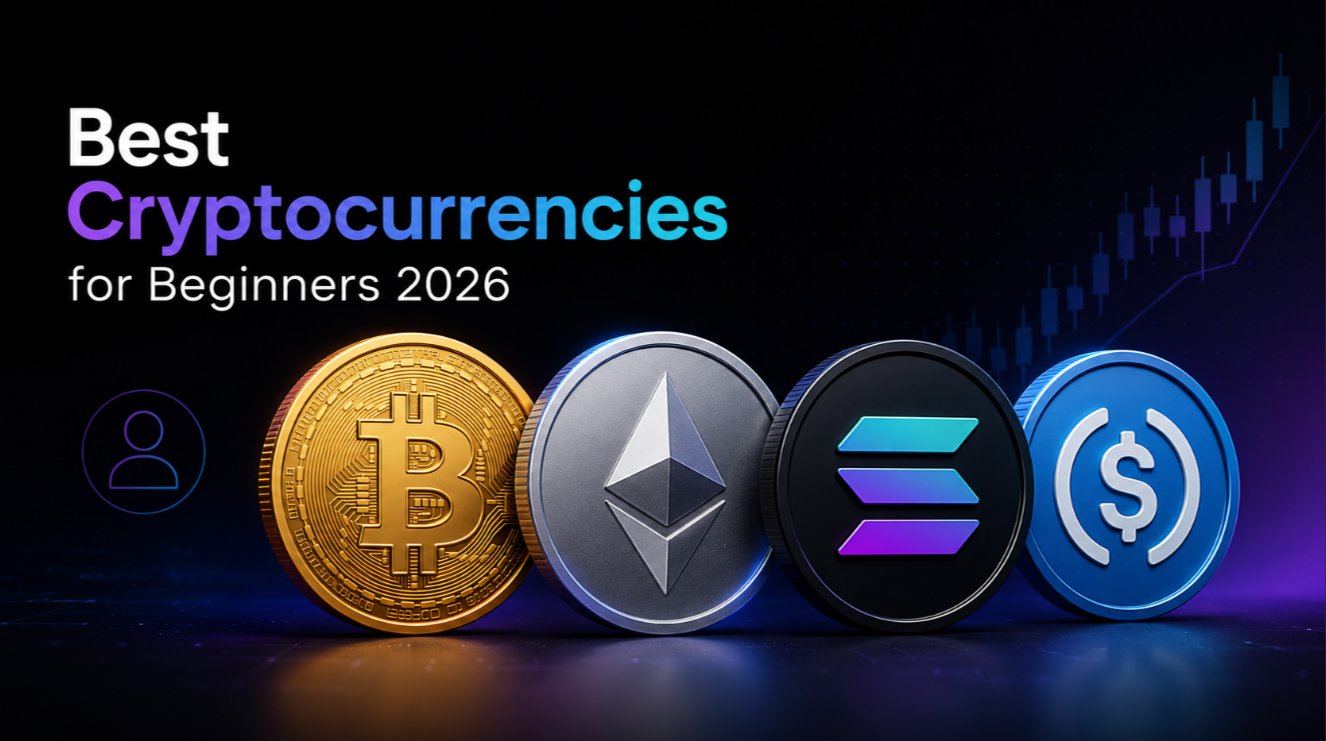
This guide covers the five assets worth understanding first: Bitcoin (BTC), Ethereum (ETH), Solana (SOL), Tether (USDT), and USD Coin (USDC). It also explains how to allocate a small starting budget, why dollar-cost averaging beats timing the market, what to avoid entirely, and how to build the mindset needed for long-term success.
Bitcoin (BTC): the original store of value
Bitcoin was launched in 2009 as the world's first decentralized digital currency. In 2026 it remains the largest cryptocurrency by market capitalization and the one most widely held by institutional investors, sovereign wealth funds, and publicly traded companies. Its hard-coded supply cap of 21 million BTC — of which roughly 19.8 million have already been mined — makes it the scarcest monetary asset in existence.
For a beginner, Bitcoin is the right starting point for three reasons. First, it is the most researched and most transparent asset in the market: every transaction since January 2009 is publicly auditable on-chain. Second, its narrative is simple — digital gold, a hedge against monetary inflation, a decentralized store of value — which makes it easy to form a reasoned investment thesis. Third, its liquidity is unmatched: you can buy $100 or $100,000 worth of Bitcoin on any major exchange in seconds and sell it just as fast.
Bitcoin's main limitation for beginners is its price volatility. Even after 15 years, 20–40% drawdowns within a single calendar year are not unusual. This is expected behavior, not malfunction. Investors who held BTC through every major drawdown since 2013 have seen their wealth multiply — those who sold at the bottom locked in losses. Bitcoin rewards patience and penalizes panic.
- Ticker: BTC | Supply cap: 21 million BTC
- Primary use case: store of value, inflation hedge, digital gold
- Average annual return 2013–2025: ~100% CAGR (with extreme yearly variation)
- Custody: self-custody via hardware wallet (Ledger, Trezor) or regulated exchange
For a price outlook and technical analysis, see the Bitcoin price forecast.
Ethereum (ETH): programmable blockchain
Ethereum is the second-largest cryptocurrency and the dominant smart-contract platform. Launched in 2015, it introduced programmable money — the ability to deploy self-executing code (smart contracts) on a decentralized network, enabling DeFi protocols, NFT marketplaces, stablecoins, staking platforms, and thousands of other applications. Nearly every major DeFi protocol, most stablecoins, and the majority of tokenized real-world assets run on Ethereum or Ethereum-compatible chains.
After the 2022 Merge, Ethereum transitioned from proof-of-work mining to proof-of-stake. This reduced its energy consumption by over 99% and turned ETH into a productive asset: holders can stake ETH to earn 3.5–5% APY while securing the network. Over 33 million ETH — roughly 27% of supply — is staked as of 2026, reducing the available circulating supply and acting as a deflationary pressure alongside ETH's burn mechanism.
For a beginner, Ethereum's investment thesis is more complex than Bitcoin's but equally accessible: you are buying the gas that powers the world's decentralized internet. Every transaction on Ethereum mainnet, every DeFi swap, every NFT mint burns a small amount of ETH. As usage grows, so does the case for Ethereum as a scarce productive asset. It is also the entry point into the broader DeFi ecosystem whenever you are ready to explore it.
- Ticker: ETH | No hard supply cap; deflationary under EIP-1559 burn mechanism
- Primary use case: smart contract platform, DeFi infrastructure, staking
- Staking yield: ~3.5%–5% APY (native), accessible via Coinbase, Lido, or hardware wallet
- Best wallets for beginners: MetaMask (browser/mobile), Coinbase Wallet
See the Ethereum price forecast for analyst projections.
Solana (SOL): speed and low fees
Solana is the third major blockchain worth knowing as a beginner. Designed for high throughput, Solana processes up to 65,000 transactions per second at fees that are typically fractions of a cent — compared to Ethereum mainnet fees that can reach $5–$50 during periods of congestion. This makes Solana practical for payments, gaming, consumer applications, and DeFi trades that would be economically unviable on Ethereum.
Solana's rise to a top-5 position has been driven by a combination of developer adoption, retail user growth, and its thriving NFT and memecoin ecosystems. The Phantom wallet has become the most downloaded crypto wallet on mobile, driven largely by Solana users. In 2025–2026, Solana attracted significant institutional attention as spot SOL ETFs were approved in multiple jurisdictions, bringing regulated exposure to retail investors who do not want to manage self-custody.
The risk profile for SOL is higher than BTC or ETH. Solana has experienced several notable network outages, and its validator set is more concentrated than Ethereum's. It also has a higher percentage of its total supply held by early investors and the Solana Foundation, which can create selling pressure. For beginners, SOL makes sense as a third position after establishing BTC and ETH — not as a starting point.
- Ticker: SOL | No hard cap; inflationary schedule tapering toward 1.5% annually
- Primary use case: high-speed DeFi, payments, NFTs, consumer apps
- Native staking yield: ~6%–8% APY, no minimum, no lock-up beyond one epoch (~2–3 days)
- Best wallet: Phantom (iOS/Android/Chrome extension)
USDT and USDC: stablecoins explained
Stablecoins are cryptocurrencies designed to maintain a fixed value — almost always $1.00 USD. The two most widely used are Tether (USDT) and USD Coin (USDC). They are not investment vehicles — their price does not appreciate. What they provide is a way to stay in the crypto ecosystem without exposure to volatility: when you expect a market downturn, you can convert BTC, ETH, or SOL into USDT/USDC and park there until you are ready to buy back in.
USDC is issued by Circle and is considered the more regulated of the two: every USDC in circulation is backed 1:1 by USD held in US-regulated bank accounts and short-term US Treasury bills, with monthly reserve attestations published by a Big Four accounting firm. In 2025, Circle became a publicly listed company under the GENIUS Act framework, adding another layer of regulatory accountability.
USDT (Tether) has the highest liquidity of any stablecoin and is the most widely paired trading asset across both centralized and decentralized exchanges. Its reserve composition has historically been less transparent than USDC's, but after years of regulatory pressure, Tether now publishes quarterly reserve reports. For a beginner, USDC is the safer choice for holding significant balances; USDT is acceptable for short-term trading pairs.
Stablecoins are a tool, not an investment. Use them to preserve capital between positions or to dollar-cost average into volatility — not as a yield-bearing savings account. Unaudited "algorithmic stablecoins" that promise high yields are not stablecoins; they are high-risk DeFi experiments.
How to allocate your first $100, $500, or $1,000
One of the most common beginner mistakes is over-diversifying too early. Buying 10 different coins with $100 means each position is $10 — not enough to learn from, not enough to matter, and impossible to track meaningfully. Start concentrated, understand what you own, then expand.
Here are three example starting allocations based on budget:
- $100 — maximum simplicity: 60% BTC ($60), 40% ETH ($40). No altcoins. Learn how exchanges work, practice buying and selling small amounts, understand gas fees and wallets. This is a learning allocation, not a wealth-building allocation.
- $500 — beginner diversification: 50% BTC ($250), 35% ETH ($175), 15% SOL ($75). Keep 10–20% of your total budget in USDC as a "dry powder" reserve to buy dips. Do not split across more than 3 assets at this stage.
- $1,000 — structured starter portfolio: 45% BTC ($450), 30% ETH ($300), 15% SOL ($150), 10% USDC ($100). The USDC portion lets you act when prices drop 20–30%, which happens regularly with all three assets.
These allocations are not personalized financial advice — they are illustrative starting points. Your actual allocation should reflect your risk tolerance, time horizon, and whether you can afford to lose the entire amount. Cryptocurrency is high-risk. Never invest money you need for rent, food, or emergencies.
Dollar-cost averaging (DCA): the beginner's best strategy
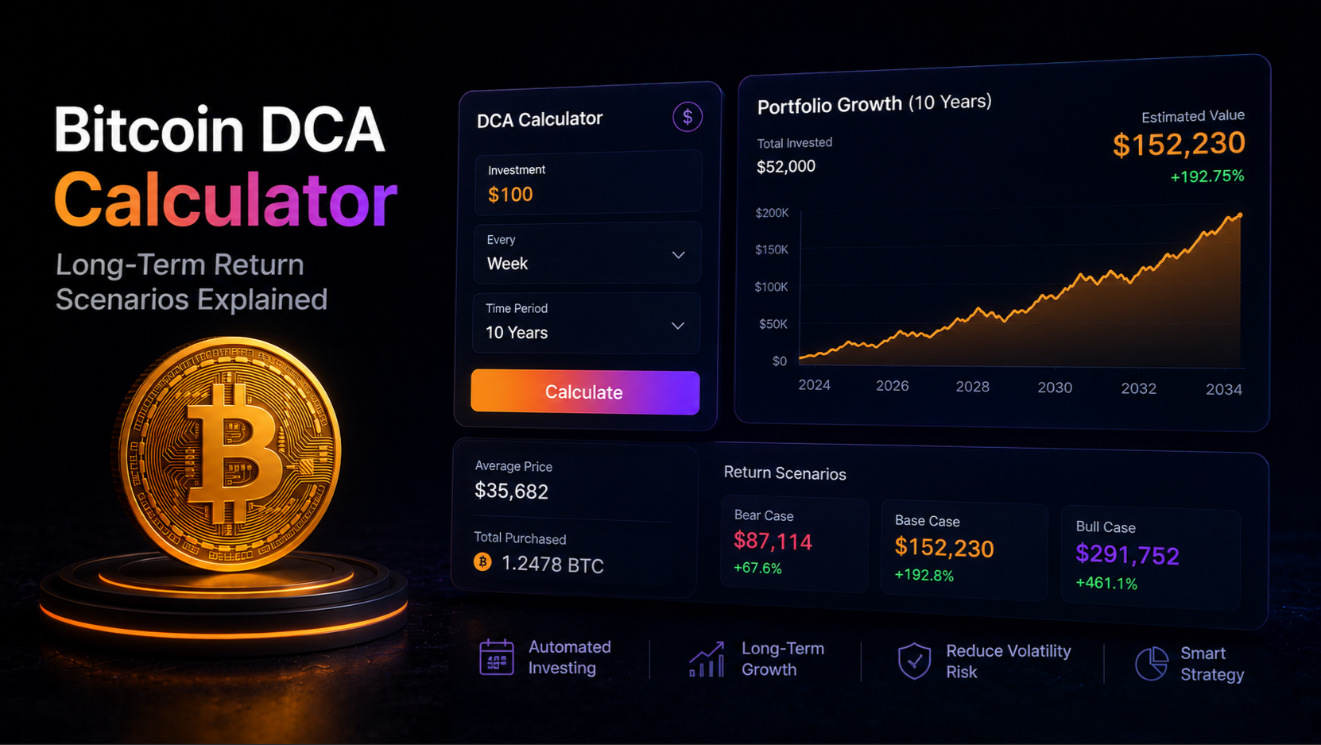
Dollar-cost averaging (DCA) means investing a fixed amount on a regular schedule — every week or every month — regardless of price. Instead of trying to time the market (buy the bottom, sell the top), you buy automatically and average your entry price over time. Studies across asset classes consistently show that regular DCA outperforms lump-sum investing for most retail investors, primarily because it removes the emotional decision-making that causes people to buy at peaks and panic-sell at bottoms.
Practical DCA example: you decide to invest $50 in BTC every Monday. Some Mondays BTC is at $80,000 and you buy 0.000625 BTC. The next week it drops to $60,000 and you buy 0.000833 BTC. Over time, your average cost per BTC is lower than the average price during the period, because you automatically buy more when prices are low and less when they are high.
- Choose your asset (BTC, ETH, or a fixed split between them).
- Decide on a fixed amount per period that you are comfortable losing entirely.
- Set a calendar reminder or use an exchange's auto-invest feature to buy on schedule.
- Do not check the price daily. Set a quarterly review to assess your overall position.
- Only stop DCA-ing if your personal financial situation changes — not because the price dropped.
Most major exchanges — including Coinbase — offer automated recurring purchases that execute DCA without any manual effort. This removes the temptation to skip a buy when markets feel scary, which is precisely when DCA delivers the most value.
What to avoid: memecoins, leverage, and micro-caps
As important as knowing what to buy is knowing what to avoid. The following categories destroy more beginner capital than any other factor in the market.
- Memecoins — Tokens with no technology, no use case, and no development activity, sustained entirely by social media hype and the greater-fool theory. Examples include the hundreds of dog-themed and celebrity-named tokens that launch weekly. A few make early holders wealthy; the overwhelming majority go to zero within months. If you cannot explain the technology or revenue model of a token, do not buy it.
- Leverage trading — Borrowing money from an exchange to make larger positions. 5x leverage means a 20% price drop wipes out your entire position — a liquidation. On crypto assets that commonly move 10–20% in a single day, leverage is not a trading tool for beginners; it is a fast path to a zero balance. Avoid leverage entirely for your first year.
- Micro-cap and new tokens — Any token with a market cap below $500 million and less than two years of trading history should be considered extremely high risk. Many are outright scams (rug-pulls: the developers drain liquidity and disappear). Others are genuine projects that fail because the market is brutal. Beginners have no edge in evaluating these.
- Unsolicited investment advice — Telegram groups, Discord servers, Twitter/X accounts, and YouTube channels promoting "100x opportunities" are predominantly operated by promoters who already hold the token and profit from your purchase. This is called a pump-and-dump scheme. Legitimate analysts do not cold-DM you with investment tips.
- Unregulated exchanges and wallets — Using exchanges that are not registered with financial regulators in your country creates significant legal and counterparty risk. Stick to regulated, audited platforms with proof-of-reserves. The collapse of FTX in 2022 is the definitive case study in what happens when you trust an unregulated custodian with your assets.
Tax basics for crypto beginners
In most jurisdictions, cryptocurrency is treated as a capital asset, meaning every sale, swap, or spend is a taxable event. You are required to report gains and losses even if you never convert to fiat currency — swapping BTC for ETH is a disposal of BTC at market price, creating a gain or loss. Ignoring crypto taxes is not a viable strategy: most major exchanges report user transaction data to tax authorities, and on-chain activity is permanently traceable.
The key principle for beginners: keep records of every purchase and every sale from your first transaction. Most tax software (Koinly, TaxBit, CoinTracker) can connect directly to your exchange accounts via API and calculate your gains and losses automatically. Setting this up at the start costs minutes; reconstructing years of transactions retroactively costs hours or thousands in accountant fees.
- Short-term vs. long-term capital gains — In the US, assets held for less than one year are taxed at ordinary income rates (10–37%); assets held over one year qualify for lower long-term capital gains rates (0–20%). Holding BTC for 12+ months before selling is a meaningful tax optimization strategy, and it aligns well with a DCA buy-and-hold approach.
- Staking rewards — Income earned from staking is typically taxed as ordinary income at the fair market value when received, in addition to any capital gains tax when you later sell the staked tokens.
- Loss harvesting — If you have unrealized losses on a position, selling it can create a tax loss that offsets gains elsewhere in your portfolio. This is called tax-loss harvesting and is a legal and commonly used strategy at year-end.
- International note — Tax treatment varies significantly by country. Germany provides tax-free status on crypto held over one year. Portugal and UAE have historically been favorable. Always verify current rules in your jurisdiction with a qualified tax professional.
When to consider altcoins beyond BTC, ETH, and SOL
Once you have held BTC and ETH through at least one full market cycle (typically 12–24 months, including at least one significant drawdown of 30%+), you will have developed the emotional and analytical foundation needed to evaluate higher-risk assets. The question "should I buy altcoins?" should only arise after you can answer all of the following:
- Do I understand what the project does and who its direct competitors are?
- Have I read the whitepaper or technical documentation?
- Do I understand the token's supply schedule, vesting cliffs for team/investor tokens, and inflation rate?
- Is the development team public, doxxed, and active on GitHub?
- Is there genuine user adoption (daily active addresses, TVL, fee revenue) — not just marketing?
- Can I afford to lose 100% of this position without material impact on my financial situation?
If you can answer all six questions for a specific token, a small speculative allocation (5–10% of your total crypto portfolio) is defensible. If you cannot answer even one of them, that is a signal to do more research — or to pass entirely. The majority of altcoins launched in any given year will be worth zero within three years. The few genuine winners in a bull cycle are impossible to identify reliably in advance. Size altcoin positions accordingly.
When you are ready to research further, check market data for on-chain metrics and liquidity depth before committing capital to any asset.
Building a long-term mindset in a short-term market
The single greatest advantage a retail beginner has over professional traders is time horizon. Hedge funds and market makers are evaluated quarterly; they cannot afford to hold through a 50% drawdown for 18 months even when they know the long-term thesis is intact. You can. This asymmetry is real and exploitable — if you have the discipline to use it.
Bitcoin has experienced five drawdowns of 50% or greater since 2013. After each one, it recovered to new all-time highs within 12–36 months. Investors who held through all five drawdowns compounded at a rate that outperforms almost every other asset class. Investors who sold at the bottom of each drawdown locked in losses and missed the recovery.
Practical habits that support long-term investing in crypto:
- Reduce news consumption. Daily price headlines are almost entirely noise. A weekly or monthly check of your portfolio is sufficient when you are investing on a multi-year horizon.
- Use cold storage for long-term holds. Move BTC and ETH you are not planning to sell for 1+ years into a hardware wallet. Out of sight, out of mind reduces impulsive decisions.
- Write down your investment thesis. Before buying any asset, write one paragraph explaining why you own it and at what price or conditions you would sell. Revisit this during market panic.
- Separate trading from investing. If you want to experiment with short-term trades, use a small separate account with an amount you can afford to lose. Do not mix it with your long-term DCA portfolio.
- Track your net worth quarterly, not daily. Measuring your portfolio value too frequently increases anxiety and encourages reactive decisions. Quarterly reviews with a clear framework are more productive.
Crypto is still a young asset class. Bitcoin is 17 years old; Ethereum is 11. The infrastructure, regulation, and institutional adoption are still maturing rapidly. Beginners who start in 2026 with a disciplined, simple approach — buy the majors, DCA regularly, avoid leverage and scams, hold for years — are well-positioned to benefit from the next decade of development regardless of where prices go in any given month.