Why Bitcoin ETFs matter for mainstream investors
A Bitcoin exchange-traded fund (ETF) lets investors gain exposure to Bitcoin's price movements through a standard brokerage account — no crypto wallet, no seed phrase, no exchange registration required. For the approximately 200 million Americans who hold retirement or brokerage accounts but have never interacted with a blockchain, ETFs represent the most accessible on-ramp to Bitcoin ever created.
In January 2024, the US Securities and Exchange Commission approved spot Bitcoin ETFs from BlackRock, Fidelity, Ark/21Shares, and eight other issuers after years of rejections. The approval transformed Bitcoin from a niche asset into a product available inside 401(k)s, IRAs, and standard taxable brokerage accounts at Fidelity, Schwab, and Merrill Lynch.
As of 2026, Bitcoin ETFs globally hold billions in assets under management, rivalling the first years of SPDR Gold Shares (GLD) — the most successful commodity ETF launch in history. Understanding how different ETF structures work is essential before choosing one.
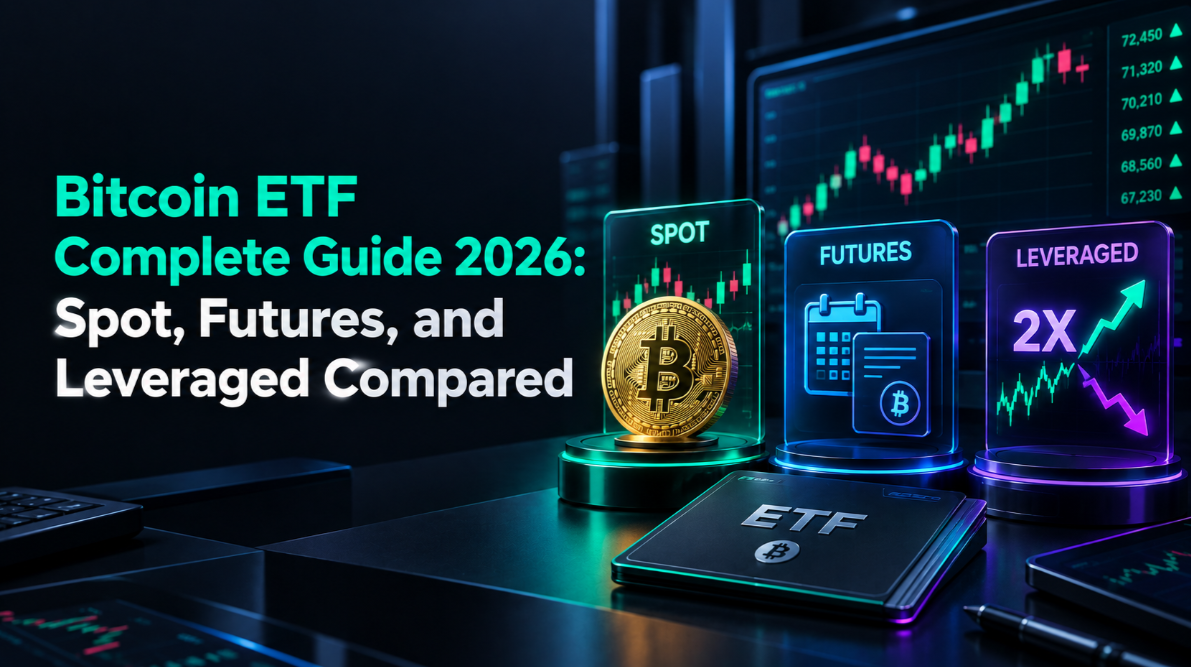
Spot Bitcoin ETFs: what they are and how they work
A spot Bitcoin ETF directly holds Bitcoin in a custodied wallet on behalf of shareholders. When you buy one share, the ETF issuer either already holds the corresponding fraction of Bitcoin or purchases it on your behalf through an authorised participant mechanism. The ETF price closely tracks the Bitcoin spot price minus the annual management fee.
The custodian — typically Coinbase Custody for most US issuers — holds Bitcoin in segregated cold storage. Authorised participants (large banks and market makers) create and redeem large blocks of ETF shares by delivering or receiving Bitcoin, which keeps the ETF price aligned with the underlying asset's market value.
Key advantages of spot ETFs: direct price exposure without tracking error caused by rolling futures contracts, regulated and insured custody, standard brokerage taxation treatment, and eligibility for IRA accounts.
For the current Bitcoin spot price and 30-day performance context, our Bitcoin market page provides live data.
The major US spot Bitcoin ETFs compared (2026)
The leading US spot Bitcoin ETFs as of 2026:
- iShares Bitcoin Trust (IBIT) — BlackRock. Largest AUM, 0.25% fee (0.12% fee waiver first year). Most liquid, tightest bid-ask spread.
- Fidelity Wise Origin Bitcoin Fund (FBTC) — Fidelity. Fidelity self-custodies its own Bitcoin, unusual among issuers. 0.25% fee.
- ARK 21Shares Bitcoin ETF (ARKB) — ARK Invest / 21Shares. 0.21% fee. Strong among retail investors aligned with ARK's innovation thesis.
- Bitwise Bitcoin ETF (BITB) — Bitwise. 0.20% fee, crypto-native issuer. Donates 10% of profits to Bitcoin open-source developers.
- VanEck Bitcoin ETF (HODL) — VanEck. 0.20% fee, ticker is a reference to the crypto community meme.
For most long-term investors, fee differences of 0.05% are negligible versus liquidity and the issuer's track record. IBIT's dominant liquidity typically makes it the default choice for institutional and high-volume traders.
Bitcoin futures ETFs: the older structure explained
Before spot ETFs were approved, investors could only access Bitcoin through futures ETFs. The ProShares Bitcoin Strategy ETF (BITO), launched October 2021, holds CME Bitcoin futures contracts — not actual Bitcoin. This distinction matters enormously over time.
Futures ETFs suffer from "contango roll cost." When the futures market is in contango (futures priced above spot), rolling expiring contracts into the next month means selling cheaper and buying more expensive. This creates a persistent drag on returns versus simply holding Bitcoin spot.
From launch through 2023, BITO underperformed actual Bitcoin spot price by several percentage points annually due to roll costs. For long-term holders, futures ETFs are structurally inferior to spot ETFs for capturing Bitcoin price appreciation. They remain useful mainly for short-term tactical exposure or for options strategies via BITO's option chain.
Leveraged Bitcoin ETFs: high risk, not for buy-and-hold
Leveraged Bitcoin ETFs — such as the ProShares Ultra Bitcoin ETF (BITU, 2x daily) and ProShares UltraShort Bitcoin ETF (SBIT, -1x daily) — seek to deliver a multiple of Bitcoin's daily return. They do not seek a multiple of long-term returns.
Due to daily rebalancing, leveraged ETFs suffer from volatility decay (also called beta slippage). In a highly volatile asset like Bitcoin, this decay is severe. A 2x leveraged ETF in an asset that swings ±10% daily can lose significant value even if the underlying asset ends the month flat.
Example: if Bitcoin falls 20% on day 1 and rises 25% on day 2, it is roughly back to its starting price. A 2x ETF falls 40% then rises 50% — it ends the two days at 90% of its original value, not 100%. This path dependency makes leveraged Bitcoin ETFs unsuitable for any investor without a specific short-term trading strategy.
International Bitcoin ETF landscape
The US approval followed years of precedent elsewhere. Canada approved spot Bitcoin ETFs in February 2021 through Purpose Bitcoin ETF (BTCC). European ETPs (exchange-traded products) have tracked Bitcoin spot prices since 2019 via Coinshares, ETC Group, and 21Shares products traded in Switzerland and Germany.
Hong Kong approved spot Bitcoin and Ether ETFs in April 2024. Brazil's Hashdex offers Bitcoin ETFs on B3. As of 2026, Bitcoin ETFs are accessible in most G20 markets, though structures vary (some are ETNs or ETPs rather than strict ETFs under local law).
Investors outside the US should check whether their brokerage platform provides access to US-listed ETFs via DTCC clearing, or whether a locally-domiciled product is more tax-efficient for their jurisdiction.
ETF vs direct Bitcoin purchase: tax and cost comparison
ETFs are subject to capital gains tax upon sale, like any security. Long-term gains (held over 12 months in the US) qualify for the preferential 0–20% rate. Short-term gains are taxed as ordinary income.
Direct Bitcoin ownership in a wallet is taxed the same way — as property, subject to capital gains rules. However, direct holders can also use specific lot identification to optimise tax treatment and can donate Bitcoin in-kind to charity at fair market value without a taxable event.
The main tax advantage of ETFs is IRA eligibility: holding Bitcoin via an ETF in a traditional or Roth IRA defers or eliminates capital gains tax on appreciation. Self-directed IRAs can hold Bitcoin directly, but they are complex and expensive; a Roth IRA investing in IBIT or FBTC is far simpler.
Management fees are the ETF's main cost disadvantage. A 0.25% annual fee on a $100,000 position costs $250 per year — compared to $0 for a self-custodied hardware wallet. Over 20 years compounded, this is meaningful. For convenience-oriented investors or those using tax-advantaged accounts, the fee is a reasonable trade-off.
Our Ledger review covers the self-custody alternative for investors who prefer to avoid ongoing management fees.
How ETFs impact Bitcoin's price and market structure
Spot ETF inflows create real Bitcoin demand: issuers must purchase Bitcoin to back new shares. BlackRock's IBIT absorbed over 200,000 BTC in its first six months — equivalent to more than 200 days of pre-halving miner output. This structural demand is qualitatively different from speculative futures activity and reduces the liquid float available to other buyers.
ETFs also stabilise Bitcoin's volatility in some respects, as institutional holders tend to have longer time horizons than retail speculators. However, ETF redemptions during market stress can amplify sell pressure, as happened briefly in March 2024 when Bitcoin fell from $73,000 to $60,000 amid ETF outflows.
How to choose the right Bitcoin ETF
Consider these factors when selecting a Bitcoin ETF:
- Structure: spot ETF for direct price exposure, futures ETF only for short-term tactical use.
- Fee: all major US spot ETFs charge 0.20–0.25%. Differences are minor but compound over decades.
- Liquidity: IBIT trades billions of dollars daily. Smaller ETFs may have wider spreads.
- Custodian: most use Coinbase Custody; Fidelity self-custodies. Diversify custodian risk if allocating large amounts across multiple ETFs.
- Issuer credibility: BlackRock, Fidelity, and ARK have established track records. Newer issuers may be less familiar with crypto-specific operational risks.
- IRA compatibility: confirm with your IRA provider which products are eligible in your specific account type.
For exchange platform comparisons that include ETF trading capabilities, see our exchange ratings. To compare trading platforms where you can buy ETFs or direct Bitcoin, our Coinbase review covers one of the leading US options.
Bitcoin ETF options: a growing toolkit for sophisticated investors
By mid-2024, BITO and then IBIT had exchange-listed options trading, enabling covered calls, cash-secured puts, and complex spread strategies on Bitcoin without directly holding the underlying asset. Bitcoin options on ETFs have lower margin requirements than CME futures and are accessible in standard brokerage options accounts.
Covered call strategies on Bitcoin ETFs allow long-term holders to generate premium income in sideways or mildly rising markets. Cash-secured puts allow investors to express a target purchase price and receive premium if that price is not reached. These tools were previously only available to sophisticated traders on crypto-native derivatives platforms.
Risks specific to Bitcoin ETF investing
- Counterparty risk: the ETF issuer, custodian, or authorised participants could face insolvency or operational failure. Bitcoin held in a self-custodied wallet has no such dependency.
- Regulatory risk: the SEC could impose new restrictions on Bitcoin ETF operations, custody requirements, or redemption mechanics.
- Tracking error: while spot ETFs are designed to minimise it, temporary dislocations during extreme market volatility can cause ETF prices to briefly diverge from Bitcoin's spot price.
- Fee drag: over 20+ years, the compounding effect of management fees reduces the total return compared to holding Bitcoin directly.
- No on-chain utility: ETF shares cannot be used for Bitcoin Lightning payments, DeFi applications, or as collateral on Bitcoin-native lending protocols.
This article is for informational purposes only and does not constitute investment advice. ETF investments involve risk including possible loss of principal. Past performance does not guarantee future results.