The fundamental choice: you hold it, or someone else does
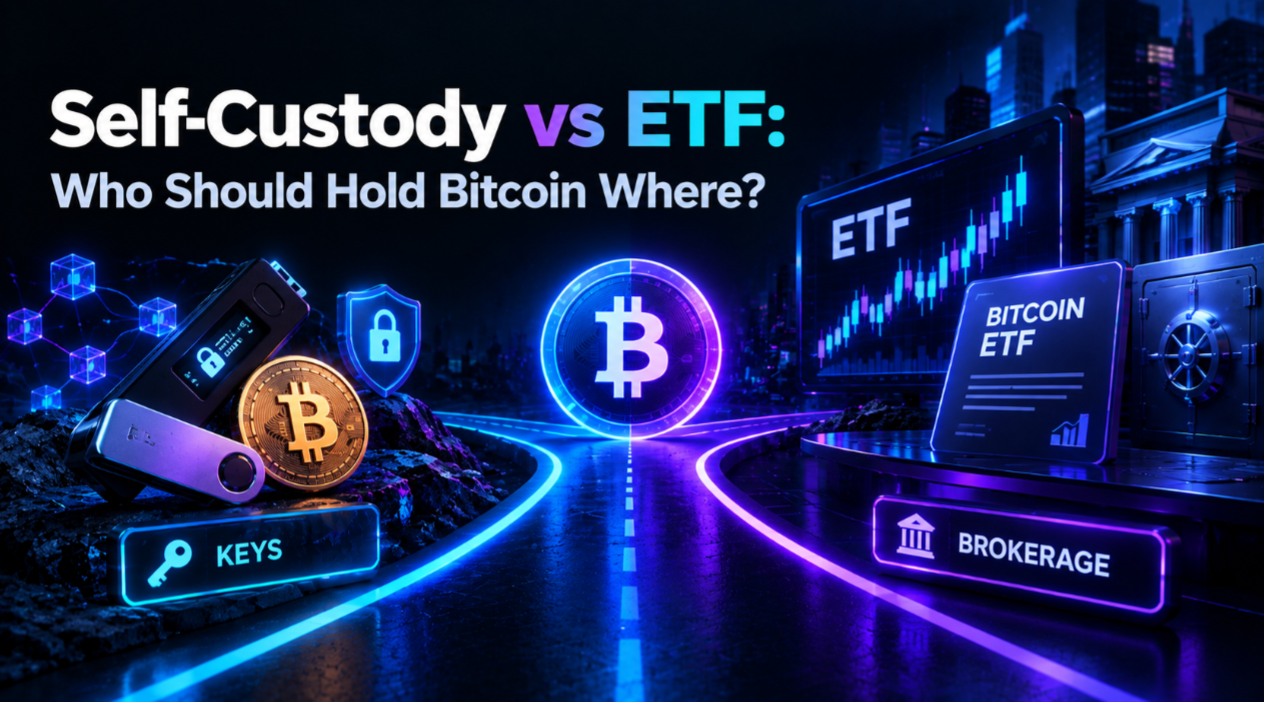
Every Bitcoin investor eventually faces the same fork in the road: hold Bitcoin directly in a self-custodied wallet, or hold it through an intermediary — a spot ETF, an exchange account, or a custodial service. This is not merely a technical question. It is a philosophical one about risk tolerance, convenience, and what you actually want from Bitcoin.
The phrase "not your keys, not your coins" is one of Bitcoin's founding mantras. It reflects a hard-learned lesson from exchange collapses — Mt. Gox in 2014, Quadriga in 2019, Celsius and Voyager in 2022, FTX in 2022 — where investors who trusted third parties lost everything despite having "Bitcoin" on their account statements.
ETFs represent the opposite philosophy: total reliance on regulated third parties, but with significant benefits in convenience, regulatory oversight, and tax-advantaged account eligibility. Understanding the genuine trade-offs is essential for making the right choice — or the right mix of both.
What self-custody actually means
Self-custody means you generate a private key (or seed phrase) that no company, government, or other party possesses. Your Bitcoin is on the blockchain; the private key is what authorises moving it. No third party can freeze, seize, or lose your funds through their own failure.
In practice, self-custody typically means using a hardware wallet (Ledger, Trezor, BitBox) or, less commonly, a properly secured software wallet. The seed phrase — usually 12 or 24 words — is the master backup. Lose the seed phrase and your Bitcoin is gone permanently. Store it correctly and your Bitcoin remains accessible regardless of what happens to any company, exchange, or financial institution.
Our wallet ratings page compares leading hardware and software wallets across security, usability, and cost.
The risks of self-custody that proponents understate
Self-custody advocates sometimes present custody as a binary: either you control your keys or you are at someone else's mercy. The reality is more nuanced. Self-custody introduces its own risks that are real and frequently underestimated.
- Seed phrase loss: if your seed phrase backup is destroyed in a fire, flood, or theft and you have no redundant copy, the Bitcoin is gone forever. No appeal is possible.
- Seed phrase theft: if a physical backup is found by the wrong person, all funds can be drained instantly. Unlike a credit card, there is no fraud reversal.
- User error: sending to the wrong address, signing a malicious transaction, or accidentally approving a phishing contract can result in immediate, irreversible loss.
- Hardware failure: while the Bitcoin is recoverable from the seed phrase, a hardware wallet without a tested backup has recovered nobody's funds in practice.
- Inheritance risk: self-custodied Bitcoin without clear inheritance instructions often becomes permanently inaccessible after the holder's death.
For a detailed guide to self-custody best practices, our Ledger review covers security setup, backup strategies, and common mistakes to avoid.
The risks of ETF and exchange custody that critics understate
ETF critics correctly point out counterparty risk. But they sometimes overstate the risk of regulated, insured custodians relative to the real track record of exchange failures.
The Bitcoin ETF custodians — primarily Coinbase Custody — are regulated money transmission businesses subject to SOC 2 audits, capital requirements, and insurance. BlackRock, Fidelity, and Vanguard have combined assets under management exceeding $10 trillion and have operated for decades without catastrophic custody failures.
The exchange failures that destroyed investor funds — Mt. Gox, FTX — were primarily unregulated or lightly regulated offshore entities with no proper auditing. These are not analogous to BlackRock holding Bitcoin through Coinbase Custody under SEC oversight.
That said, counterparty risk is real even in regulated contexts. Insurance coverage for digital assets is still limited compared to FDIC-insured bank deposits. Regulatory changes could theoretically affect redemption mechanics. And no institutional custodian is entirely immune to operational failure.
Who should use self-custody?
Self-custody is likely the better primary option if you:
- Hold a meaningful amount of Bitcoin that would be life-changing to lose (even $10,000+ is worth the setup effort)
- Are philosophically aligned with Bitcoin's core value proposition — sovereignty over your own assets
- Are technically capable of correctly backing up and securing a seed phrase with geographic redundancy
- Plan to hold Bitcoin through long market cycles (5–10+ years) without needing frequent access
- Want to use Bitcoin for actual transactions, Lightning Network payments, or on-chain protocols
- Prefer to avoid ongoing management fees (ETFs charge 0.20–0.25% annually)
Self-custody is not appropriate as a beginner's first step with significant funds. The learning curve should be practiced with a small amount before moving large holdings.
Who should use an ETF?
A Bitcoin ETF is likely the better primary option if you:
- Want Bitcoin exposure in a Roth IRA or 401(k) where the tax-free growth significantly outweighs the management fee
- Are not yet comfortable managing seed phrase backups and private key security
- Have a financial advisor or wealth manager who can allocate to regulated products on your behalf
- Want simplicity — one brokerage account, one tax form (1099-B), standard financial statement integration
- Only need price exposure and do not intend to use Bitcoin as a payment or DeFi tool
- Have compliance or fiduciary constraints that make direct crypto ownership impractical
The hybrid approach: most investors benefit from both
The binary framing of "ETF vs self-custody" is a false dilemma for many investors. A practical hybrid portfolio might look like:
- Core retirement allocation: Bitcoin ETF (IBIT or FBTC) inside a Roth IRA for tax-free long-term growth, managed by a standard brokerage.
- Active holding: hardware wallet holding Bitcoin for sovereign ownership, Lightning Network use, and philosophical alignment with self-custody.
- Exchange account: small balance for occasional purchases or sales, maintained at a regulated exchange. Never store long-term savings here.
This approach captures the tax advantage of ETFs (Roth IRA), the sovereignty benefit of self-custody (hardware wallet), and the convenience of a liquid exchange balance for day-to-day operations.
For exchange platform options, our Binance review and Coinbase review cover two leading platforms across fees, security, and features.
Amount thresholds: a practical framework
General guidance based on holding size and risk tolerance:
- Under $1,000: exchange or ETF is fine; hardware wallet setup cost is disproportionate to the holding.
- $1,000–$10,000: hardware wallet strongly recommended for the self-custody portion; ETF appropriate for retirement accounts.
- $10,000–$100,000: hardware wallet with passphrase + secondary geographic backup is the baseline; ETF for IRA allocation.
- Over $100,000: multi-signature setup or geographically distributed hardware wallets plus ETF for institutional/retirement exposure.
The inheritance problem: often overlooked
One of the strongest arguments for ETF allocation is estate planning simplicity. Bitcoin held in an ETF inside a Roth IRA passes to beneficiaries through standard financial account inheritance procedures — the same process your family would follow to inherit a brokerage account.
Bitcoin held in a self-custodied wallet requires explicit inheritance instructions: where the seed phrase backup is located, how to use a hardware wallet, and instructions for any passphrase. Without this, self-custodied Bitcoin frequently becomes permanently inaccessible after the holder's death.
If you hold significant self-custodied Bitcoin, documenting a recovery plan for trusted heirs is not optional — it is an essential part of responsible custody. This documentation should be stored separately from (but cross-referenced with) the seed phrase backup.
The Bitcoin forecast and when custody choice matters most
If you believe Bitcoin will appreciate significantly over the next halving cycle, the custody method determines how much of that appreciation you actually capture. Management fees compound against you over long periods. Counterparty failures can wipe out years of gains overnight.
Our Bitcoin price forecast page models analyst scenarios for the 2024–2028 cycle, which provides useful context for deciding how much of an allocation might be worth the overhead of self-custody setup.
The Bitcoin market page at /market/bitcoin/ provides current price, volume, and on-chain data to assess entry points and portfolio sizing.
Making the decision: a checklist
- Do I have a genuine understanding of how to back up and restore a hardware wallet seed phrase? If no: start with ETF.
- Will I be using tax-advantaged retirement accounts? If yes: prioritise ETF for that allocation.
- Do I want Bitcoin for its sovereignty and censorship-resistance properties, not just price exposure? If yes: self-custody is philosophically important.
- Do I have a plan for inheritance? If no: ETF for at least part of the holding simplifies estate planning.
- Am I comfortable paying 0.20–0.25% annually for convenience? If yes: ETF. If no: self-custody after proper setup.
This article is for informational and educational purposes only. Neither self-custody nor ETF investment is free of risk. Assess your own situation or consult a qualified financial adviser before making custody or investment decisions.