What is a centralised exchange (CEX) and how it works
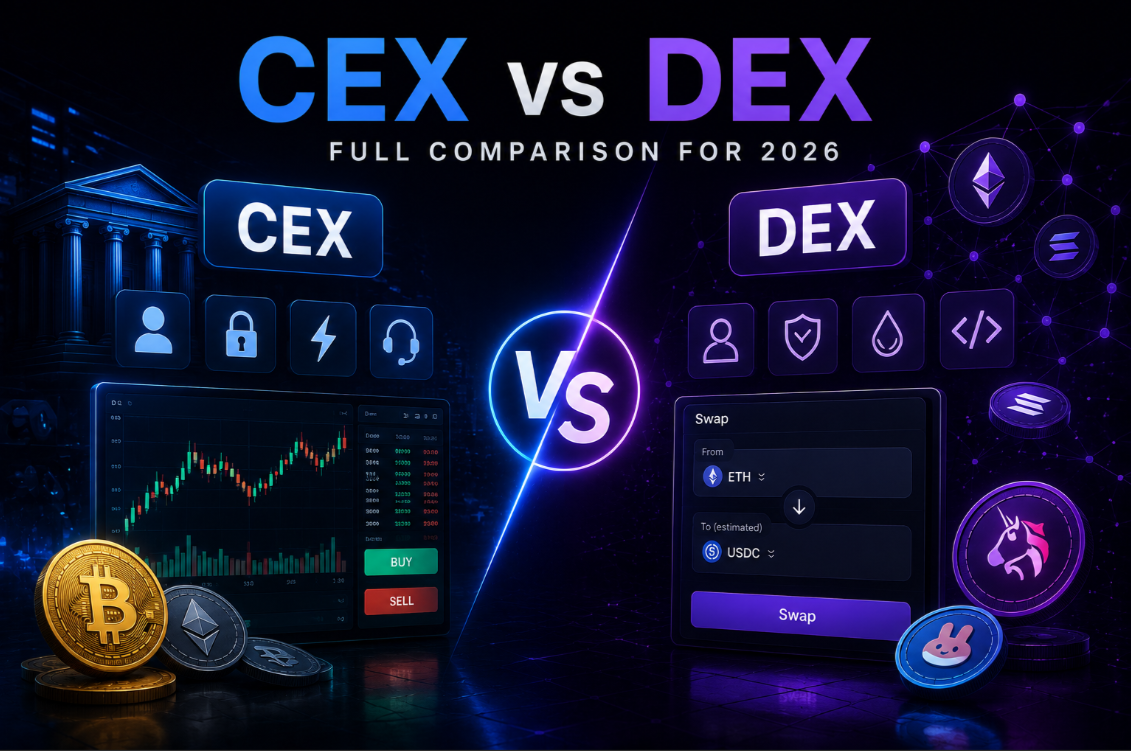
A centralised exchange (CEX) is an exchange operated by a company that acts as intermediary between buyers and sellers. When you deposit crypto or fiat onto a CEX, the platform takes custody of your assets and records your balance in its own internal ledger. Trades happen off-chain within the platform's database — no blockchain transaction is needed for each order match.
CEXes run traditional order books: a list of buy and sell orders at specific prices. When a buy order and a sell order at the same price match, the trade executes instantly. Major CEXes like Binance, Coinbase, and Kraken process millions of trades per second and offer deep liquidity across hundreds of trading pairs.
What is a decentralised exchange (DEX) and how it works
A decentralised exchange (DEX) is a smart contract protocol on a public blockchain that allows peer-to-peer trading without a central intermediary. You connect a self-custody wallet, sign transactions, and trade directly on-chain. The exchange has no custodian — only code that executes trades according to its rules.
Modern DEXes use automated market makers (AMMs) instead of order books. Liquidity is provided by users who deposit token pairs into pools. A mathematical formula (typically x × y = k) sets prices based on the ratio of tokens in the pool. Uniswap, Curve, and dYdX are the most significant DEXes by volume. In 2026, DEX trading volume exceeds $3 trillion annually. Check our exchange ratings for a side-by-side comparison.
Custody: the most important difference
The fundamental difference between CEX and DEX is who holds your private keys. On a CEX, the platform controls the keys — your balance is an IOU. On a DEX, you hold your keys in a self-custody wallet. No trade or deposit transfers custody away from you.
- CEX custody pros: Account recovery, customer support, regulated protection in many jurisdictions, simpler onboarding.
- CEX custody cons: Exchange hacks (Mt. Gox, Bitfinex), insolvency (FTX, Celsius), withdrawal freezes, and regulatory seizures can lock or destroy your funds.
- DEX self-custody pros: Only you can authorise transactions. No platform can freeze or steal your assets. Works 24/7 without maintenance windows.
- DEX self-custody cons: Lost seed phrase = lost funds permanently. Smart contract vulnerabilities. More complex for beginners.
Liquidity and trading depth comparison
CEXes dominate in liquidity for major pairs. Binance's BTC/USDT order book regularly shows $50–100 million of depth within 1% of spot price. This makes large trades possible with minimal slippage.
DEXes have narrowed the gap dramatically. Uniswap v3 on Ethereum and its Layer 2 deployments, combined with aggregators like 1inch and Paraswap that route across multiple DEX pools, can match or beat CEX prices for swaps under $500,000. For illiquid tokens with no CEX listing, DEXes are the only option — which is why they're essential for early-stage projects.
Trading fees: CEX vs DEX in 2026
CEX fees vary by tier. Binance Spot charges 0.10% maker/taker, dropping to 0.02%/0.04% for high-volume traders or BNB-payers. Coinbase Advanced charges 0.06%/0.10% at the base tier. Kraken charges 0.16%/0.26% for low-volume traders.
DEX fees are built into the swap. Uniswap v3 pools charge 0.01%–1% depending on the fee tier chosen when the pool was created. On Layer 2 networks like Arbitrum and Base, gas costs are fractions of a cent, making DEX trading genuinely cheap. A $1,000 swap on Uniswap v3 in a 0.05% pool costs $0.50 in fees plus under $0.10 in gas on L2.
KYC and privacy requirements
All major CEXes require identity verification (KYC) to unlock full functionality. A basic account lets you trade but severely limits withdrawal amounts. Full KYC requires a government ID, selfie, and sometimes proof of address. This data is stored on the exchange's servers and can be subpoenaed by governments.
DEXes have no sign-up, no email, no KYC. You connect a wallet address and trade. While on-chain transactions are permanently visible on the blockchain, they are pseudonymous — not linked to your real-world identity unless you choose to reveal it. Regulatory pressure to enforce KYC on DeFi front-ends is growing, but the underlying contracts remain accessible.
Asset availability: what you can trade
CEXes list tokens through a vetting process. Getting listed on Binance or Coinbase typically requires legal review, background checks, and sometimes listing fees. This limits CEX listings to projects that have passed compliance screening — which also provides some quality filtering.
Any token deployed as a smart contract can be traded on a DEX immediately. This gives DEXes vastly larger asset selection. The flip side: scam tokens, honeypots, and rug pulls are freely listable on DEXes. Traders must verify token contract addresses independently. See our guides on Bybit and Hyperliquid for exchanges with both CEX and hybrid DEX models.
Speed and user experience
CEX trades execute in milliseconds off-chain. The interface is polished and familiar — similar to a stock brokerage. Mobile apps, charts, portfolio tracking, and fiat on/off ramps are standard. Customer support via live chat is available on major platforms.
DEX trades require signing a transaction in your wallet and waiting for blockchain confirmation — typically 1–15 seconds depending on the chain. The interface has improved significantly since 2021, but still requires understanding of gas, slippage tolerance, and wallet management. Aggregators like 1inch and Paraswap have simplified routing but added complexity for newcomers.
Regulatory compliance and legal protection
CEXes operating in regulated markets provide legal protections. Coinbase is publicly listed and SEC-regulated. Kraken holds money transmission licences across US states. Regulated exchanges must segregate customer funds, maintain proof of reserves, and comply with consumer protection rules.
DEXes exist in a regulatory grey zone. Protocol developers, governance token holders, and large LPs have faced enforcement actions. Front-end interfaces may block certain wallets or regions while the underlying contracts remain accessible globally. The regulatory outcome for DEXes remains uncertain across most jurisdictions in 2026.
Advanced trading features: where CEX still leads
CEXes offer spot, margin, futures, options, staking, lending, earn products, and fiat payments under one roof. Binance's ecosystem alone spans dozens of financial products. Algorithmic trading via APIs, sub-accounts, and institutional services are mature on major CEXes.
DEXes offer composability CEXes cannot match: a single transaction can borrow, swap, provide liquidity, and stake — atomically. Flash loans are a DEX-only primitive. Options and perpetuals on DEXes (dYdX, GMX, Hyperliquid) have grown rapidly but still lag CEX depth for large institutional flows.
When to use CEX and when to use DEX
- Use a CEX when: buying with fiat, trading high-volume pairs with best execution, needing customer support, accessing advanced order types, or operating in a jurisdiction requiring compliance documentation.
- Use a DEX when: trading newly launched tokens, maintaining self-custody, accessing DeFi yield protocols, needing privacy, or swapping assets not listed on any CEX.
- Use both: Most experienced traders use CEXes as fiat entry/exit ramps and keep the majority of assets in self-custody, using DEXes for on-chain activity.
This article is for educational purposes only. Not financial advice. Both CEX and DEX carry significant risks including platform failure, smart contract exploits, and market volatility.