What is cloud mining and why it attracts scammers
Cloud mining is the concept of purchasing hashrate from a remote data centre that operates ASICs on your behalf. You pay upfront or in periodic subscription fees; the provider mines and deposits your share of rewards directly to your wallet. On paper, it removes the hassle of hardware, electricity, cooling, and maintenance. In practice, the overwhelming majority of cloud mining platforms are either scams or economically unviable.
Cloud mining attracts scammers for a simple reason: it is a perfect vehicle for Ponzi dynamics. Early customers are paid from later customers' deposits. Because hashrate is intangible and mining revenue is genuinely variable, fraudulent operators can maintain plausible deniability for months before the scheme collapses.
The Ponzi structure: how cloud mining fraud works
A typical cloud mining scam follows a predictable pattern:
- Platform launches with professional-looking website, claimed mining facilities (stock photos or real warehouses rented for marketing videos), and promises of 5–15% monthly returns.
- Early investors receive real payouts, funded from new depositors. Word spreads organically and via aggressive affiliate marketing with high commission tiers.
- When new deposit inflows slow, the platform begins delaying withdrawals, adding new fee requirements, or offering "upgrade packages" to maintain access to funds.
- Withdrawals are eventually frozen. The platform either disappears entirely or announces a "hack" or "regulatory seizure."
- Founders take the pooled deposits. Victims have no legal recourse in most jurisdictions as operators are typically offshore.
This exact pattern played out with Hashflare (2018), BitConnect (2018), Mining Max (2018), and hundreds of smaller operations. It continues in 2026 under new branding.
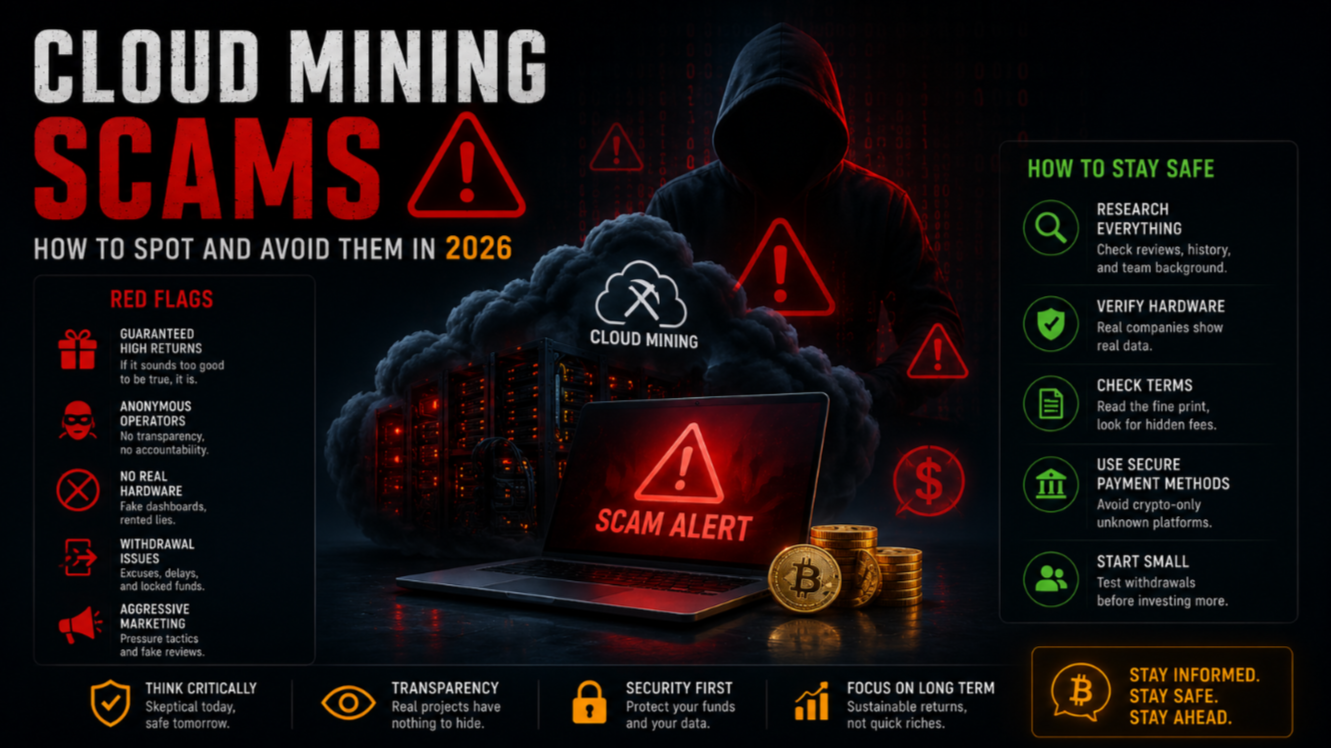
Red flag 1: guaranteed returns or unrealistic APY
Bitcoin mining revenue is NOT fixed. It depends on BTC price (highly volatile), network difficulty (increases as more miners join), and block rewards (cut in half every four years). Any platform promising guaranteed daily or monthly returns — especially numbers like 1% per day or 10% per month — is mathematically implying returns that legitimate mining cannot generate.
At 1% per day compounding, $1,000 becomes $37 million in one year. At any legitimate mining rate, returns fluctuate and decline over time as difficulty rises. If the rate sounds too good to be true, it is a Ponzi scheme using your money to pay earlier investors.
Red flag 2: no verifiable proof of mining infrastructure
Legitimate cloud mining companies (the very few that exist) can demonstrate physical mining infrastructure. They provide:
- Third-party audits of their mining facility
- Real-time hashrate dashboards linked to a public mining pool where you can verify the pool's reported hashrate
- Physical address and business registration in a verifiable jurisdiction
- Documented hardware inventory with serial numbers
Scam platforms use stock photos of data centres, AI-generated mining facility images, or unverifiable claims of "partnerships" with real mining companies. Always demand pool-level hashrate verification — a legitimate operator can show you the pool dashboard where your contracted hashrate appears.
Red flag 3: aggressive affiliate and referral programmes
Multi-level referral structures are a hallmark of Ponzi schemes. When a cloud mining platform pays you 5–10% of the deposits made by people you recruit, it is recruiting you as a sales agent for what is effectively a pyramid scheme. The business model depends on constant new recruitment rather than actual mining profitability.
Legitimate businesses market themselves through normal channels. They do not need to pay customers commissions to recruit new depositors because the product generates real, sustainable revenue. Any cloud mining platform with tiered affiliate commissions should be treated as extremely high risk.
Red flag 4: no contract transparency or forced reinvestment
Legitimate cloud mining contracts specify: exact hashrate in TH/s, contract duration, maintenance fees, and payout schedule — all in writing. Scam platforms use vague language like "mining shares," "hashpower units," or "mining credits" without specifying actual underlying hardware.
Forced reinvestment is another warning sign. If the platform requires you to reinvest a portion of earnings to "unlock" withdrawals, or imposes escalating maintenance fees that consume your entire revenue, you are in a designed trap. These mechanics are specifically engineered to delay withdrawals long enough to collect more deposits.
The few legitimate cloud mining options that exist
A small number of cloud mining operations have operated with some degree of legitimacy over the years. The economics are still typically poor compared to self-operated hardware or simply buying BTC, but at least they are not outright fraud:
- Nicehash: Primarily a hashrate marketplace rather than traditional cloud mining. Buyers purchase hashrate from sellers (real home miners). Transparent, verifiable on-chain. Still subject to profitability risk.
- Compass Mining: Hosts customer-owned hardware in real data centres. You buy the physical ASIC, they operate it. More legitimate model, but requires capital and the economics still depend on electricity rates.
- Genesis Mining (historically): One of the largest cloud mining operations from 2014–2021. Suspended many contracts during bear markets. Illustrates that even "legitimate" cloud miners can fail to deliver during downturns.
Even with legitimate providers, cloud mining economics are generally worse than buying Bitcoin directly. You pay a premium for the abstraction of not managing hardware, and that premium typically exceeds any mining profit.
Due diligence checklist before using any cloud mining service
If you are still considering a cloud mining platform after reading the above, apply this checklist:
- Verify the company's legal registration and physical address. Search for the business in official corporate registries.
- Find the mining pool they use and independently verify their hashrate contribution on the pool's public dashboard.
- Read all contract terms: hashrate, duration, maintenance fees, payout minimums, and withdrawal conditions.
- Search "[company name] scam" and "[company name] review" on Reddit (r/BitcoinMining) and independent forums.
- Calculate the actual ROI based on stated hashrate using a current mining profitability calculator. If it does not make sense mathematically, the returns must come from somewhere other than mining.
- Never invest more than you can afford to lose entirely. Start with a small test amount and actually withdraw before depositing more.
What to do if you have been scammed
If you have already deposited money into a cloud mining platform that has frozen withdrawals or disappeared:
- Report to your national financial regulator (FCA in UK, SEC/CFTC in US, BaFin in Germany)
- Report to the FBI's Internet Crime Complaint Center (ic3.gov) if in the US
- File a report with Action Fraud (UK) or your local equivalent
- Document all transactions, communications, and promotional materials for the report
- Be extremely wary of "recovery scammers" who claim they can recover your funds for an upfront fee — this is a secondary scam targeting victims
Recovery of funds from crypto scams is rare but not impossible, particularly if the operator is in a jurisdiction with crypto asset regulations. Class action lawsuits have recovered partial funds in some high-profile cases.
Alternatives to cloud mining
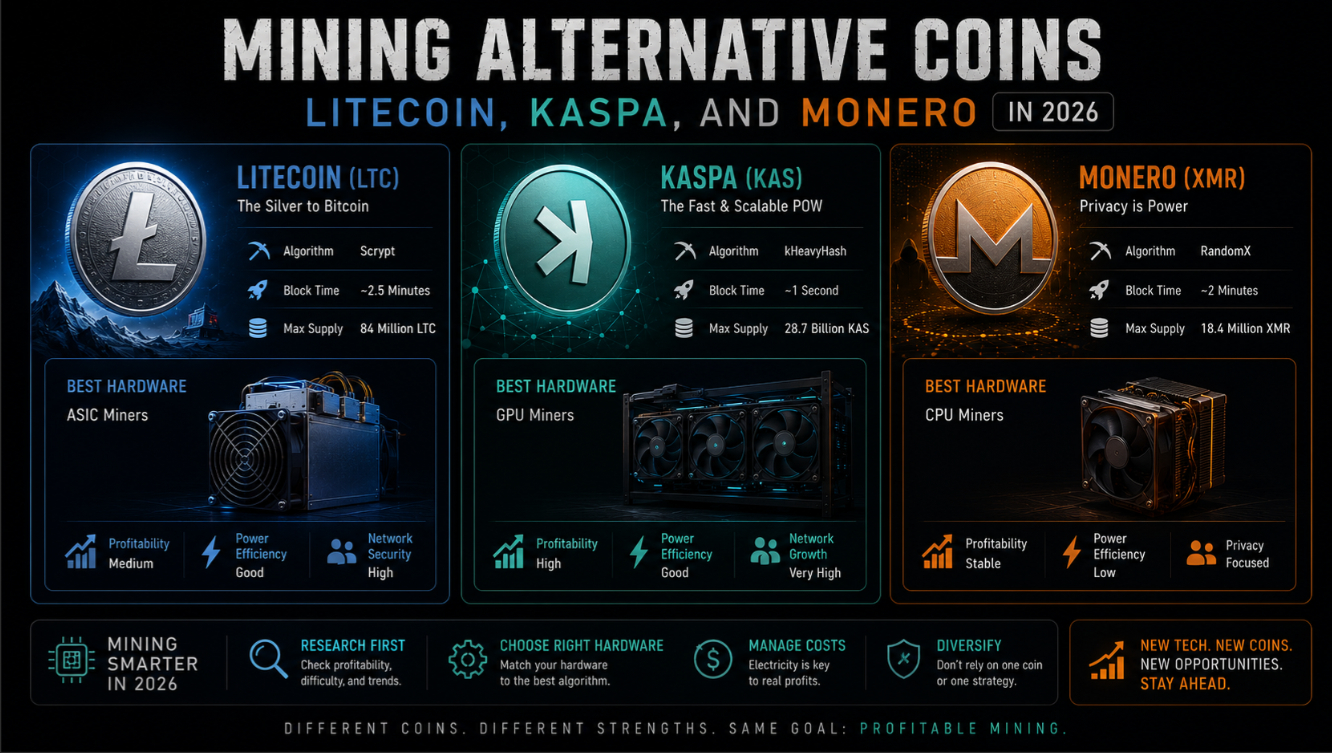
For investors who want Bitcoin exposure without the complexity of hardware mining, better alternatives exist. Buying BTC directly on a regulated exchange is the simplest. For those who want operational exposure to Bitcoin mining without owning hardware, publicly traded mining stocks (MARA Holdings, Riot Platforms, CleanSpark) provide indirect exposure with regulatory accountability. For people specifically interested in the Litecoin or Monero ecosystems, joining a small community mining pool with your own hardware is far preferable to any cloud contract.
This article is for educational purposes only. Cloud mining carries extreme fraud risk. Always conduct independent due diligence. Not financial advice.