Why mine alternative coins instead of Bitcoin?
Bitcoin dominates cryptocurrency mining by hashrate and market cap, but it is not always the best choice for individual miners. Industrial farms with economies of scale, cheap electricity, and bulk hardware purchasing dominate Bitcoin mining to a degree that leaves little margin for small operators. Alternative coins — particularly those using algorithms that resist ASIC specialisation, or those with smaller but still growing networks — can offer better returns per dollar of invested hardware for the right miner.
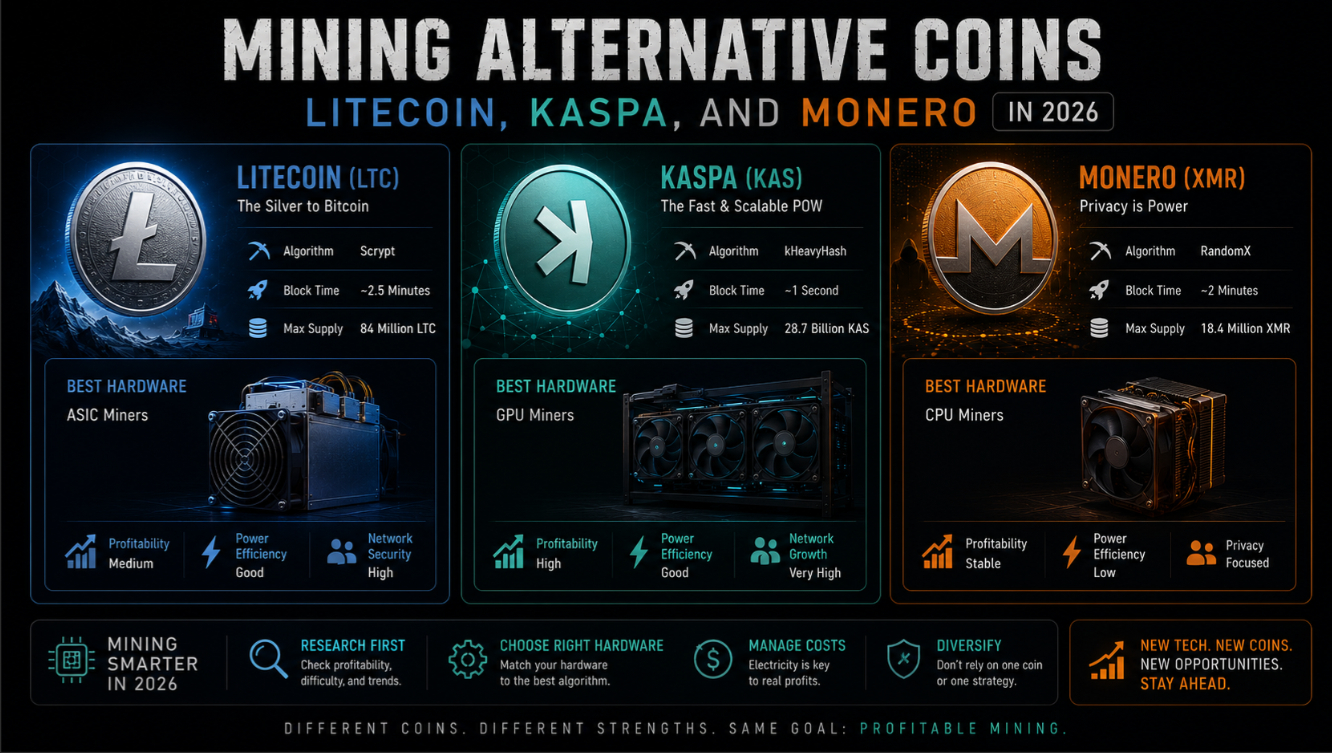
This article covers the three most compelling alternatives for miners in 2026: Litecoin (Scrypt algorithm, established and merged-mined), Kaspa (kHeavyHash algorithm, GPU-friendly, fast-growing), and Monero (RandomX algorithm, CPU-mineable, ASIC-resistant by design). Each represents a different philosophy and hardware requirement.
Litecoin mining: Scrypt ASICs and merge mining
Litecoin uses the Scrypt proof-of-work algorithm, which was originally designed to be memory-hard and ASIC-resistant. That goal failed — ASICs for Scrypt were developed by 2014 and now dominate Litecoin mining just as SHA-256 ASICs dominate Bitcoin. The current generation of Scrypt ASICs includes machines like the Antminer L9 (17 GH/s, ~3,260 W) and the Goldshell LT6 (6 GH/s, ~3,100 W).
Litecoin's key advantage for miners is merge mining with Dogecoin. Since 2014, miners can simultaneously mine both LTC and DOGE using the same hardware and energy, effectively earning two block rewards for one electricity bill. The combined LTC+DOGE daily revenue from a Scrypt ASIC is substantially better than either coin alone, making Scrypt ASIC economics more resilient.
- Block time: 2.5 minutes (faster than Bitcoin's 10 minutes)
- Block reward: 6.25 LTC (after October 2023 halving)
- Network hashrate: ~800 TH/s (much smaller than Bitcoin's 700 EH/s)
- Algorithm: Scrypt (ASIC-dominated)
- Merge mining: Yes — simultaneous LTC + DOGE
For current Litecoin price and market data, check the market page to calculate revenue projections before purchasing hardware.
Kaspa mining: GPU mining with kHeavyHash
Kaspa is one of the most exciting mining opportunities of 2024–2026. It uses the kHeavyHash algorithm, which was designed specifically to be GPU-friendly while remaining ASIC-resistant for as long as possible. Kaspa's blockDAG architecture (a directed acyclic graph of blocks rather than a single chain) allows near-instant block times of 1 block per second — creating a very different mining dynamic from traditional blockchains.
Until 2024, Kaspa was predominantly GPU-mined. In late 2023–2024, ASICs for kHeavyHash began appearing (notably from IceRiver and Bitmain), and they have since largely displaced GPUs for competitive mining. However, Kaspa's network is smaller and less saturated than Bitcoin or Ethereum (now PoS), meaning individual miners still have meaningful participation.
- IceRiver KAS KS3 (8 TH/s, ~3,500 W): One of the top Kaspa ASICs available in 2026. Priced around $2,000–3,500 on the secondary market.
- Antminer KS5 Pro (21 TH/s, ~3,150 W): Bitmain's Kaspa ASIC. High efficiency but expensive. New units $4,000–6,000.
- GPU mining: Still viable on older Nvidia 3000/4000 series GPUs, particularly for miners who already own the hardware, though profitability per GPU is lower than dedicated ASICs.
Kaspa's tokenomics feature a monthly emission reduction, meaning the block reward decreases each month by approximately 0.99x. This creates a continuous mild difficulty/profitability adjustment without abrupt halvings. The Kaspa market page has current price and market cap data for profitability calculations.
Monero mining: CPU power and true ASIC resistance
Monero (XMR) is unique among major proof-of-work cryptocurrencies in its genuine, maintained commitment to ASIC resistance. The RandomX algorithm was specifically designed for general-purpose CPUs and is actively updated to break ASICs whenever they appear. This makes Monero the only major coin where a consumer CPU can competitively mine — no specialised hardware required.
Modern high-core-count CPUs perform best on RandomX. The AMD Ryzen Threadripper PRO 5975WX (32 cores) achieves ~30,000 H/s and can earn meaningful XMR daily. Even a mid-range desktop CPU like the AMD Ryzen 9 5900X achieves ~13,000 H/s.
- Algorithm: RandomX (CPU-optimised, ASIC-resistant)
- Block time: 2 minutes
- Block reward: Dynamic emission — currently ~0.6 XMR per block, declining slowly toward tail emission of 0.3 XMR/block
- Network hashrate: ~3 GH/s (all CPU-based)
- Privacy features: Ring signatures, stealth addresses, RingCT — transactions are private by default
Monero's CPU-only mining democratises participation — anyone with a modern computer can contribute. The trade-off is that RandomX is CPU-intensive and will run your processor at full load continuously, generating heat and noise comparable to a sustained benchmark. Dedicated CPU mining rigs using server processors (AMD EPYC) offer the best performance per dollar at scale.
See the Monero market page for current XMR price and network statistics.
Profitability comparison: LTC vs KAS vs XMR
Profitability rankings shift constantly based on coin price movements and network hashrate changes. The key principle for altcoin mining is that you are betting on the coin's price relative to the network's difficulty growth.
A useful mental model: when a coin pumps in price, miners rush in, hashrate increases, difficulty adjusts up, and profitability normalises. Being an early miner on a growing network (as Kaspa was in 2022–2023) can be extremely profitable. Being a late miner on a mature network (as Bitcoin is) means razor-thin margins.
- Litecoin: Mature network, stable profitability, merge mining benefit. Best for: existing Scrypt ASIC owners or risk-averse miners wanting predictability.
- Kaspa: Growing network, higher reward volatility, newer hardware ecosystem. Best for: miners willing to accept price risk for potentially higher returns.
- Monero: Stable niche, CPU-only (low hardware cost), privacy-focused community. Best for: miners with existing server hardware or those prioritising ASIC-free participation.
Switching between coins: multi-algo mining
Some miners use Nicehash or similar hashrate marketplaces to automatically sell their hashrate to the highest bidder, regardless of which specific coin is being mined. This auto-switching approach maximises short-term revenue but requires compatible hardware (typically GPUs) and cedes control over which network you support.
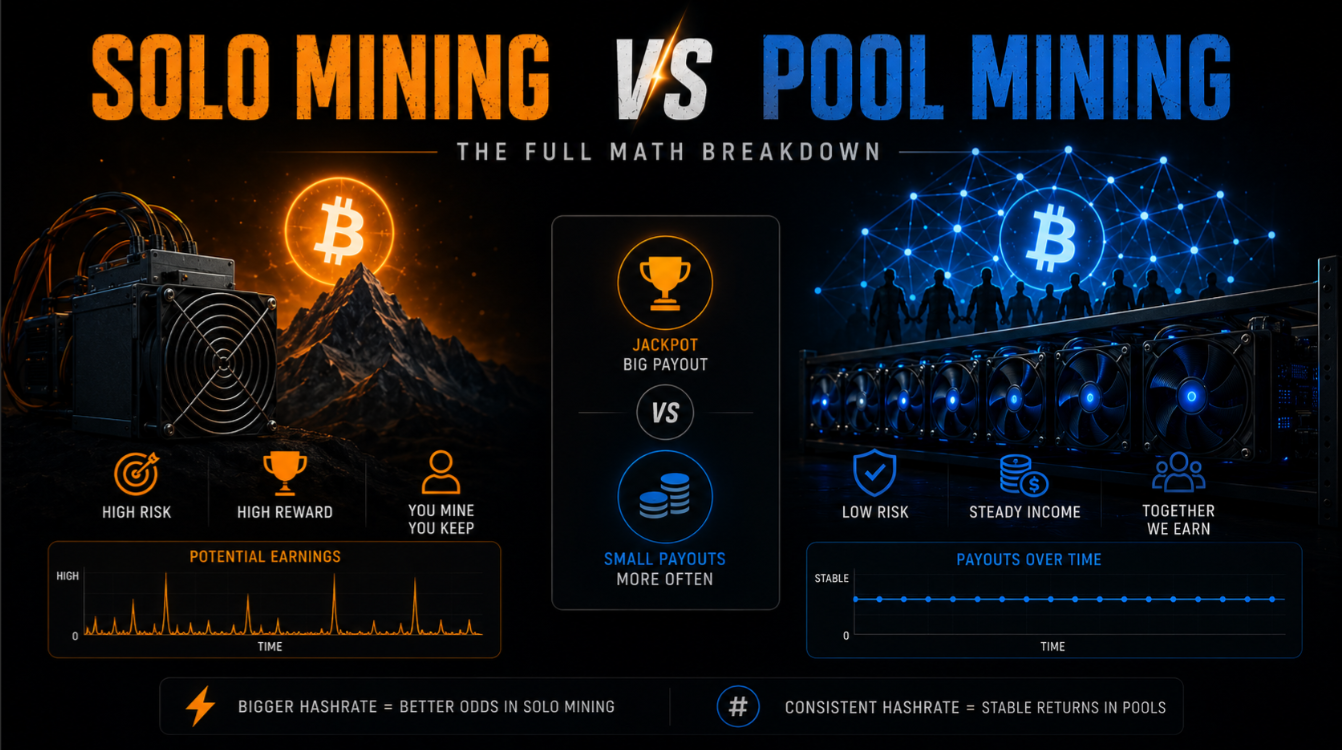
For ASIC miners, switching is not an option — a Scrypt ASIC can only mine Scrypt coins, a SHA-256 ASIC only SHA-256 coins. This is one reason GPU mining retains appeal: a single GPU rig can mine across dozens of algorithms and switch to the most profitable option daily.
Mining pools for LTC, KAS, and XMR
All three coins have active mining pool ecosystems:
- Litecoin pools: Litecoinpool.org (oldest, merge mines DOGE automatically), F2Pool (large, reliable), ViaBTC.
- Kaspa pools: K1Pool, Woolypooly, F2Pool Kaspa. Check pool hashrate distribution to avoid overly centralised options.
- Monero pools: MineXMR (largest), SupportXMR, Nanopool. Monero community advocates using smaller pools to preserve decentralisation — consider pools with <15% network share.
Hardware acquisition strategy for altcoin miners
For Litecoin, the secondary market is well-established. Scrypt ASICs from the 2020–2023 era are widely available at significant discounts and can still be profitable in conjunction with DOGE merge mining.
For Kaspa, the hardware landscape is still evolving rapidly. Buying new equipment risks purchasing hardware that is superseded within months. Monitoring mining community forums (r/kaspa, Kaspa Discord) for hardware release news before major purchases is advisable.
For Monero, invest in high-core-count server CPUs. AMD EPYC processors dominate XMR mining benchmarks. Used server hardware from enterprise data centre liquidations can provide excellent RandomX performance at low cost.
This article is for educational purposes only. Mining profitability is highly sensitive to coin price and network difficulty. Not financial advice.