What is solo mining and how does it work?
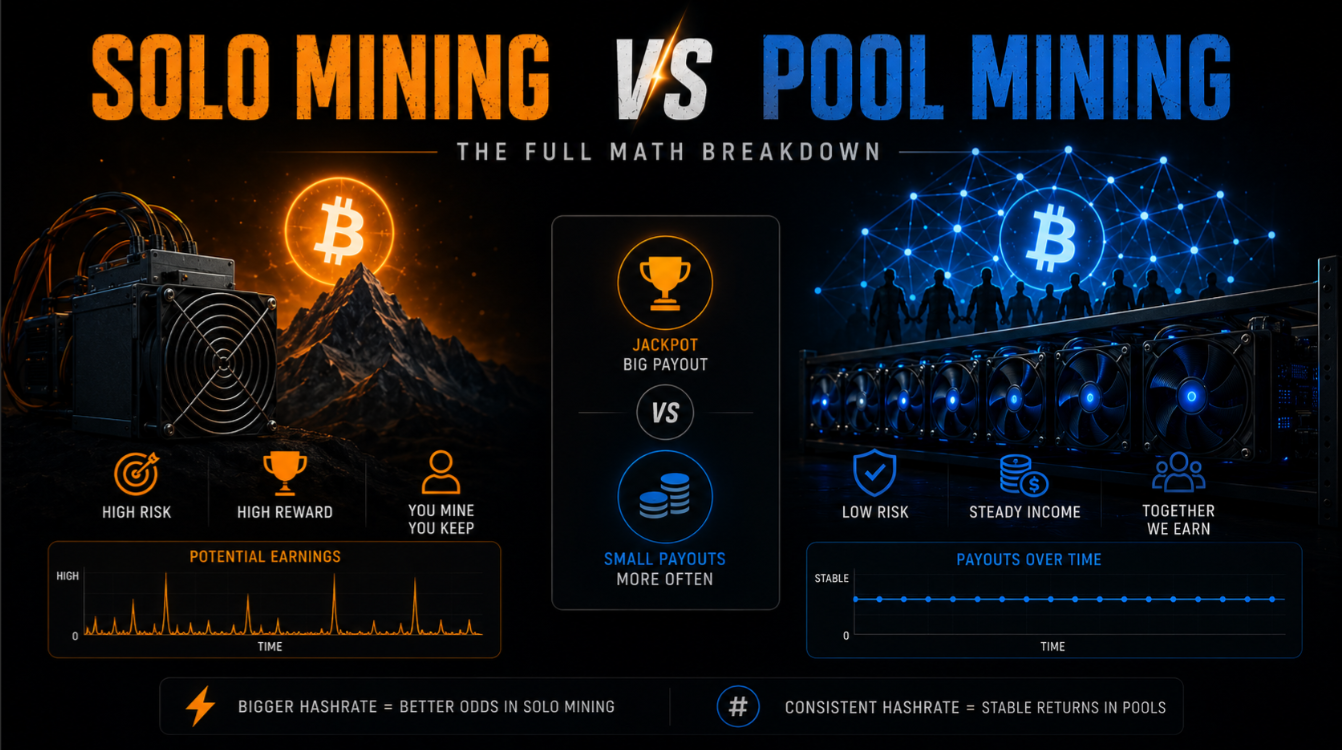
Solo mining means pointing your ASIC miner directly at the Bitcoin network and attempting to find a valid block entirely on your own. When you find one, you collect the full block reward — 3 BTC subsidy plus all transaction fees in that block, which can add up to an additional 0.5–2 BTC on average in 2026. The catch: you receive nothing until you actually find a block.
A block is found roughly every 10 minutes across the entire global network. With over 700 EH/s of total hashrate, the probability of your single machine being the one to find the next block is vanishingly small. Solo mining is a lottery: possible, but statistically, you might never win.
What is pool mining and how payouts work
A mining pool aggregates hashrate from thousands of individual miners. When any machine in the pool finds a block, the reward is split among all pool participants proportional to how much valid work (shares) each contributed since the last block. This transforms mining from an all-or-nothing lottery into a stream of small, regular payouts.
Pools use different payout methods, each with different variance and fee structures:
- PPS (Pay Per Share): You are paid a fixed amount for every share you submit, regardless of whether the pool finds a block. Pool absorbs variance risk. Typically 2–4% fees.
- PPLNS (Pay Per Last N Shares): You earn a share of blocks found within a rolling window of recent shares. Lower fees (1–2%) but higher variance — earnings fluctuate day to day.
- FPPS (Full Pay Per Share): Like PPS but also includes a share of transaction fees, not just the block subsidy. More accurate to actual revenue. Used by Foundry USA.
- SOLO mode pools: Some pools (like Braiins) offer SOLO mode — your hashrate still connects via the pool's infrastructure but you only get paid if YOUR machine finds the block. Convenient solo mining with low overhead.
The probability mathematics of solo mining
Let's do the actual math. Assume a single Antminer S19 XP running at 140 TH/s = 1.4 × 10^14 hashes per second.
The Bitcoin network in 2026 performs approximately 7 × 10^20 hashes per second (700 EH/s). Your miner's probability of finding any given block is:
P = 1.4 × 10^14 / 7 × 10^20 = 0.0000002 = 0.00002%
Since a block is found every 10 minutes, there are 144 blocks per day, or 52,560 blocks per year. Your expected number of solo blocks per year is:
Expected blocks/year = 52,560 × 0.0000002 = 0.01051
That means, on average, one S19 XP mining solo would find a block approximately once every 95 years. With 10 machines, once every 9.5 years. With 100 machines, once every 0.95 years — getting more realistic, but still high variance.
Variance: the hidden cost of solo mining
Expected value is the same whether you mine solo or in a pool — both give you the same long-run BTC per unit of hashrate. The difference is variance: how much your actual earnings deviate from the expected value.
In a pool, variance is extremely low. Day-to-day payouts are nearly deterministic — you get approximately what your hashrate share predicts. In solo mining, variance is extremely high. You might mine for 5 years with zero reward, or find a block in week 1. Both outcomes are equally possible.
High variance has practical consequences beyond the mathematics. You cannot plan cash flow with solo mining. You cannot pay electricity bills with the expected value — you need actual cash. If you take out a loan to buy mining hardware, you must service that debt from real income, not statistical expectation. This is why pool mining dominates for all but the largest operations.
When does solo mining make sense?
Solo mining is rational in only a few specific scenarios:
- Very large hashrate: If you operate 1,000+ ASICs (roughly 200 PH/s), your expected block time drops to under a week. Variance is still significant but manageable. Industrial miners at this scale often split between solo and pool.
- Block reward timing: Transaction fees can spike dramatically during congestion. If you find a block during peak fees (sometimes 2–5 BTC in fees alone), solo mining delivers the full premium to you rather than splitting it with pool members.
- Privacy: Pool mining requires connecting to a pool server and often registering an account. Solo mining is more private. This is a minor practical advantage for most users.
- Hobbyist/lottery mindset: Some miners knowingly accept worse expected outcomes for the excitement of potentially finding a full block. This is a valid personal choice, not a financial strategy.
For context on what block rewards look like, see the Bitcoin market page which shows current block data and Bitcoin price forecasts for long-term planning.
Pool fees: how much do they actually cost?
Pool fees are typically 1–3% of your gross mining revenue. On a machine earning $15/day in revenue, a 2% pool fee costs $0.30/day or $109/year. For a 10-machine operation earning $150/day, the same fee costs $3/day or $1,095/year. The fees are real but small compared to electricity costs.
The real cost comparison is variance-adjusted. PPS pools charge higher fees but guarantee you the expected value every day. PPLNS pools charge less but expose you to luck-based variance. For small miners, PPS or FPPS is usually worth the extra fee for cash flow predictability.
Pool centralisation risk: should you care?
When a single pool controls more than 50% of the network's hashrate, it theoretically has the power to execute a 51% attack — reorganising blocks, double-spending, or censoring transactions. In practice, large pools have strong economic incentives not to attack the network they depend on, and pool miners can switch pools instantly if a pool behaves maliciously.
However, pool concentration is a genuine long-term concern for Bitcoin's decentralisation. Foundry USA alone has approached 30% of global hashrate at times. Splitting your hashrate across two or three pools if you run multiple machines helps maintain network health, even if the direct personal benefit is small.
Stratum V2: the next generation of pool mining
Stratum V2 is an updated mining protocol developed by Braiins with input from Bitcoin Core developers. Key improvements over Stratum V1 include: encrypted communication between miners and pools, and — critically — Job Negotiation, which allows individual miners to select which transactions to include in blocks rather than outsourcing that decision entirely to the pool.
Stratum V2 with Job Negotiation restores a degree of decentralised transaction selection that pools currently suppress. Braiins Pool has supported it since 2022. Adoption is growing but still minority. For miners concerned about Bitcoin's long-term decentralisation and censorship resistance, running Stratum V2-compatible firmware (Braiins OS) is a meaningful contribution.
Making the choice: solo, pool, or hybrid
The decision framework is simple: if you operate fewer than ~500 TH/s of hashrate (roughly 3–4 top-tier ASICs), pool mining is almost certainly the right choice. The variance reduction more than justifies the fees. Join a reputable pool with transparent operations, preferably one supporting Stratum V2.
If you operate at industrial scale, a hybrid approach — pooling the majority while running a small portion in solo/FPPS mode — can balance consistent cash flow with exposure to full block rewards during high-fee periods.
This article is for educational purposes only. Mining profitability depends on BTC price, network difficulty, and electricity costs, all of which change continuously. Not financial advice.