Why crypto regulation matters more than ever in 2026
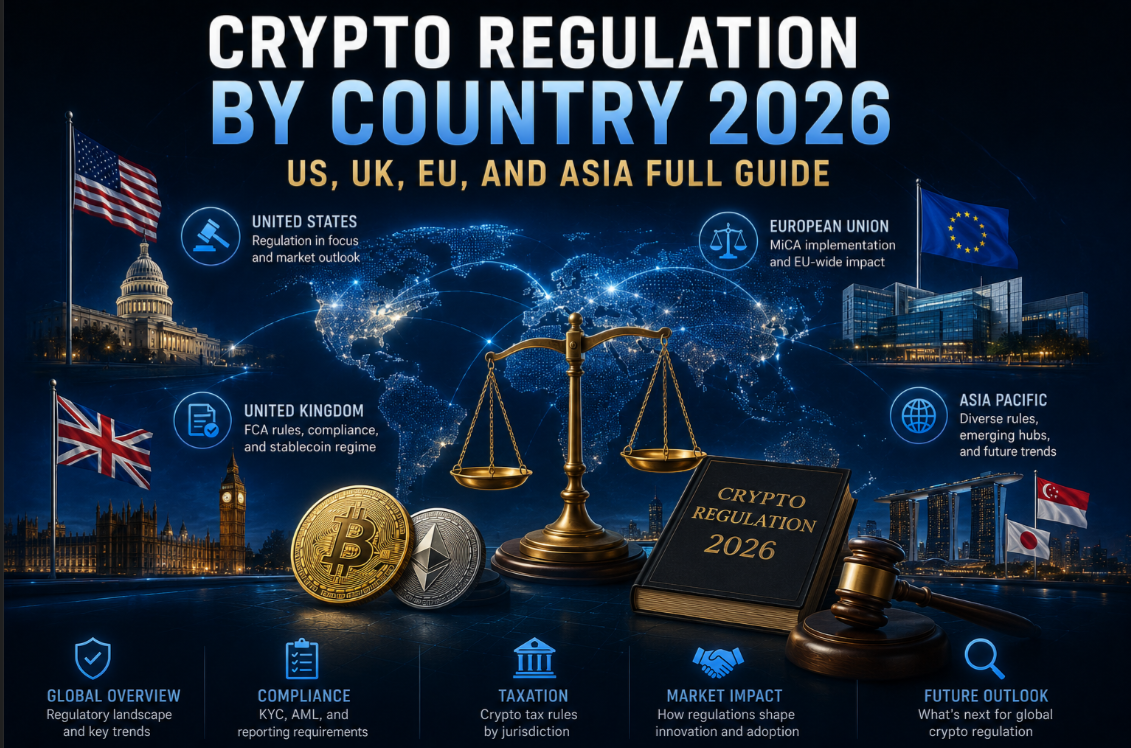
Governments around the world have spent the past five years moving from cautious observation to active rulemaking. In 2026, operating in crypto without understanding the local regulatory framework is a material risk — for exchanges, for retail investors, and for projects that issue tokens. This guide walks through the current state of regulation in the US, UK, EU, and major Asian jurisdictions so you can understand what rules apply to you.
Regulatory clarity has a direct effect on markets. When the US SEC approved spot Bitcoin ETFs in early 2024, institutional capital poured in within weeks. When China tightened its blanket ban in 2021, on-chain activity shifted overnight to South-East Asia and the Gulf. Knowing the rules — and which direction they are heading — is part of doing due diligence.
United States: the SEC, CFTC, and state-level complexity
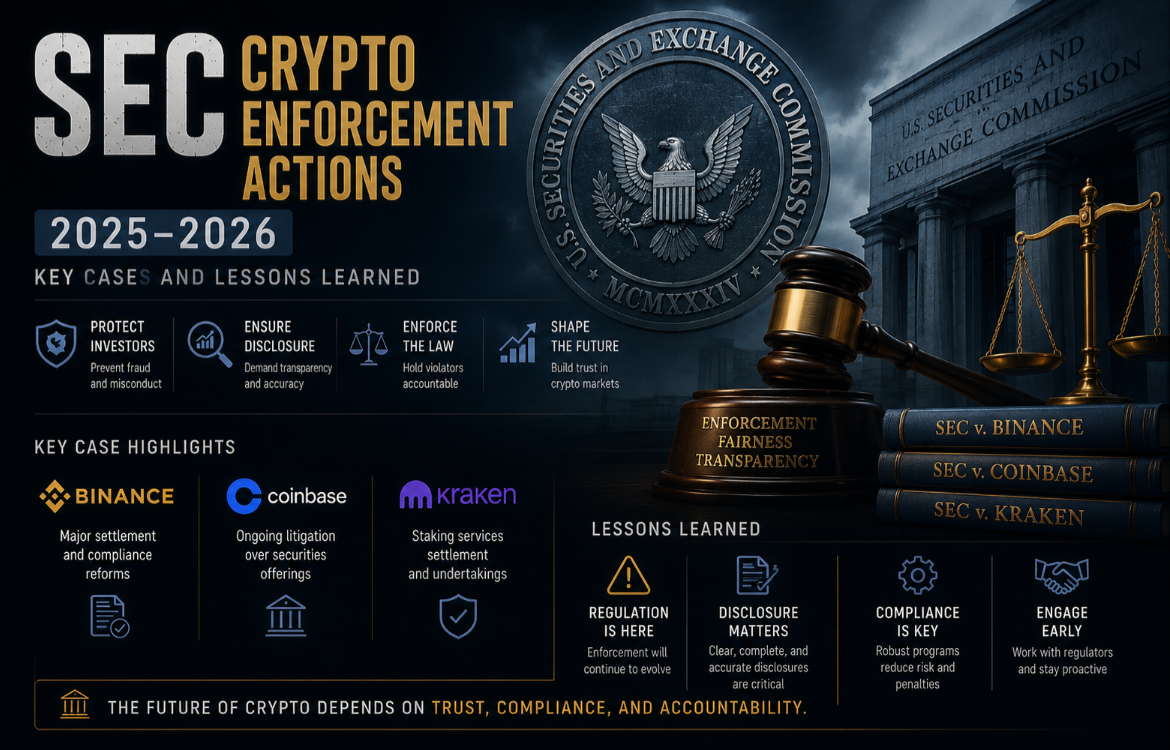
The United States remains the most complex jurisdiction for crypto regulation because authority is split between multiple agencies. The Securities and Exchange Commission (SEC) claims jurisdiction over tokens it considers securities. The Commodity Futures Trading Commission (CFTC) claims jurisdiction over Bitcoin and Ethereum as commodities. FinCEN, the Treasury's financial intelligence unit, oversees anti-money-laundering (AML) compliance for money services businesses, which includes most exchanges.
The 2025 Digital Asset Market Structure Act created a partial framework that assigns classification responsibility to a new inter-agency committee, but full implementation is expected to continue into 2027. In the meantime, exchanges operating in the US must register as Money Services Businesses with FinCEN, comply with state-level money transmitter licences (which vary enormously), and implement Bank Secrecy Act (BSA) AML programmes.
For retail users, the most immediate regulatory obligation in the US is tax reporting. The IRS treats crypto as property: every disposal — sale, swap, or purchase — is a taxable event. Exchanges are required to issue 1099-DA forms for transactions above reporting thresholds from 2026 onwards.
United States: what retail investors must do
- Report all disposals on Schedule D / Form 8949, including crypto-to-crypto swaps.
- Keep transaction records (date, cost basis, proceeds) for at least seven years.
- Disclose foreign exchange holdings above $10,000 on FBAR (FinCEN 114) and potentially on FATCA Form 8938.
- Treat staking rewards and airdrops as ordinary income at the fair market value on receipt.
United Kingdom: the FCA licensing regime
The UK Financial Conduct Authority (FCA) regulates crypto asset businesses under the Money Laundering Regulations. Any firm offering crypto services to UK customers must be registered with the FCA — a process that has been notoriously difficult: between 2020 and 2024, the FCA approved fewer than 15% of applications.
From January 2026, the UK is implementing its own stablecoin and crypto asset regime under the Financial Services and Markets Act 2023. Stablecoins used for payments will require FCA authorisation as e-money. Crypto exchanges will face conduct-of-business rules similar to those applied to investment firms: clear client categorisation, risk warnings, marketing restrictions, and operational resilience requirements.
For UK retail users, HMRC taxes crypto in the same way as other capital assets. Gains above the annual exempt amount (£3,000 in 2025–26) are subject to Capital Gains Tax at 10% (basic rate) or 20% (higher rate). Income from staking, mining, and DeFi yield is taxed as income at the marginal rate.
European Union: MiCA sets the standard
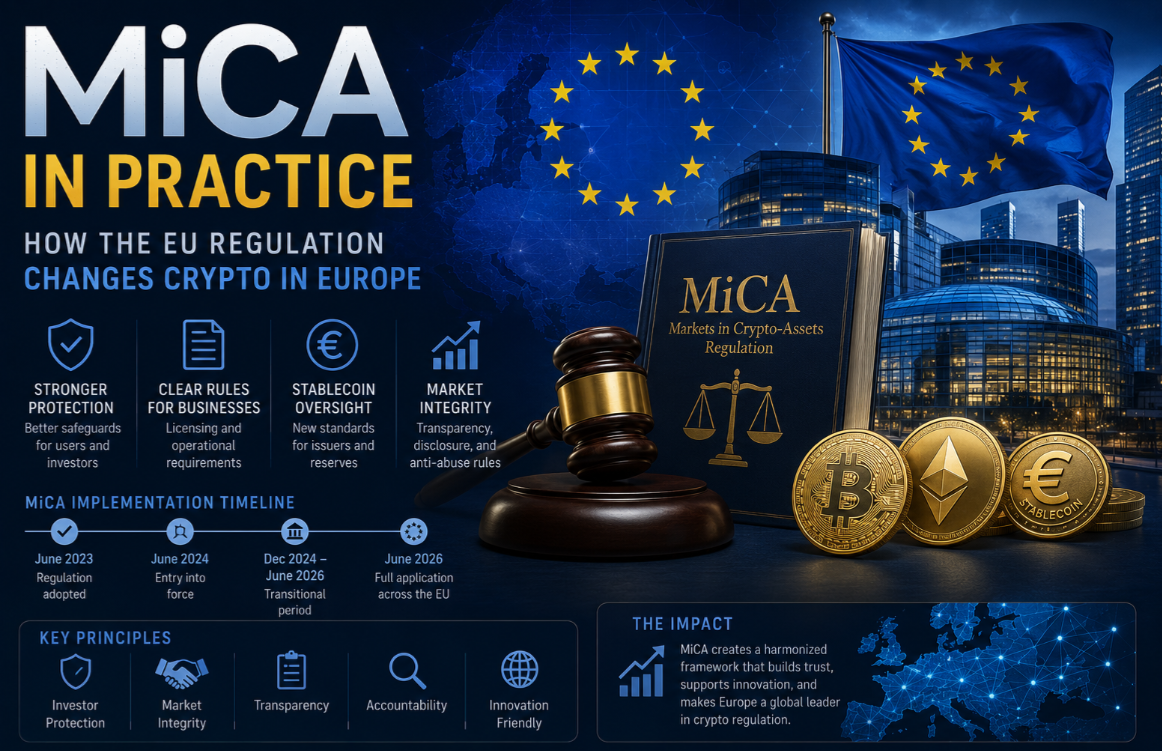
The EU's Markets in Crypto-Assets Regulation (MiCA) is the most comprehensive crypto regulatory framework in the world. It entered full application in December 2024, covering crypto asset service providers (CASPs), issuers of asset-referenced tokens (ARTs), and issuers of e-money tokens (EMTs). A CASP licence issued by one EU member state passports across all 27 member states — a major advantage for exchanges choosing to base their EU operations inside the bloc.
MiCA imposes capital requirements, custody rules, governance standards, and a whitepaper disclosure regime on token issuers. Stablecoins pegged to a single fiat currency (EMTs) are directly regulated as e-money. Algorithmic stablecoins that cannot maintain their peg are effectively banned.
See our dedicated MiCA explainer for a full breakdown. For the USDC regulatory status specifically, see our USD Coin market page and the Tether market page for how MiCA affects the two dominant stablecoins.
EU retail user obligations under MiCA
- Use only MiCA-registered CASPs for buying, selling, or holding crypto within the EU.
- Expect KYC/AML verification on all regulated platforms — this is a legal requirement, not a discretionary policy.
- Be aware that some stablecoins may be restricted or delisted if their issuers do not obtain EMT authorisation.
- Report crypto income and capital gains per your national tax authority's rules — MiCA does not harmonise tax.
Japan: the world's most established licensing regime
Japan has licenced crypto exchanges since 2017 under the Payment Services Act, making it one of the earliest adopters of formal oversight. The Financial Services Agency (FSA) maintains a public register of registered Crypto Asset Exchange Service Providers. Unregistered exchanges are banned from soliciting Japanese users.
Japan's framework is notable for strict cold-storage custody requirements: exchanges must keep the majority of customer assets in cold wallets, segregated from their own funds. After the Coincheck hack of 2018 (the largest crypto theft at the time), the FSA tightened these rules substantially. Japan also taxes crypto gains as "miscellaneous income," which can attract marginal rates up to 55% for high earners — a persistent criticism from the domestic crypto industry.
Singapore: the MAS regulated framework
Singapore's Monetary Authority of Singapore (MAS) regulates digital payment token (DPT) services under the Payment Services Act 2019, as amended in 2022. Businesses must hold a Major Payment Institution licence to provide crypto services. Singapore has positioned itself as a regional crypto hub, with a relatively transparent and predictable licensing process.
However, MAS tightened retail marketing rules sharply after the TerraLUNA collapse in 2022: exchanges cannot promote crypto to the general public through advertisements in public spaces, social media influencer campaigns, or unsolicited marketing. Only accredited investors may access certain higher-risk products. Singapore does not tax capital gains, making it attractive for long-term holders.
Hong Kong: regulated hub open to retail since 2023
Hong Kong relaunched its virtual asset regulatory framework in 2023 under the Securities and Futures Commission (SFC). Unlike the mainland China ban, Hong Kong explicitly allows retail trading on licenced exchanges. As of 2026, several major exchanges have obtained SFC licences, and the city is actively competing with Singapore as Asia's primary crypto financial centre.
The SFC requires licenced exchanges to segregate client assets, maintain minimum capital, conduct KYC/AML, and implement cybersecurity controls. Derivatives and leveraged products face additional restrictions for retail users.
China: blanket ban with ongoing enforcement
China banned all cryptocurrency trading and mining in September 2021 and has maintained that ban through 2026. Domestic exchanges operating for Chinese users are illegal. VPN-based access to foreign exchanges is technically possible but carries legal risk. The digital yuan (e-CNY) remains the only government-sanctioned digital currency.
Despite the ban, China remains significant in the blockchain sector — particularly in enterprise blockchain applications, Web3 infrastructure development for export, and NFT platforms that operate on approved domestic chains. Cross-border use by Chinese nationals via offshore entities continues to exist in a grey zone.
How to stay compliant regardless of jurisdiction
- Use exchanges that are licenced in your country. Check the FCA register (UK), ESMA CASP list (EU), FSA register (Japan), or MAS list (Singapore).
- Complete KYC fully and honestly. Providing false information is a criminal offence in every major jurisdiction.
- Keep complete transaction records — exchange statements, wallet addresses, transaction hashes, and timestamps.
- Report all taxable events to your national tax authority, even if the exchange has not issued a tax document.
- Monitor regulatory updates — the landscape is changing quarterly. Follow your national financial regulator's official communications.
This article is for informational purposes only and does not constitute legal or tax advice. Consult a qualified adviser for guidance specific to your jurisdiction.