What are Ethereum gas fees and why do they exist
Every operation on the Ethereum network — sending ETH, swapping tokens, minting an NFT, deploying a smart contract — consumes computational resources from the validator node processing it. Gas fees compensate validators for that computation and serve as a pricing mechanism that rations scarce block space. Without fees, the network would be overwhelmed with spam and low-value transactions.
Gas is measured in units (gwei). Every EVM operation has a fixed gas cost: a simple ETH transfer costs exactly 21,000 gas units; a complex DeFi interaction might cost 200,000–500,000 units or more. The total fee paid equals gas units consumed multiplied by the gas price in gwei (1 gwei = 0.000000001 ETH).
How EIP-1559 changed Ethereum fees forever
Before August 2021, Ethereum used a first-price auction model: users bid a gas price, miners picked the highest bids, and the entire fee went to the miner. This created highly volatile, unpredictable fees and frequent overpayment.
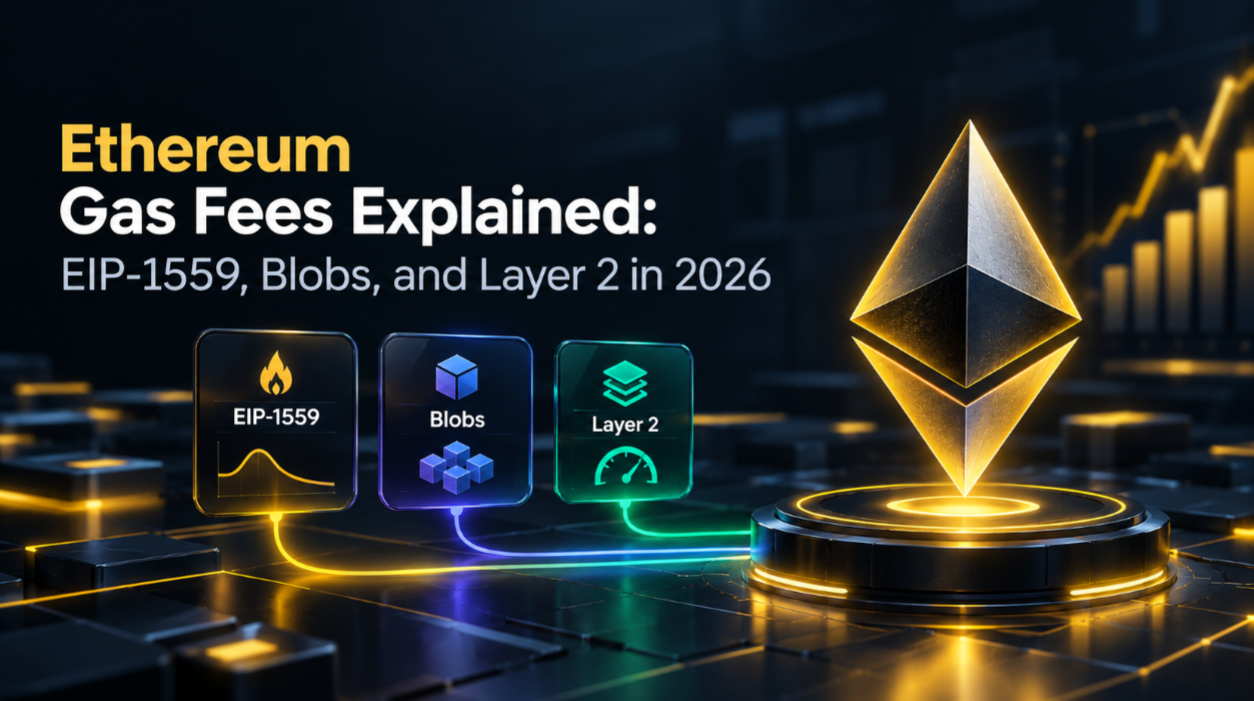
EIP-1559, activated in the London hard fork, introduced a two-part fee structure that transformed the gas market:
- Base fee: A protocol-set minimum gas price per block, calculated algorithmically. It increases when blocks are more than 50% full and decreases when they are less than 50% full. The base fee is burned — permanently removed from the ETH supply, not paid to validators.
- Priority fee (tip): An optional fee users add on top of the base fee to incentivise validators to include their transaction faster. During quiet periods, 1 gwei tip is sufficient. During peak demand, tips spike to 10–50 gwei or more.
- Max fee: Users set a maximum total gas price they are willing to pay. They are charged min(max_fee, base_fee + tip). Any unused portion is refunded. This caps overpayment.
The burn mechanism in EIP-1559 introduced deflationary pressure on ETH supply. At high network activity, more ETH is burned per block than is issued as staking rewards — making ETH net deflationary. At low activity, issuance outpaces burns and supply grows slowly. This dynamic is tracked in real time at ultrasound.money.
Reading the mempool: why your transaction gets stuck
Pending transactions wait in the mempool until a validator includes them in a block. Validators prioritise transactions by tip: the higher your priority fee relative to others waiting, the faster you get included.
When the base fee spikes suddenly — during an NFT mint, a token launch, or a market volatility event — transactions with max fees below the new base fee become stuck. They sit in the mempool until the base fee drops back below their max, or until the user replaces the transaction with a higher max fee (requires paying a minimum 10% bump on both base and tip to replace).
Good gas management means checking current base fee trends before sending a time-sensitive transaction. Tools like Etherscan Gas Tracker, Blocknative Gas Estimator, and the MetaMask wallet gas estimator all show real-time and predicted gas prices.
EIP-4844 proto-danksharding: blobs and L2 cost reduction
The biggest reduction in Ethereum transaction costs since EIP-1559 came from EIP-4844, activated in the Dencun upgrade (March 2024). EIP-4844 introduced "blob-carrying transactions" — a new transaction type that carries large, temporary data payloads attached to blocks.
Layer 2 rollups (Arbitrum, Optimism, Base, zkSync, Starknet) batch hundreds or thousands of L2 transactions, compress the data, and post a single "proof batch" to Ethereum mainnet. Before Dencun, this data was posted as regular calldata on Ethereum — expensive because it occupies permanent storage. Blobs are different: they are large (~128 KB each), kept only for ~18 days, and priced on a completely separate fee market from regular calldata.
The effect was dramatic. Within weeks of Dencun, L2 transaction fees fell by 90–99%: a swap on Arbitrum dropped from $0.05–0.30 to under $0.01. Base, Optimism, and zkSync all saw similar drops. EIP-4844 made Ethereum-secured L2 activity economically viable at massive scale.
Layer 2 networks and how they reduce fees
Layer 2 networks execute transactions off Ethereum mainnet (L1) but settle their state proofs or fraud proofs on L1, inheriting Ethereum's security. Because computation happens off-chain in bulk, each individual user transaction bears only a tiny fraction of the L1 settlement cost.
- Optimistic rollups (Arbitrum, Optimism, Base): Assume transactions are valid by default. Post transaction data on L1 as blobs. Fraud proofs can challenge invalid state transitions during a 7-day challenge period. Withdrawals back to L1 take 7 days without a liquidity bridge.
- ZK rollups (zkSync Era, Starknet, Polygon zkEVM): Generate cryptographic validity proofs (SNARKs or STARKs) for every batch. Proofs are verified on L1 in near real-time. Withdrawals are immediate after proof verification. Higher computational cost to generate proofs, but improving rapidly.
For everyday Ethereum users in 2026, most DeFi activity happens on L2s. Uniswap, Aave, Curve, and major protocols are fully deployed on Arbitrum, Base, and Optimism. Mainnet usage is concentrated in high-value settlements, protocol governance, and large transfers where gas cost is a small percentage of the transaction value.
Gas optimisation strategies for regular users
You can significantly reduce gas costs with simple habits:
- Time your transactions: Ethereum gas is cheapest on weekends (Saturday/Sunday UTC) and late-night weekday hours (00:00–08:00 UTC) when US and EU users are inactive. Check Etherscan gas chart to see historical patterns.
- Use L2 for small transactions: Any transaction under $10,000 is almost always cheaper on an L2. Bridge to Arbitrum or Base once, then operate there at 100x lower cost.
- Set custom gas limits: Modern wallets let you set a max fee and let the algorithm handle the rest. On MetaMask, the "Advanced" gas settings allow you to set a low max fee for non-urgent transactions — the transaction will execute whenever the base fee drops to your range.
- Batch transactions: Some protocols (Permit2 by Uniswap, account abstraction wallets) allow bundling approvals and swaps into a single transaction, saving gas on multiple interactions.
- Avoid gas-heavy contracts: First-time interactions with a contract require paying extra gas for storage slot initialisation. Prefer protocols you have used before when gas is high.
Gas fees and MEV: the hidden cost
Gas fees are not the only cost in Ethereum transactions. MEV (maximal extractable value) is value extracted by validators or searchers who reorder, insert, or censor transactions for profit. The most common MEV affecting regular users is sandwiching: a searcher inserts buy and sell orders around your swap to profit from your price impact.
To protect against MEV: use aggregators like 1inch or CoW Protocol (Coincidence of Wants), which route orders through private mempools and batch matching to minimise exposure. Set a tight slippage tolerance (0.5% for liquid pairs) to make sandwich attacks unprofitable.
The future of gas fees: full danksharding and beyond
EIP-4844 is described as "proto-danksharding" — the first step. Full danksharding (planned for Ethereum's next major upgrade cycle) will increase the blob capacity from 3–6 blobs per block to 64–128, proportionally reducing L2 settlement costs again. Data availability sampling will allow light clients to verify blob availability without downloading full blobs.
The end state: Ethereum mainnet becomes a high-security settlement and data availability layer, while nearly all user-facing activity happens on specialised L2s and L3s at near-zero cost. The Ethereum market page tracks network activity metrics that reflect this architectural shift in real time.
Summary: understanding Ethereum gas in 2026
- Gas fees compensate validators for computation and ration block space.
- EIP-1559 introduced a base fee (burned) + tip (to validators) model, replacing unpredictable auctions.
- EIP-4844 blobs reduced L2 settlement costs by 90–99% starting March 2024.
- Layer 2 networks (Arbitrum, Base, Optimism, zkSync) offer sub-cent fees with Ethereum security.
- Gas optimisation: transact off-peak, use L2s for small amounts, set custom max fees for non-urgent transactions.
- MEV is a separate cost — use DEX aggregators with private routing to minimise exposure.
This article is for educational purposes only. Not financial advice. Gas fee estimates are based on network conditions as of 2026 and will change over time.