Why smart contract security is a life-or-death matter in DeFi
Smart contracts are immutable programs deployed on a blockchain — they execute exactly as written, with no ability to pause or undo transactions once confirmed. This immutability is a feature for trustlessness and censorship-resistance, but a catastrophic vulnerability for security: a bug in a smart contract can be exploited instantly, at scale, with no recourse. Since 2020, over $5 billion has been lost to smart contract exploits. Understanding how to assess contract security is a fundamental skill for anyone allocating funds to DeFi.
This guide covers the most common vulnerability classes, how professional audits work, how to read an audit report, and the practical steps any DeFi user can take to reduce their smart contract risk exposure.
The most common smart contract vulnerabilities
Most exploits fall into a small number of well-documented vulnerability categories:
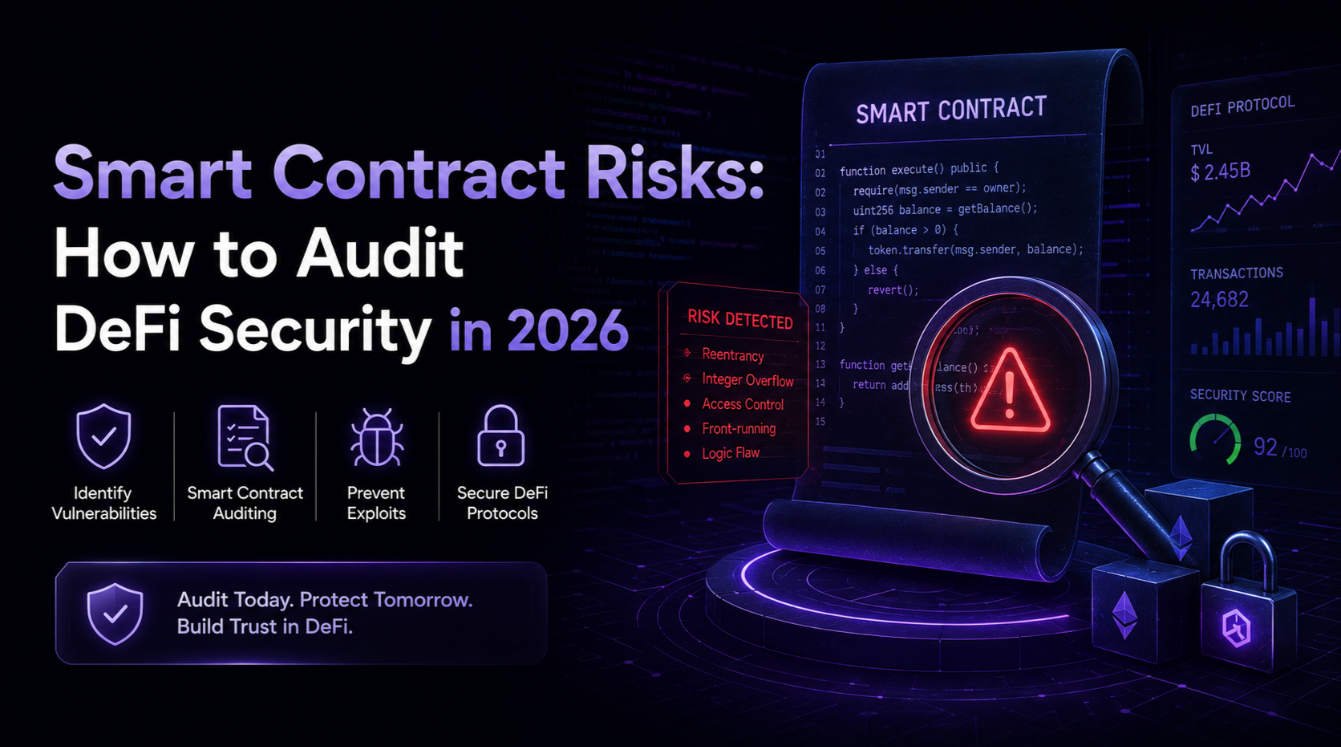
- Reentrancy: A contract calls an external address before updating its own state. The external contract calls back into the original before the first call completes, draining funds. The 2016 DAO hack ($60M) was the canonical reentrancy attack. The fix is the checks-effects-interactions pattern: always update state before making external calls.
- Integer overflow/underflow: In older Solidity versions (pre-0.8.0), arithmetic wraps around at 256-bit boundaries. An overflow can turn a large number into zero or vice versa. Solidity 0.8+ reverts on overflow by default. Legacy contracts and low-level assembly may still be vulnerable.
- Access control errors: Critical functions (owner-only operations, admin controls, fund withdrawals) lack proper access restrictions or use flawed ownership patterns. The Parity wallet hack ($150M frozen) was an access control error in an unprotected initialisation function.
- Oracle manipulation: Contracts that read prices from on-chain AMMs as oracles can be manipulated via flash loans. An attacker borrows millions, moves a price on a low-liquidity AMM, exploits a contract reading that price, and repays the loan — all in one transaction. Use time-weighted average prices (TWAPs) or Chainlink price feeds to mitigate.
- Logic errors: The code executes as intended but the business logic is wrong. These are the hardest to catch with automated tools — they require human reasoning about what the protocol should do versus what it actually does.
- Flash loan attacks: Flash loans allow uncollateralised borrowing within a single transaction. Attackers use them to temporarily manipulate protocol state (governance votes, collateral ratios, liquidity depths) in ways that exploit economic logic flaws.
What a smart contract audit is — and what it is not
A smart contract audit is a systematic review of the codebase by independent security researchers. The process typically includes: automated static analysis, manual code review, business logic analysis, and testing of edge cases. Auditors produce a report listing vulnerabilities by severity and recommendations for fixes.
An audit is not a guarantee of safety. Audits are point-in-time reviews. They do not cover: code added after the audit, interactions with other contracts the auditors did not review, economic attack vectors that are not bugs in the code, and insider threats. Some of the largest exploits (Euler Finance, $197M; Ronin bridge, $625M) occurred in audited contracts. An audit reduces risk — it does not eliminate it.
How to find a protocol's audit reports
Reputable protocols publish their audit reports publicly. Where to find them:
- Check the protocol's official documentation or GitHub repository — most list audits in a dedicated /audits folder or security page.
- Look at the auditor firm's own website: Trail of Bits, OpenZeppelin, Certik, Spearbit, Sherlock, and Code4rena all publish public summaries.
- Check DefiSafety.com and ImmuneFi.com — both aggregate audit and security information for major protocols.
- For Ethereum projects, look at their etherscan.io contract page for verified source code. A lack of verified source code is an immediate red flag.
How to read an audit report: severity levels
Audit reports classify vulnerabilities by severity. The standard classification:
- Critical: Direct loss of user funds, arbitrary code execution, or protocol shutdown possible. Must be fixed before deployment. A single unfixed Critical in a deployed protocol is a red flag sufficient to avoid it.
- High: Significant impact on protocol functionality or funds, though exploiting may require specific conditions. Should be fixed before deployment. Unfixed High findings require understanding precisely what conditions would trigger them.
- Medium: Moderate impact, often edge cases or low-probability scenarios. Typically fixed in the deployment version but sometimes acknowledged as acceptable risk with documented reasoning.
- Low / Informational: Minor issues, best practices not followed, code quality suggestions. Not exploitable in isolation but may contribute to future issues.
When reading a report, focus first on Critical and High findings. Look at whether they are marked "Resolved", "Mitigated", or "Acknowledged". "Acknowledged" means the team was aware but did not fix it — read why carefully.
Recognising red flags in audit reports
Beyond finding severity, look for these warning patterns:
- Any Critical or High findings marked "Acknowledged" without a clear, compelling rationale.
- A very short audit engagement (1–2 days for a complex protocol) — insufficient depth.
- Auditor firm is unknown, very new, or the "report" is just a badge without a full report document.
- Audit was conducted on a different commit hash than the deployed contract — the code on-chain was not what was audited.
- The audit scope explicitly excludes key components (e.g., "oracle interactions not in scope").
- No audit at all — common in newly launched projects and meme coins. Treat no-audit protocols as experimental, regardless of promised APY.
Bug bounties: the audit that never stops
Bug bounty programmes pay external security researchers to find vulnerabilities in live code. ImmuneFi is the largest crypto bug bounty platform, with payouts reaching $10M+ for critical vulnerabilities in top protocols. A large, well-funded bug bounty programme is a strong signal: the protocol is incentivising continuous security review and has confidence in its code quality.
When evaluating a protocol, check: is there a bug bounty? How large is the maximum payout? Has anything been paid out (which means researchers are actively reviewing the code)? Aave, Uniswap, Chainlink, and major L2s all run multi-million dollar bounties. New or small protocols with no bug bounty have a gap in their security coverage.
Upgrade mechanisms and admin keys: the human risk
Many protocols use proxy patterns or admin keys that allow the team to upgrade contract logic or pause functionality. This is a security trade-off: upgradability allows bug fixes but also gives the admin the ability to change the rules or drain funds.
- Immutable contracts: Cannot be changed. Maximum trustlessness, but bugs cannot be patched. Uniswap v2 and v3 core contracts are immutable.
- Upgradeable proxies with timelock: Can be upgraded but changes take effect after a delay (e.g., 48–72 hours). This gives users time to withdraw if a malicious upgrade is proposed. Aave uses this model.
- Admin key without timelock: The team can change anything instantly. This is a centralisation red flag — the protocol's security is as strong as the team's key management practices and intentions.
- Multisig controls: Admin functions require M-of-N team signatures. Reduces single-point-of-failure risk. Check the multisig composition and threshold — a 2-of-3 with small team members is weaker than a 5-of-9 with diverse global signers.
For safe interaction with DeFi, use MetaMask or a hardware wallet integration to review exactly what permissions you are granting in every transaction. Token approvals should be set to exact amounts, not unlimited.
Ethereum-specific tooling for security research
Several Ethereum-native tools help both auditors and advanced users assess contract safety. Slither (Trail of Bits) is an open-source static analyser that catches common vulnerabilities automatically. Echidna is a fuzzer that generates random inputs to find edge-case failures. Tenderly provides simulation of transactions against mainnet state before execution — invaluable for testing complex interactions.
For the Arbitrum ecosystem and other L2s, these tools work identically since all EVM-compatible chains share the same bytecode format. EigenLayer restaking contracts, Lido DAO staking contracts, and similar high-TVL protocols publish their complete audit trails on their official documentation sites.
Practical steps to reduce smart contract risk
- Only use protocols with at least two audits from reputable firms (Trail of Bits, OpenZeppelin, Spearbit, Certik Enterprise).
- Check that the deployed contract address matches the audited code — verify on Etherscan.
- Never give unlimited token approvals. Use Revoke.cash or Etherscan's token approval checker to audit and revoke old approvals.
- Diversify across protocols. Never put more into a single smart contract than you can afford to lose entirely.
- Follow security researchers on social media (samczsun, @kelvinfichter) for real-time exploit alerts.
This article is for educational purposes only. Not financial advice. Smart contract risk is real and can result in total loss of funds. Always use audited, established protocols and never invest more than you can afford to lose entirely.